 EveryMemory
Best Puzzle Apps for the Brain
The best puzzle apps for the brain train real skills - logic, spatial reasoning, memory. Here's the field by skill, the criteria that matter, and an honest read on what puzzles do.
Part of the guide: Brain Exercises for Seniors: The Complete Guide →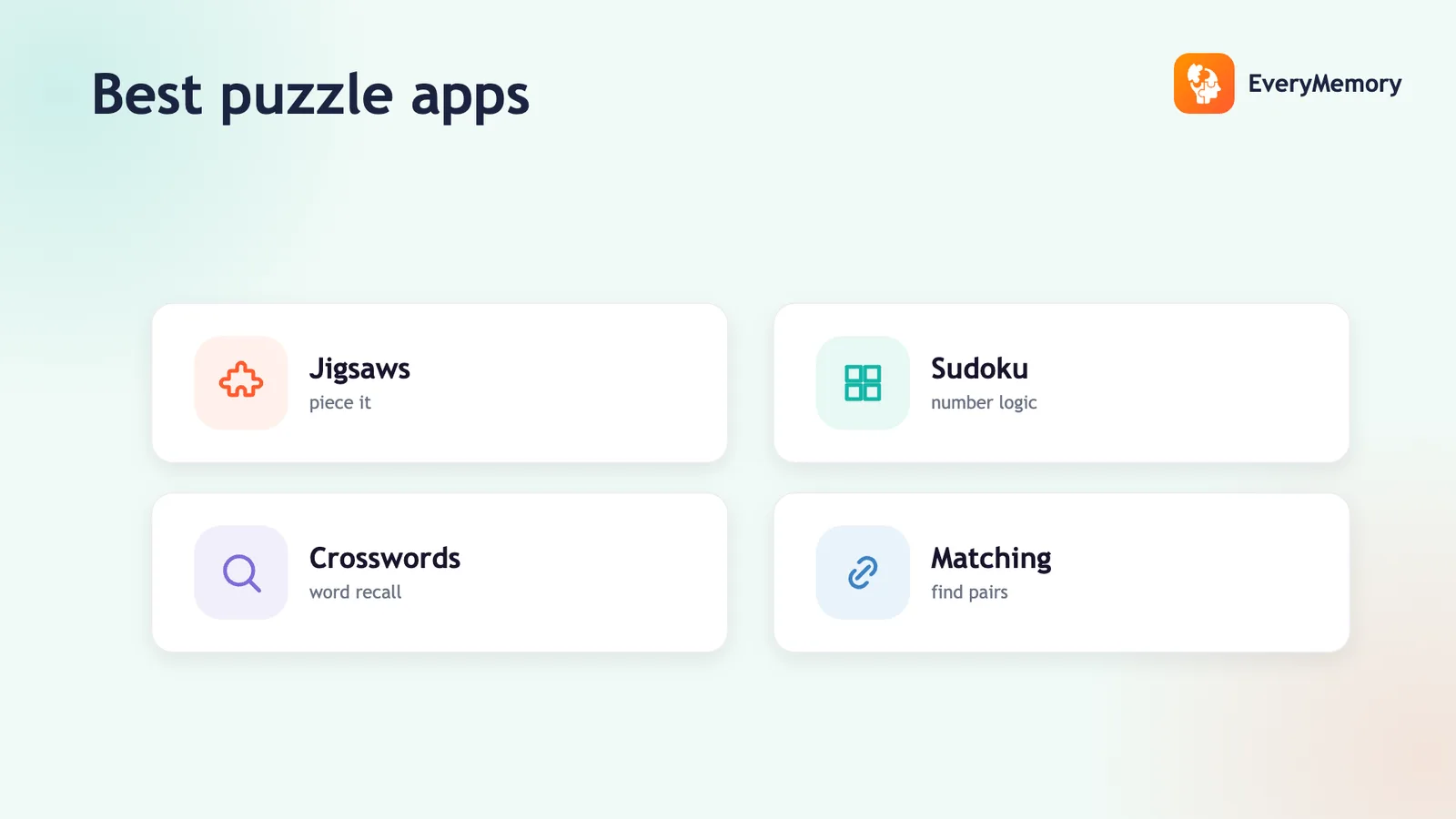
⚡ Quick answer
The best puzzle apps for the brain train logic, spatial reasoning, memory and pattern recognition - and the good ones scale difficulty to your level and track your progress honestly. They sharpen the specific skills you practise; they don't raise your IQ or prevent decline. Try one free before paying.
Key takeaways
- Puzzle types train logic, spatial reasoning, patterns, working memory and numeracy.
- Good puzzles ramp difficulty and need real reasoning, not lucky taps or paid hints.
- They sharpen trained reasoning and engage you - they don't raise IQ or prevent decline.
- Pair puzzles with EveryMemory's memory/speed/attention games; self-relative, free to start.
Puzzle apps occupy a happy middle ground between idle games and structured brain training. They're absorbing enough to play for fun and demanding enough to feel like real mental work - which is exactly why people ask which ones are actually good for the brain rather than just good at killing time.
This guide maps the main puzzle types by the skill they exercise, gives you the criteria that separate a brain-stretching app from a dopamine treadmill, and stays honest about what a puzzle habit does and doesn't deliver.
Puzzle types by skill
Different puzzles work different muscles. Pick the type that matches what you want to stretch.
| Puzzle type | Skill it trains | Example mechanic |
|---|---|---|
| Logic grids | Deductive reasoning | Eliminate options from clues |
| Spatial / shape puzzles | Spatial reasoning | Rotate and fit pieces |
| Pattern / sequence | Pattern recognition | Predict the next item |
| Memory puzzles | Working memory | Hold and match hidden items |
| Number puzzles | Numerical reasoning | Balance, fill or order numbers |
For broader options, see brain games online and best memory game apps.
What separates a brain puzzle from a time-sink
Plenty of 'puzzle' apps are really tap-to-win games dressed up with a leaderboard. The genuinely brain-stretching ones share a few honest traits.
- Difficulty that ramps as you solve, so you're always near your edge.
- Puzzles that require actual reasoning, not just lucky taps or paid hints.
- Progress tracked against your own past performance.
- No fake percentile, brain-age or IQ claim attached to your solving.
An honest read on what puzzles do
Solving puzzles regularly makes you better at solving those puzzles and closely related reasoning tasks - a real, satisfying benefit. It's also engaging, which is half the value, since an app you enjoy is one you'll keep using.
What it won't do is make you broadly smarter or shield your brain from ageing. Those claims outrun the evidence. So choose a puzzle app for the focused reasoning practice and the enjoyment, and discount any marketing that promises a general intelligence upgrade. See do brain games really work.
Pairing puzzles with broader training
Puzzles lean heavily on reasoning, so they pair well with games that train memory, speed and attention to give your routine more range. A varied diet keeps more skills active and the habit fresher than grinding one puzzle type.
EveryMemory complements puzzle play with short adaptive games across memory, speed and attention, all tracked against your own baseline rather than a percentile. It's free to start, so you can round out a puzzle habit with honest, broader practice.


