 EveryMemory
Cognitive Flexibility Games
Cognitive flexibility games train you to switch rules and shift gears without getting stuck. Here are the task-switching mechanics that work - and an honest take on what transfers.
Part of the guide: Brain Exercises for Seniors: The Complete Guide →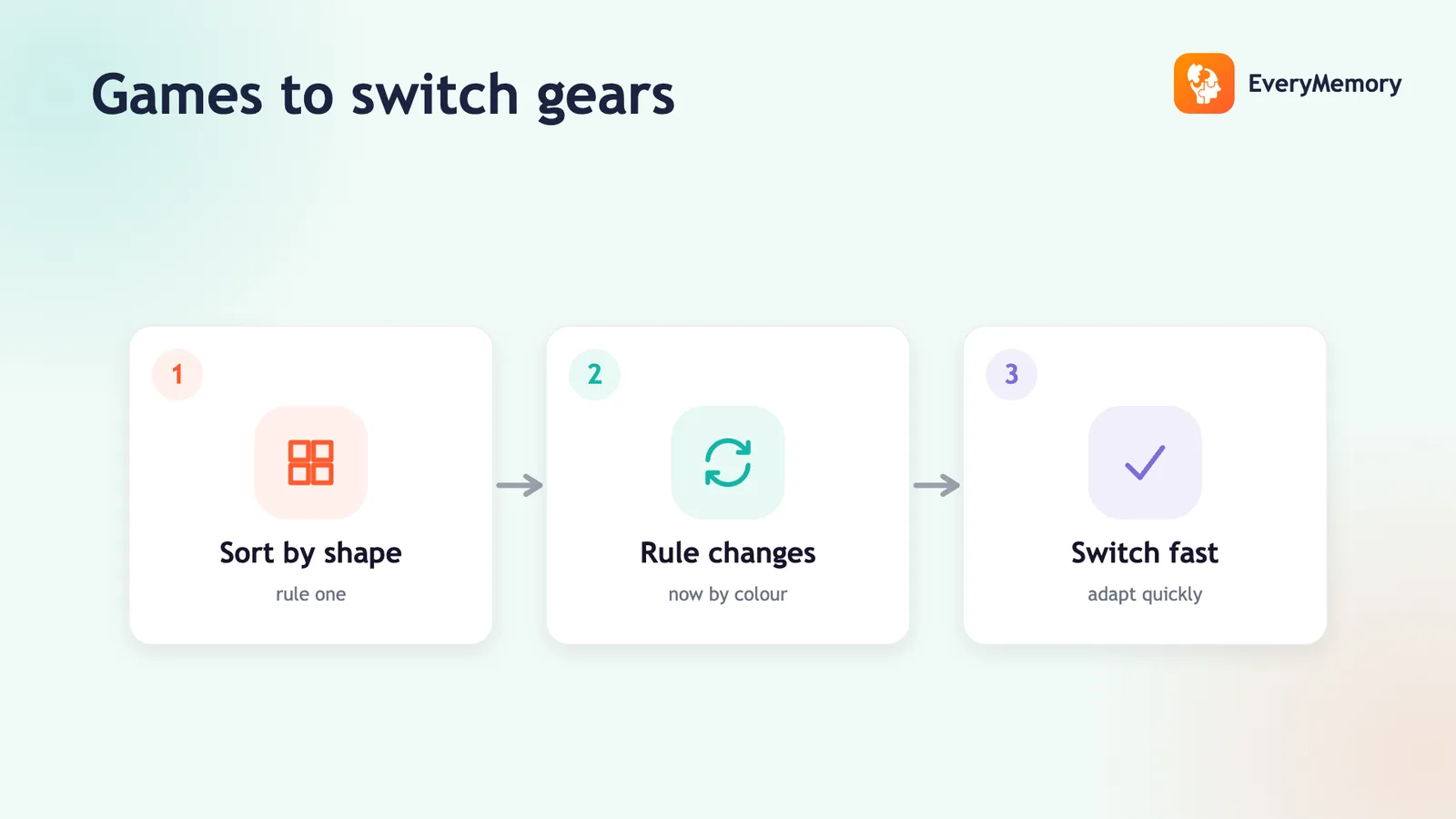
⚡ Quick answer
Cognitive flexibility games train you to switch between rules and strategies without getting stuck. The core mechanic is task-switching: the game keeps changing which rule applies, so you must drop the old one fast. You'll get quicker at switching and similar shifting tasks, but it won't broadly raise your intelligence.
Key takeaways
- Flexibility is switching rules without getting stuck (switch cost)
- Task-switching, rule-shift, and set-shifting are the core mechanics
- Practice shrinks switch cost; it won't broadly raise intelligence
- Use varied formats so you train switching, not one pattern
Cognitive flexibility is the ability to switch - to drop one rule and pick up another, change strategy when the situation changes, and not get stuck repeating what just worked. It's what lets you reorganise plans on the fly instead of grinding the same gear when it stops fitting.
Flexibility games make switching the whole point. They keep changing the rule on you, and they measure the cost of every change - that little stumble when your brain has to let go of the old instruction. Train against that cost and the switches get smoother. Here's how the good ones work, and what to honestly expect.
What cognitive flexibility is
Flexibility is the opposite of getting stuck. When a rule changes - sort by colour, now by shape - a rigid mind keeps sorting by the old rule for a beat. That beat is the "switch cost," and reducing it is what flexibility training is about.
It overlaps with attention and working memory but isn't the same: you have to hold the new rule, suppress the old one, and apply it cleanly. That's why flexibility games feel uniquely tricky - they punish autopilot.
Mechanics that train flexibility
- Task-switching - alternate between two rules on cue, so you can never settle into autopilot.
- Rule-shift - a hidden rule changes mid-game and you must detect and adopt the new one.
- Set-shifting - sort by one feature, then suddenly by another, dropping the old criterion.
- Mixed-cue trials - a symbol tells you which rule applies this turn, forcing a fresh decision each time.
What unites them is the forced change. A game that lets you lock into one steady rule is training focus, not flexibility - flexibility needs the rug pulled out regularly.
Game versus everyday benefit
| Game mechanic | What it trains | Everyday version |
|---|---|---|
| Task-switching | Fast rule changes | Bouncing between two open projects |
| Rule-shift | Detecting a changed rule | Noticing the plan changed and adapting |
| Set-shifting | Dropping an old criterion | Switching from skim-reading to careful reading |
| Mixed-cue | Per-turn decisions | Following a recipe that keeps interrupting you |
These payoffs are genuine but narrow. Flexibility practice transfers to similar switching demands, not to a general boost in cleverness. The honest picture is in do brain games really work.
What to honestly expect
Your switch cost shrinks with practice - switches get faster and you make fewer slips when the rule changes. Closely related shifting tasks may feel a touch easier. That near-transfer is the real reward. What flexibility games can't deliver is broad intelligence gains or a smoother life by default; those depend on rest, mood, and how chaotic your day is.
Variety matters here more than most skills: practise several switching formats so you train the act of switching, not one game's pattern. For the wider menu, see brain training games list, and pair flexibility with the logic side via problem-solving games.
✅ Try this today - A 90-second switching drill
Two simple rules and a stopwatch make a flexibility game.
- Pick a list of numbers 1-20. Rule A: say each number doubled. Rule B: say each number plus three.
- Alternate rules every number: A, B, A, B down the list.
- Time yourself and count any slips where you applied the wrong rule.
- Repeat and try to cut the slips while keeping a steady pace.
- Swap in new rules so you train switching, not one routine.


