 EveryMemory
Are Brain Age Tests Accurate?
Brain age tests give you a tidy number, but there's no biological clock behind it - they mostly reward speed and practice, so treat the result as fun, not a measurement.
Part of the guide: Understanding Memory Loss and Forgetfulness: A Calm, Reassuring Guide →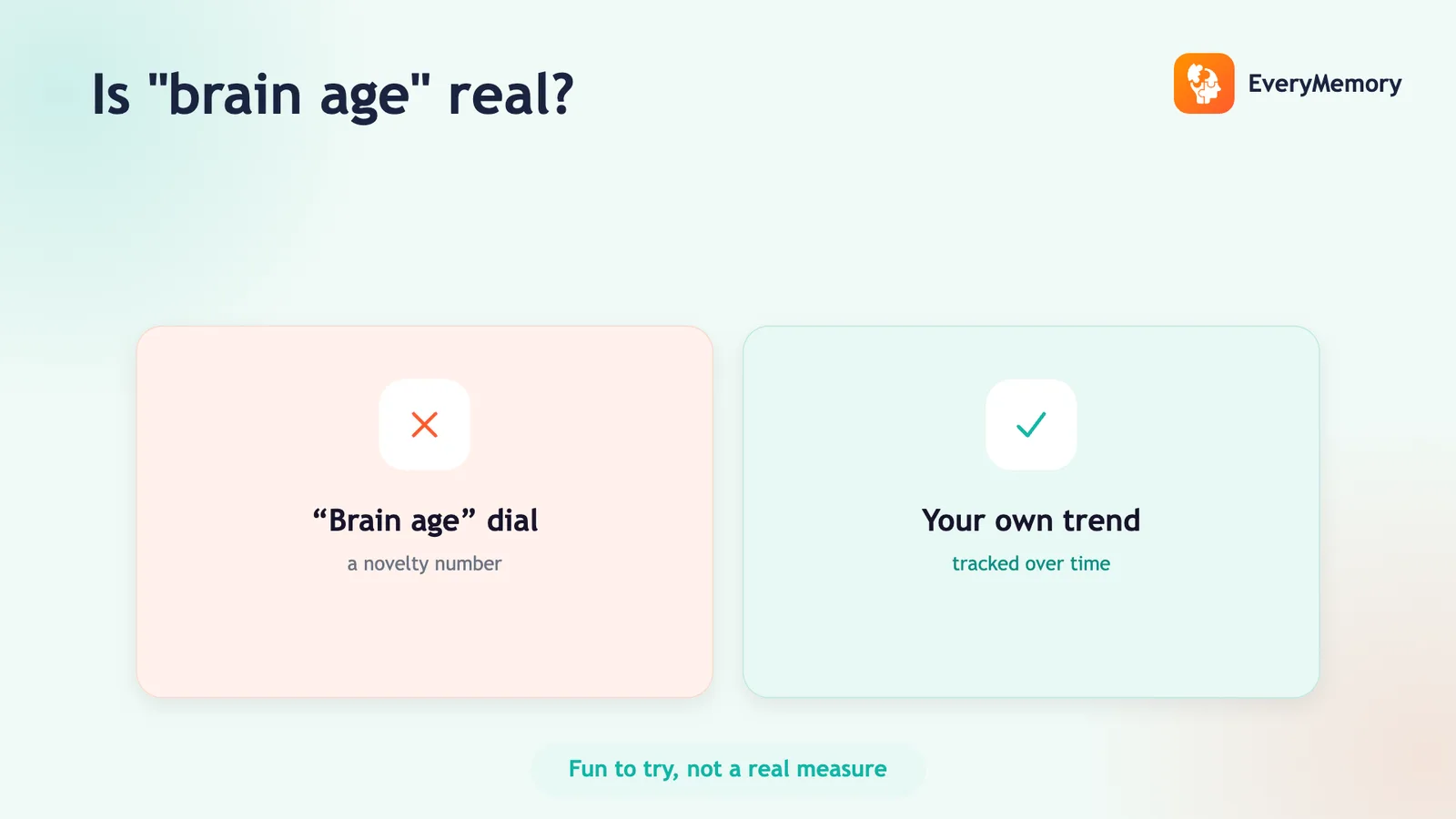
⚡ Quick answer
Brain age tests are not accurate as measurements, because there's no biological brain age for them to measure. They mainly capture how quickly you react and how familiar you are with the task, both of which improve with practice and vary with sleep and caffeine. Treat the number as entertainment, not an assessment of your brain.
Key takeaways
- There is no biological "brain age" for a quiz to measure.
- These tests mostly reward reaction speed and task familiarity.
- Scores swing with sleep, caffeine, and your device's lag.
- Track your own trend over time instead of one dramatic number.
A brain age test hands you a satisfying result - your brain is 31, or 58 - and it's easy to take that as a real measurement of how your mind is doing. It isn't. There is no biological clock inside your head that a quick online quiz can read, and no medical definition of a single "brain age" that these tools are tracking.
That doesn't make them worthless, but it does mean you should read them honestly. Knowing what a brain age score actually reflects - and what it can't - keeps you from celebrating or panicking over a number that mostly tells you how fast you tapped today.
There's no real "brain age" to measure
The phrase sounds scientific, but no clinician assigns your brain a single age. Thinking is made of many separate abilities - attention, working memory, processing speed, vocabulary - that change at different rates and in different directions. Some sharpen with experience while others slow a little. Compressing all of that into one age is a design choice for a satisfying result, not a finding.
Because there's no agreed definition, two brain age tests can give you wildly different ages on the same day. That alone tells you the number isn't reading something fixed and real about you.
What they actually measure
Most brain age tests lean heavily on reaction time and short pattern tasks, then map your speed onto an age curve. So the result is really a speed-and-familiarity score wearing an age costume.
- Reaction speed - which slows gradually and predictably across adulthood.
- Task familiarity - you get faster the second and third time you play.
- State factors - sleep, caffeine, stress, and even your device's lag all move the score.
- Test design - different age curves baked in by different makers.
For the wider picture on how reliable these tools are, see are online memory tests accurate.
Myth versus honest reading
| The claim | The honest version |
|---|---|
| "Your brain is 25." | You reacted quickly today; speed alone doesn't equal a young brain. |
| A high age means decline. | It often just means you were tired, distracted, or new to the task. |
| The number is medical. | No clinician uses a single brain age; it isn't a screening result. |
| It's a fixed score. | Repeat it tomorrow and it shifts with sleep, caffeine, and practice. |
If you want a tool grounded in something real, look at brain age test for an honest framing, and use repeated self-checks rather than one dramatic number.
A better, honest way to track
The useful question isn't "how old is my brain" - it's "how am I doing compared with my own past, under similar conditions?" Repeat the same quick check every week or two, around the same time of day, and watch your own trend. That removes the invented population you're supposedly being ranked against and replaces it with the only fair yardstick: you, last month.
Used that way, a quick test becomes a genuine progress signal rather than a verdict. See memory test online for a self-relative check you can repeat.
⚠ When to talk to a professional
This is general educational information, not medical advice, and brain age tests are not a screening or diagnosis of any condition. If you have a genuine or persistent concern about your memory or thinking, please speak with a doctor or qualified professional.


