EveryMemory
Understanding Memory Loss and Forgetfulness: A Calm, Reassuring Guide
Most everyday forgetfulness is normal - and explainable. A reassuring overview of what causes it, what changes with age, and when a professional's view is worth seeking.
⚡ Quick answer
Most everyday memory lapses - forgetting names, misplacing items, losing a word mid-sentence - are normal, particularly as we age, and are typically linked with changeable factors like poor sleep, stress, or divided attention. They are not a reliable sign of serious disease. Patterns that are sudden, rapidly worsening, or significantly disrupting daily life are worth discussing with a qualified healthcare professional.
Key takeaways
- Most everyday forgetfulness - names, lost objects, mid-sentence word blanks - is normal and linked with changeable factors like sleep and stress.
- Some aspects of memory processing do slow with typical aging, but significant memory loss is not an inevitable part of getting older.
- Sudden, rapidly worsening, or daily-life-disrupting memory changes are worth discussing promptly with a qualified healthcare professional.
- Simple, consistent habits - better sleep, less multitasking, regular movement - support the conditions in which memory works best.
Forgetting where you left your glasses, blanking on a name you know perfectly well, walking into a room and having no idea why you're there - these moments are unsettling, but they are also remarkably common. For most people, most of the time, everyday forgetfulness is not a sign of something going wrong. It is an honest reflection of how human memory actually works.
This guide is a calm, comprehensive starting point for anyone who has noticed their memory slipping, feels anxious about forgetfulness, or simply wants to understand what is normal and what is worth paying attention to. We cover how memory works, what genuinely changes with age, the everyday factors that make things worse, and - with warmth rather than alarm - the signs that suggest a conversation with a professional would be worthwhile.
How memory actually works
Before worrying about forgetting, it helps to understand what memory is - and how much of it is designed to be imperfect. Memory is not a recording device. Each time we form a memory, the brain encodes a rough sketch rather than a photograph, drawing on attention, emotion, and context. Each time we retrieve it, we rebuild it slightly.
This means forgetting is not a failure - it is part of normal, healthy cognitive function. The brain selectively discards information it judges unimportant in order to free capacity for what matters. Understanding this architecture makes everyday slips far less alarming. Our article on how memory works walks through encoding, storage, and retrieval in plain language - a genuinely useful foundation for everything else on this page.
What actually changes with age - and what does not
Some aspects of memory do shift as we get older, and knowing which ones helps distinguish normal aging from something worth noting. Processing speed - how quickly the brain handles new information - tends to slow gradually from midlife onward. Retrieving a name or word on demand can take a moment longer. Working memory, the mental scratch-pad we use for holding several pieces of information at once, may shrink slightly.
What does not change, in typical aging, is the overall store of knowledge and experience, the ability to learn new things (though it may take a little longer), or the sharp clarity of long-established memories. Most people in their sixties, seventies, and beyond have excellent memory for events that mattered to them, for skills they have practised, and for facts they revisit often.
The contrast between normal and concerning is worth exploring carefully. Our companion article on memory loss versus normal aging offers a detailed, side-by-side breakdown. And our piece on common myths about memory and aging tackles the assumptions - including the idea that significant memory decline is simply inevitable - that can cause unnecessary anxiety.
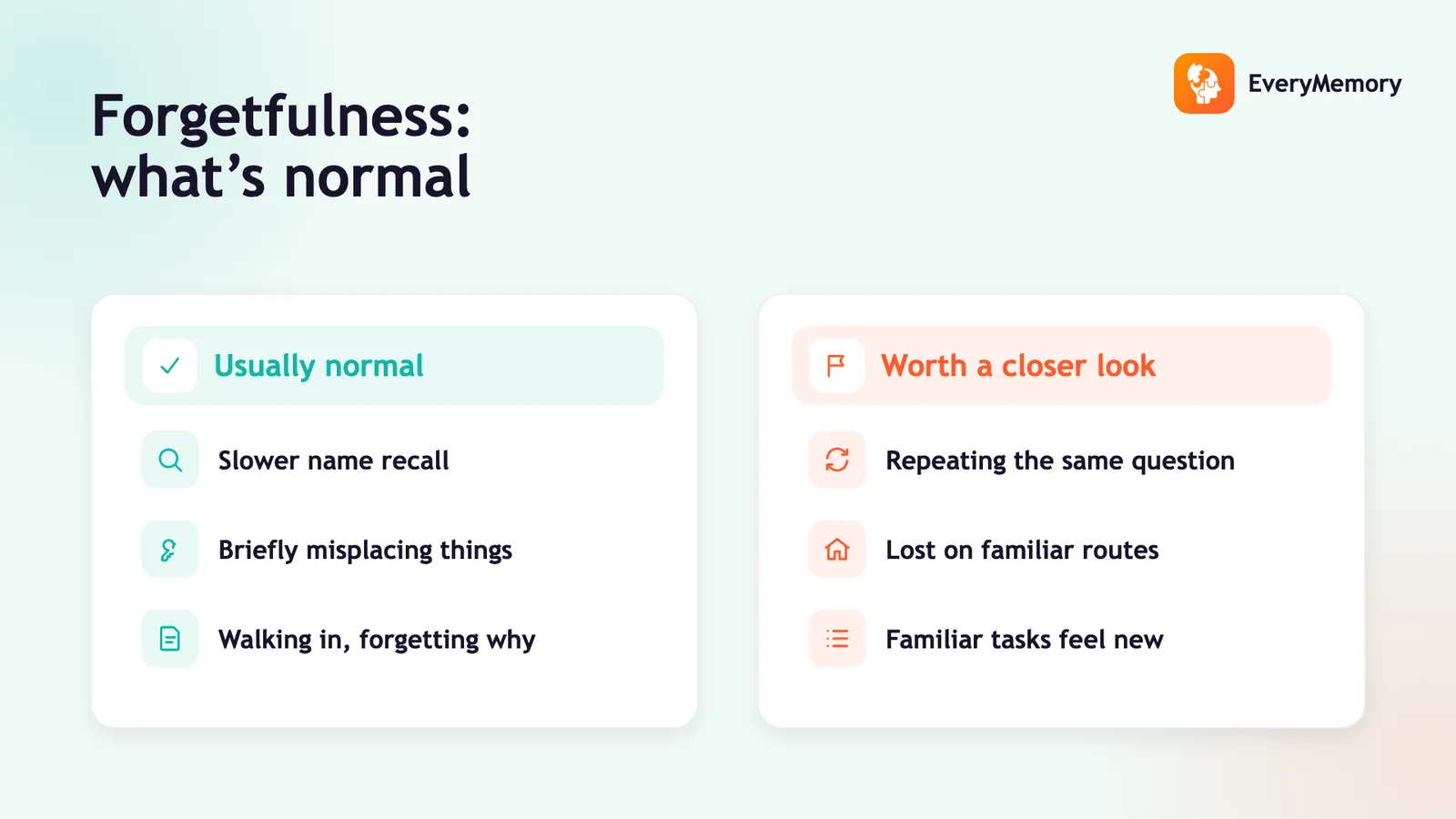
- Slower name or word recall is very common in normal aging and is not the same as memory loss.
- Forgetting things that happened recently, but remembering the distant past vividly, is a normal pattern in typical aging.
- Difficulty remembering things you never paid full attention to is not memory loss - it's an attention issue at the encoding stage.
The most common everyday causes of forgetfulness
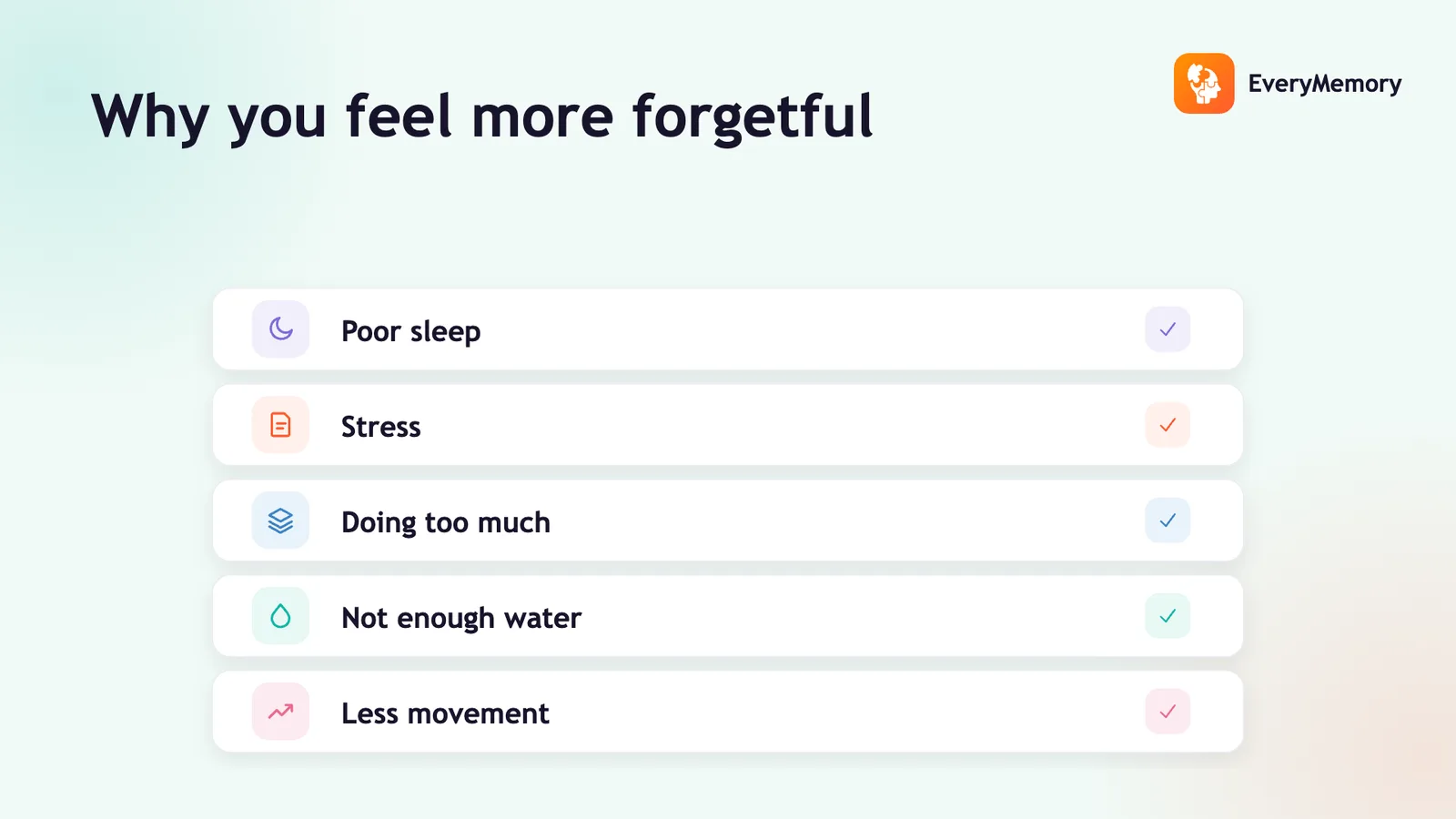
For most adults who notice they are forgetting more, the real culprit is not age but an everyday factor that is entirely changeable. Sleep is the most significant: the brain uses sleep to consolidate new information into longer-term storage, and even a few nights of poor rest produce measurable gaps in recall. Stress comes close behind - sustained cortisol is linked with difficulty forming new memories and retrieving existing ones.
Divided attention is another major one. If your focus is split - half-watching television while trying to remember something - the memory may never be properly formed in the first place. Mild dehydration, low physical movement, grief, recovering from illness, and disrupted routines all commonly contribute to a foggier, slower feeling of recall.
Our article on everyday reasons for forgetfulness is a comprehensive checklist with a signpost to a deeper guide on each factor. For the particular fog that grief, loss, or illness can bring, see our piece on grief, illness, and temporary forgetfulness. And for brain fog specifically - that slow, hazy quality of thinking - our guide on brain fog causes and what can help covers the territory in practical depth.
The small, specific forgetting that worries people most
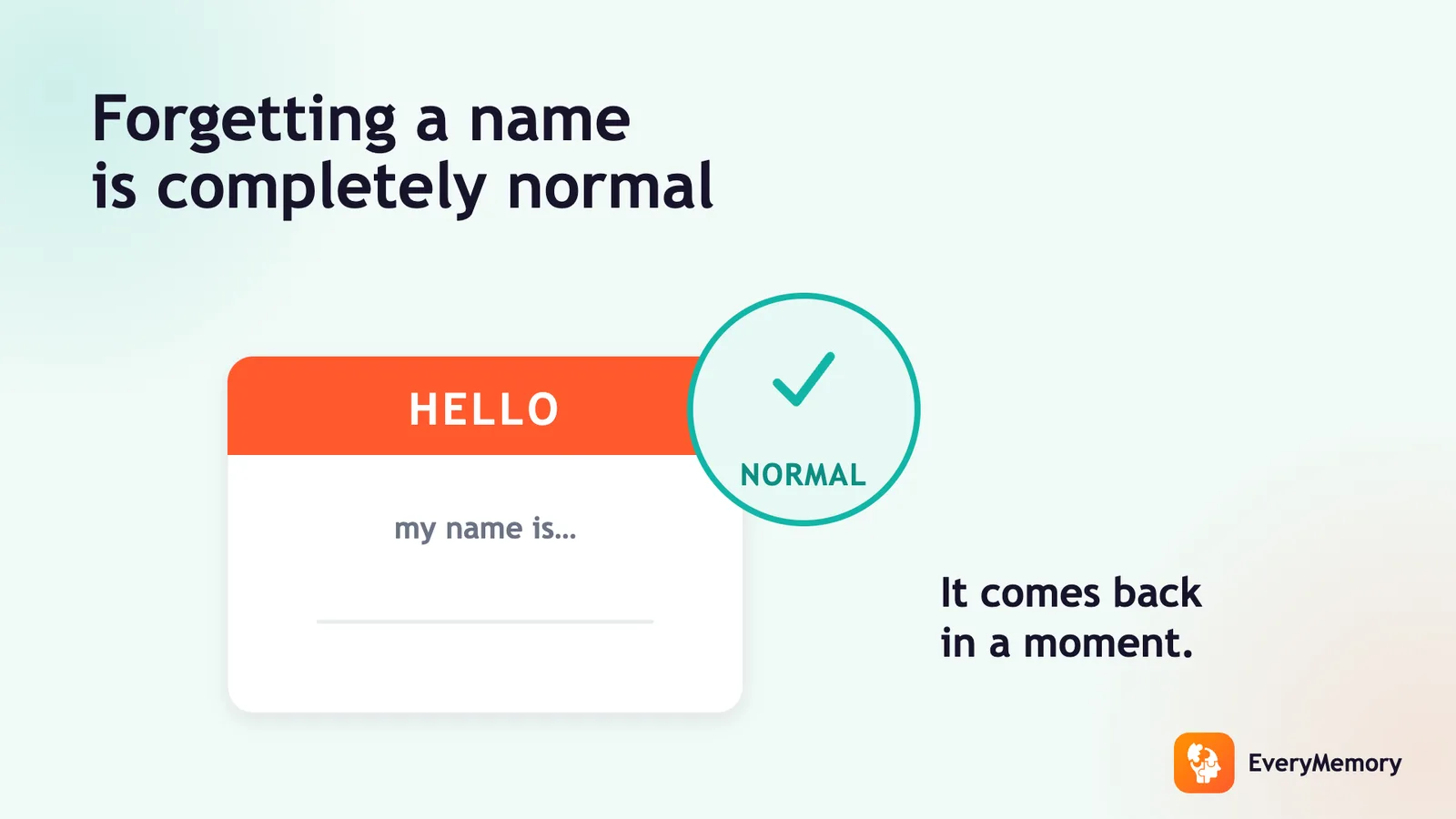
Certain flavours of forgetfulness generate disproportionate anxiety - often because they feel pointed or symbolic, even when they are entirely ordinary. Forgetting names is one of the most common, particularly after sixty. It is unnerving in social situations, but name retrieval is among the first and most benign things to slow with age. Our reassuring deep-dive into whether it is normal to forget names after 60 explains exactly why this happens and what actually helps.
Walking into a room and having no idea why is another near-universal experience - so common it has acquired its own research literature. It is a well-understood attention-switching phenomenon, not a sign of decline. Our article on why we forget why we entered a room explains the mechanics. The same goes for losing things: why we keep misplacing things is almost always about attention at the moment of placement, not memory capacity.
Losing words mid-sentence - reaching for something and coming up empty - is explored in two dedicated guides: why we forget words while speaking and the tip-of-the-tongue phenomenon, which covers why the word feels so tantalizingly close and how retrieval actually works in those moments.
When short-term memory feels unreliable
Short-term memory - holding onto something just long enough to use it - is the form of memory people most often notice struggling with. Forgetting why you picked up your phone, losing the thread of a conversation, or needing to re-read a paragraph you just finished are all signs that short-term recall is under strain.
Most of the time this is driven by the same everyday factors listed above: sleep, stress, divided attention. But it is a legitimate concern, and it deserves a proper look. Our article on short-term memory problems covers when this kind of forgetfulness is typical and when it might benefit from professional attention. Understanding the difference between short-term and long-term memory - and which is actually affected - is a useful first step; our piece on short-term versus long-term memory covers this clearly.
What you can do - practical starting points
The good news is that much everyday forgetfulness responds well to simple, consistent habits. Improving sleep is the single highest-leverage change for most people. Reducing multitasking - genuinely focusing on one thing at a time - is the most direct way to improve encoding. Regular physical movement, staying well hydrated, and maintaining a daily routine all support the conditions in which memory works best.
Memory also responds to practice: the brain forms stronger traces around things it rehearses. Simple techniques - association, chunking, spaced repetition - make it significantly easier to hold onto names, numbers, and new information. A small, gentle daily habit is far more effective than an intensive effort once a week.
If you want a practical record of how things are changing over time, our article on what to track before talking to a doctor gives you a structured, non-clinical way to note patterns - useful both for your own peace of mind and, if needed, for a professional conversation.
A warm safety note: when to seek a professional's view
The vast majority of what this guide describes is ordinary - the everyday textures of a human memory in a busy, tiring, ageing life. But there are patterns that deserve a professional's attention, and recognising them calmly is part of looking after yourself.
It is worth speaking with a qualified healthcare professional if you notice:
- Memory changes that are sudden - appearing quickly over days or weeks rather than gradually.
- Changes that are clearly worsening over time, rather than fluctuating with sleep, stress, and circumstances.
- Forgetting entire recent events - not just the details, but that something happened at all.
- Confusion about time, place, or familiar people.
- Memory problems that are significantly disrupting daily life or safety - medication, driving, managing finances.
- Personality or behaviour changes noticed by others, not just yourself.
These are not cause for panic - many have straightforward explanations that a doctor can identify. But they are worth investigating promptly rather than watching and waiting. A professional appointment is reassuring more often than it is alarming. This site does not diagnose or treat any condition; the information here is general and non-medical.
Explore the full guide
This hub connects to a complete set of in-depth articles on every aspect of everyday memory and forgetfulness. Dive into whichever topic is most relevant to you:
- Memory loss versus normal aging - a detailed side-by-side comparison of what's typical and what's worth noting
- Is it normal to forget names after 60? - why name recall slows and what actually helps
- Why do I forget why I entered a room? - the attention-switching science behind this near-universal slip
- Why do I keep misplacing things? - why losing objects is almost always an attention issue, not a memory one
- Why do I forget words while speaking? - the mechanics of mid-sentence word loss
- Short-term memory problems - when everyday lapses deserve a closer look
- Brain fog causes and what helps - the hazy, slow-thinking feeling and its most common drivers
- Tip of the tongue: why words get stuck - how retrieval works and why the word feels so close
- Everyday reasons for forgetfulness - a reassuring checklist of the most common, changeable contributors
- Common myths about memory and aging - the assumptions that cause unnecessary worry, examined
- How memory works - encoding, storage, and retrieval explained in plain language
- Grief, illness, and temporary forgetfulness - why loss and physical recovery cloud the mind
- What to track before talking to a doctor - a structured, practical guide to noting patterns over time
✅ Try this today - A simple forgetfulness self-check
Before assuming the worst, run through these three questions - they often point quickly to the most likely everyday contributor.
- Sleep and stress check: Have you had fewer than seven hours of sleep most nights this week, or been under sustained pressure? These are the two most reliably reversible causes of a memory dip - addressing either often produces noticeable improvement within days.
- Attention check: When you are trying to remember something, are you also doing something else? Divided attention at the moment of encoding is why many memories never properly form in the first place. Try a week of deliberate single-tasking for anything you want to remember.
- Pattern check: Is your forgetfulness tied to particular circumstances - a stressful week, a period of poor sleep, recovering from illness? Or is it persistent, worsening, and unrelated to any obvious everyday cause? The first points to lifestyle; the second is worth mentioning to a professional.
⚠ When to talk to a professional
This article contains general, non-medical information only. EveryMemory does not diagnose or treat any medical condition. If you notice sudden, rapid, or clearly worsening memory changes - or changes that are significantly affecting daily life or safety - please speak with a qualified healthcare professional. These patterns are worth discussing promptly rather than monitoring alone.