 EveryMemory
Best Brain Games for Adults
The best brain games for adults match a real skill to a real goal. Here's the field mapped by what each game trains, plus honest criteria for choosing one worth your time.
Part of the guide: Brain Exercises for Seniors: The Complete Guide →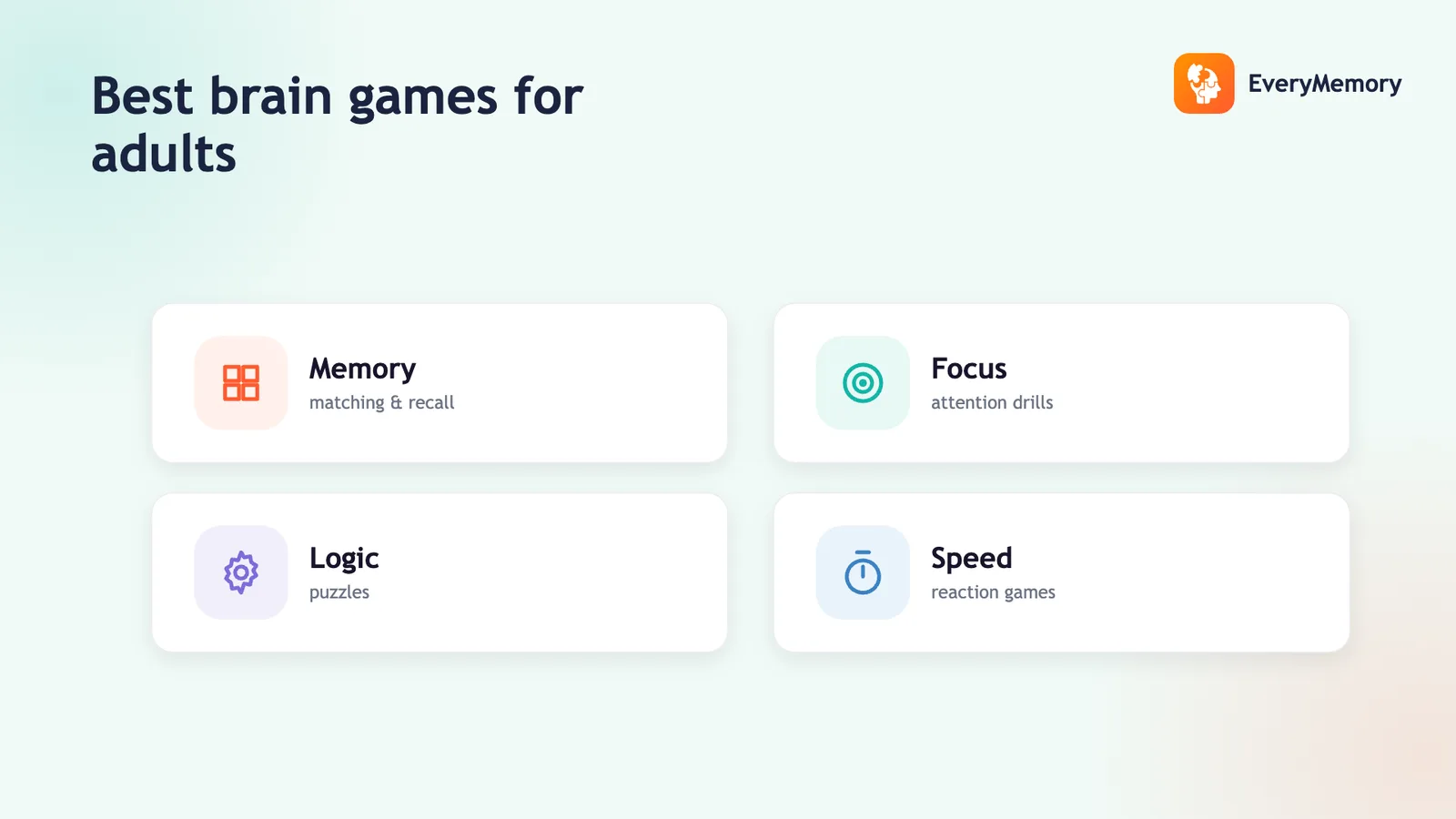
⚡ Quick answer
The best brain games for adults are the ones that match a specific skill to your goal - memory games for recall, matching games for speed, attention games for focus, reasoning puzzles for problem-solving. The good ones adapt to your level and track progress against your own baseline, while staying honest that they sharpen the trained skill, not your IQ.
Key takeaways
- Match the game to your goal: recall, speed, focus, flexibility or reasoning.
- Favour adaptive difficulty, self-relative tracking and short repeatable sessions.
- Gains are real for trained skills; 'smarter overall' / decline-prevention claims aren't.
- EveryMemory offers a short, varied, adaptive daily set; free to start.
'Best brain games for adults' is a search with a hidden question behind it: best for what? Sharpening focus at work, keeping a daily mental habit, having fun on a commute and tracking your own progress are different goals that point to different games. The best game for you is the one that matches yours.
Rather than crown a single winner, this guide maps the field by the skill each game trains, then hands you honest criteria so you can pick one that's worth your time - without falling for the apps that promise more than any game can deliver.
Match the game to the goal
Start from what you actually want, then pick the family of game that trains it.
| Your goal | Game type | What it trains |
|---|---|---|
| Sharper recall | Memory / sequence games | Working and short-term memory |
| Quicker thinking | Matching / speed games | Processing speed |
| Better focus | Find-the-target games | Selective attention |
| Flexible thinking | Rule-switch games | Cognitive flexibility |
| Problem-solving | Logic / spatial puzzles | Reasoning |
For a wider sweep, see brain games online and the app field in brain training apps compared.
The criteria for a game worth your time
A fun game that never gets harder and tracks nothing is a toy. The ones worth a regular slot share a few traits.
- Adaptive difficulty so the challenge grows with you.
- Self-relative progress tracking - your trend, not a stranger's percentile.
- Variety across skills so you don't grind a single task.
- Short, repeatable sessions that fit an actual adult schedule.
- Honest, non-medical claims about what it does.
What brain games realistically do for adults
Be clear-eyed about the payoff. Regular practice makes you measurably better at the games and closely related tasks - faster matching, stronger sequence recall, sharper sustained focus during the session. That's real and worth having.
What the evidence doesn't support is the leap to 'smarter overall' or 'protected against decline'. Those broad-transfer claims are weak. So choose a brain game for the trained-skill benefit and the enjoyable habit, and treat any decline-prevention or IQ promise as marketing. See do brain games really work.
Building a routine that sticks
The best game is the one you'll actually return to, so design for consistency over intensity. A few minutes most days beats an hour once a fortnight, and variety keeps boredom from killing the habit.
EveryMemory is built for exactly this adult use case - short, varied games that adapt to your level, with progress tracked against your own baseline rather than dressed up as a percentile. It's free to start, so you can match it against the criteria above and see whether it earns a daily slot.


