 EveryMemory
Brain Training Apps Compared: How to Judge Them
A criteria-led way to compare brain training apps - adaptive difficulty, honest tracking, evidence-honest claims and price - instead of trusting marketing.
Part of the guide: How to Keep Your Brain Healthy: A Complete Lifestyle Guide →
⚡ Quick answer
Judge a brain training app on five things: does it adapt difficulty to your level, does it track your own baseline rather than fake percentiles, are its claims evidence-honest (trained skills improve; broad IQ transfer is limited), is it free to try before paying, and does it avoid medical or fear-based marketing? An app that passes those is worth more than one that simply looks slick.
Key takeaways
- Compare apps against fixed criteria, not download charts or polish.
- Adaptive difficulty is the single most informative test of a real trainer.
- Trust self-relative baselines; ignore fake percentiles and "brain age" scores.
- Honest claims mean trained skills improve while broad IQ transfer stays limited.
Most "best brain training app" lists rank by polish and download counts. That tells you which app markets well, not which one will actually do anything for you. A better comparison starts from what a training app should do, then checks each candidate against it.
This is a checklist, not a leaderboard. We won't quote competitor prices or feature counts - those change and they're easy to misstate. Instead, here are the criteria that separate a genuinely useful app from an attractive time-sink, and how to score any app you're looking at.
Start from criteria, not brand names
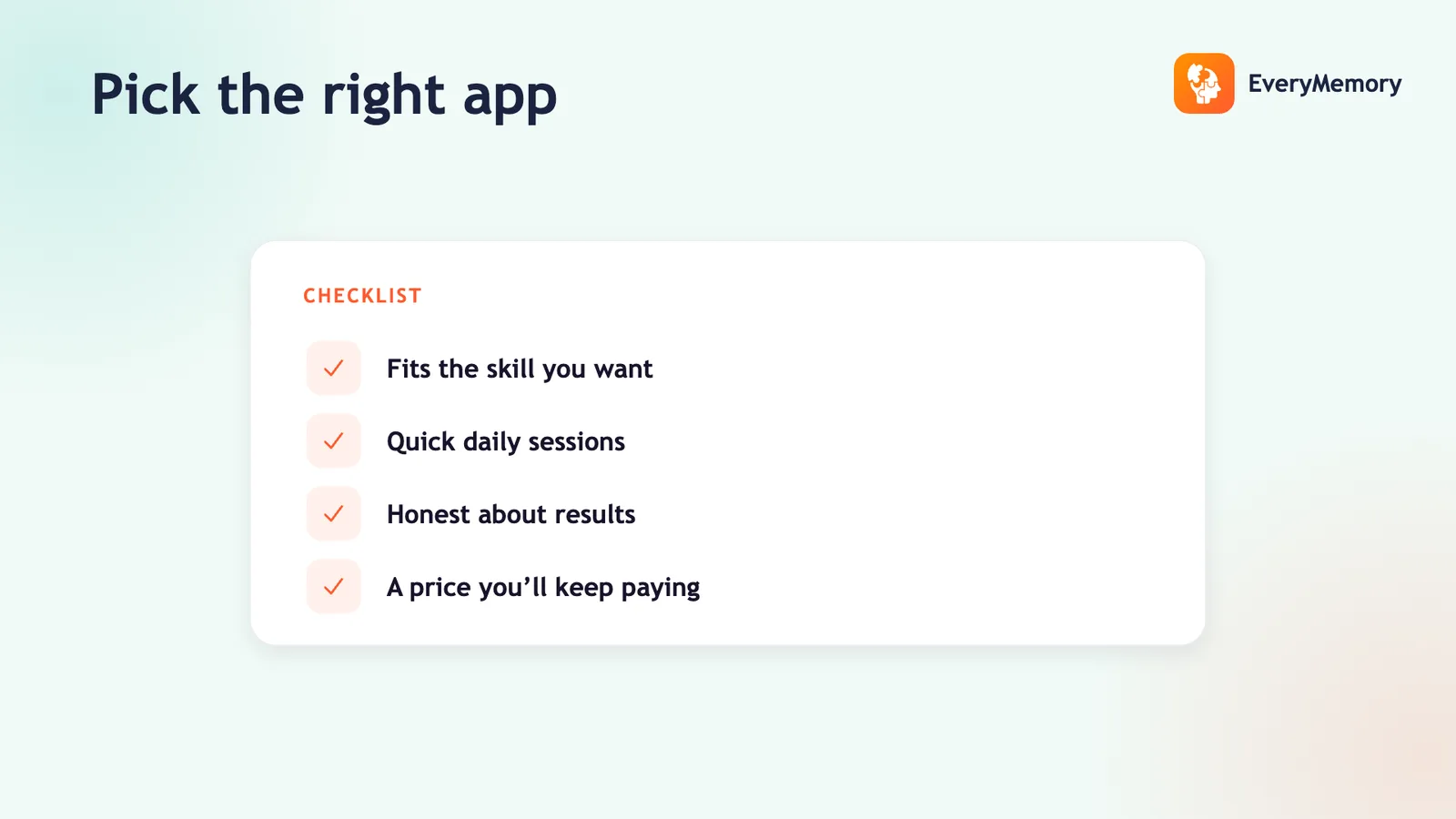
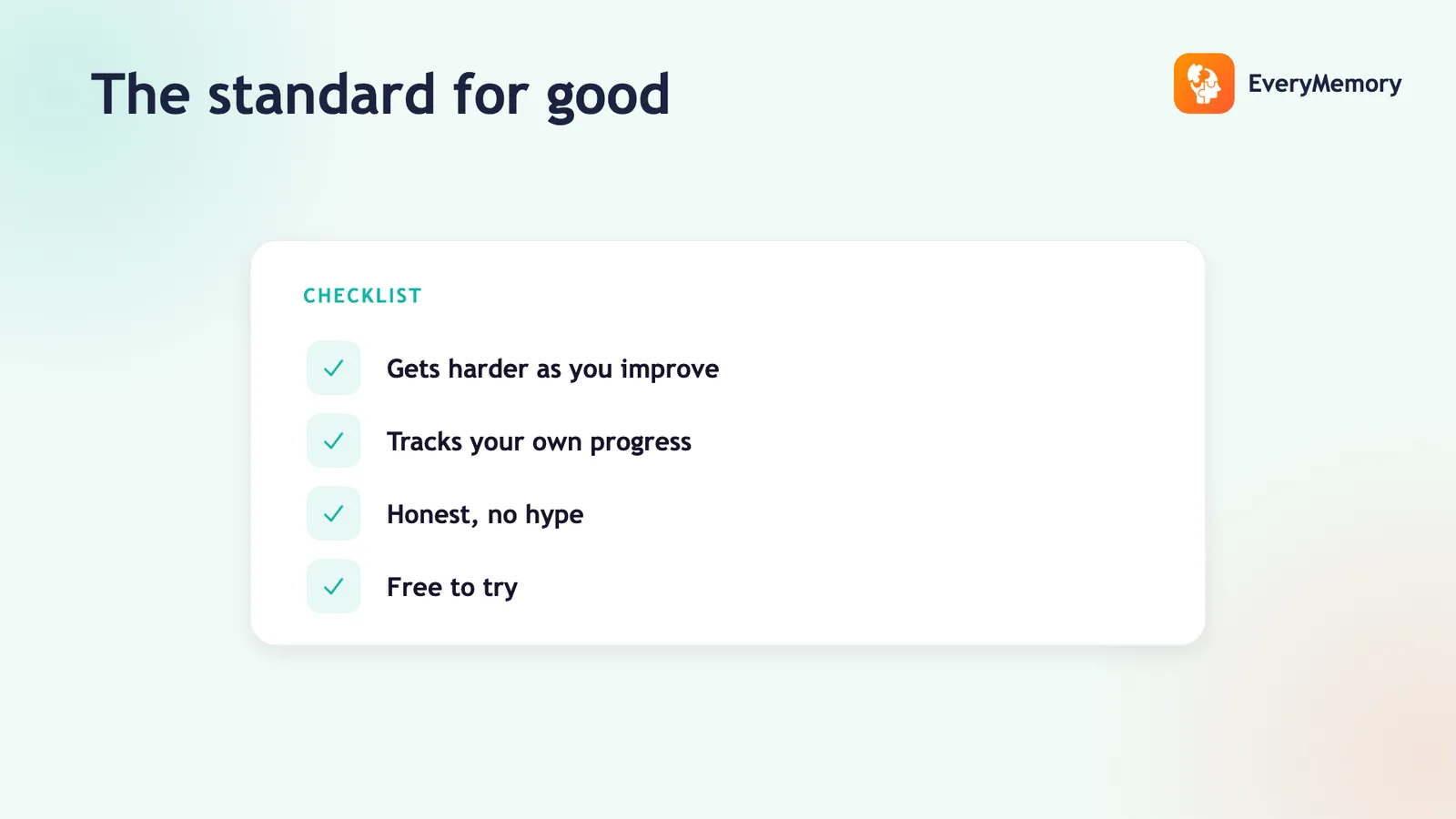
Comparing apps brand by brand is a trap: marketing dominates, and the loudest app isn't the most useful. Score each one against a fixed set of criteria instead, the same way you'd evaluate any tool. The table below is the scorecard the rest of this article unpacks.
| Criterion | What "good" looks like | Red flag |
|---|---|---|
| Adaptive difficulty | Gets harder as you improve, eases when you struggle | Same fixed levels for everyone |
| Progress tracking | Tracks your own baseline over time | Fake percentiles vs strangers |
| Claims | Says trained skills improve; transfer is limited | Promises a smarter brain / IQ gains |
| Pricing | Free to try, clear paywall | Paywall before you've played |
| Tone | Practice, not panic | Fear of decline as a sales hook |
Adaptive difficulty matters most
Training only works in the zone just past your current ability - hard enough to stretch, not so hard you fail constantly. A good app finds that edge automatically and moves it as you improve. Fixed levels can't: they're too easy for some users and too hard for others, and they stop challenging you the moment you've learned the pattern.
When you compare apps, this is the single most informative test. Play badly on purpose, then play well, and watch whether the difficulty responds. If it doesn't react to you at all, it isn't really training - it's a fixed puzzle with a streak counter.
Honest tracking beats flattering scores
Some apps show you a "brain age" or a percentile against other users. Those numbers feel motivating and mean almost nothing - the comparison group is unverified and the metric isn't a real benchmark. What's genuinely useful is a self-relative baseline: your score today versus your score last month, on the same task. That you can act on.
App-Store-safe, evidence-honest apps avoid fake benchmarks for a reason. If an app leans on percentiles or a single scary "brain age" number, treat it as a marketing tell, not a measurement. For the wider question of whether any of this works, see do brain games really work.
Read the claims carefully
The honest position, backed by the research, is narrow: you reliably get better at the specific tasks you practise, and that improvement transfers modestly to closely related skills. Broad promises - a higher IQ, a "smarter brain," protection against decline - outrun the evidence. An app that promises those is overselling, and the gap usually hides in the small print.
No app should make medical claims either. Brain games don't diagnose, treat, or prevent any condition. An app that implies otherwise has crossed a line worth walking away from.
Where EveryMemory lands on the scorecard
For transparency: EveryMemory is built to the criteria above. Difficulty adapts to your performance, your starting level is computed from your own total score rather than a comparison with strangers, there are no fake percentiles or medical claims, and you can take a baseline and train for free before deciding to pay. That's the standard we think you should hold every app to - including ours.
Want to apply the checklist yourself? How to choose a brain training app turns it into a step-by-step process.