 EveryMemory
Free IQ Tests: An Honest Guide
Most free online IQ tests aren't real IQ tests - they're engagement machines built to flatter you and sell certificates. Here's how to spot the difference and what they can actually tell you.
Part of the guide: How to Keep Your Brain Healthy: A Complete Lifestyle Guide →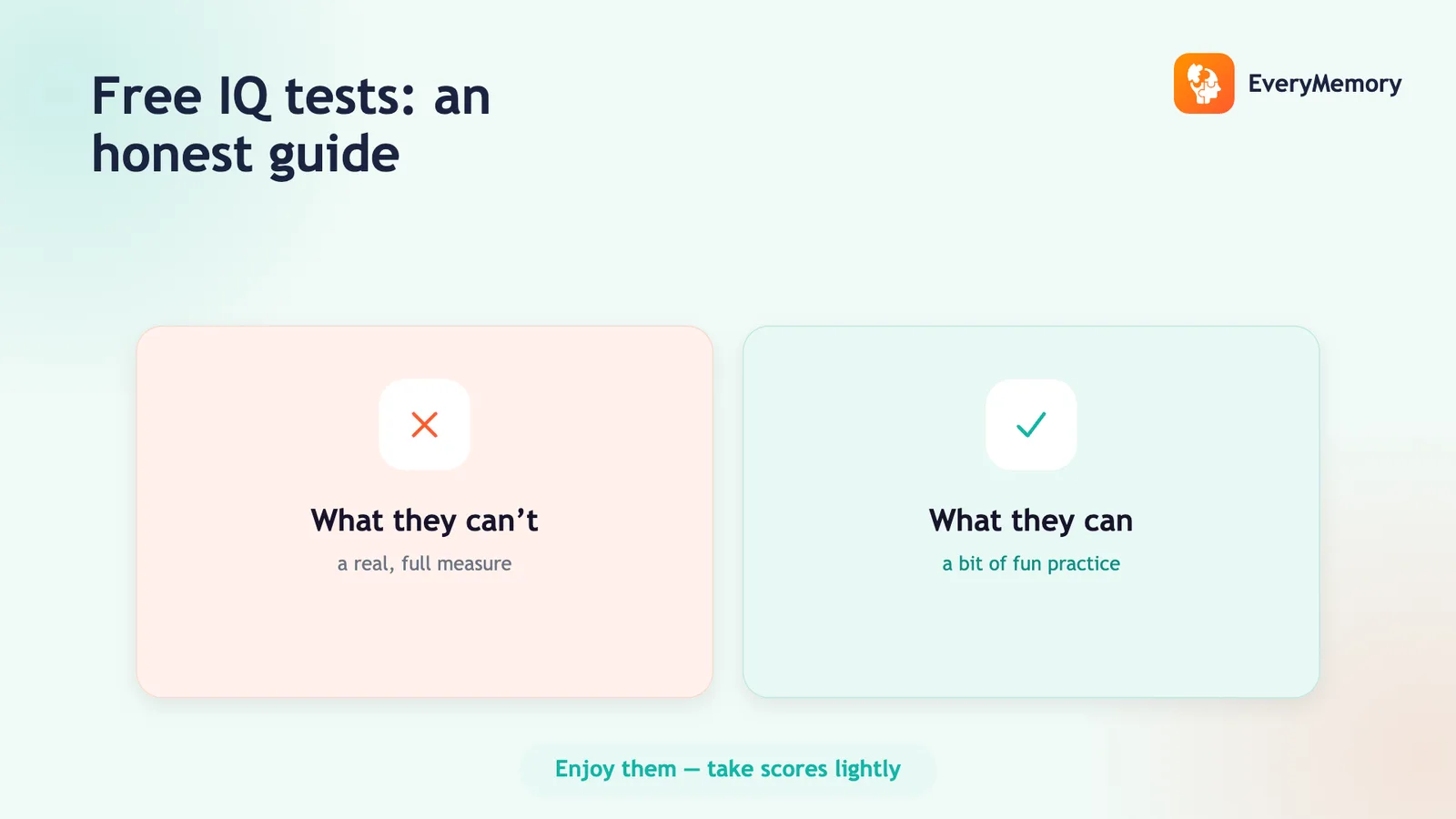
⚡ Quick answer
Most free online IQ tests are not validated, standardized instruments, so they can't tell you your "real IQ." Real IQ testing requires professionally normed tests administered under controlled conditions. Free tests are fine as casual puzzle practice, but treat the number as entertainment, not a measurement.
Key takeaways
- Most free online IQ tests aren't standardized, so they can't reveal your real IQ.
- Red flags: paid certificates, flattering scores, no norming, few questions.
- Real IQ testing needs professional norming under controlled conditions.
- Fine as casual puzzle practice - treat the number as entertainment, not measurement.
Type "free IQ test" into a search bar and you'll find thousands of them, each promising to reveal your true number in minutes. They're fun, they're fast, and they're almost never what they claim to be. The result you get is usually closer to a quiz score than a genuine, standardized IQ.
That doesn't make them worthless - a good puzzle quiz is enjoyable mental exercise. It just means you should read the output with clear eyes. This guide explains how these tests actually work, where they go wrong, and how to get something honest out of the experience.
How a real IQ test differs
A legitimate IQ test is standardized: it's been given to a large, representative sample so that any individual score can be compared against a proper distribution. It's administered under controlled conditions, usually by a trained professional, and scored against published norms. That's what makes the number mean anything.
Free online tests almost never meet that bar. They're rarely normed on a representative population, conditions aren't controlled, and the scoring is often opaque. So the "IQ" they hand you isn't anchored to a real scale - it's a number the site decided to show you. We go deeper in are online IQ tests accurate.
The red flags to watch for
You can spot a low-quality test before you even finish it. A few patterns recur across the worst offenders.
- It asks for payment to "unlock" your full result or a certificate.
- Everyone seems to score impressively high - a sign of flattery, not measurement.
- There's no explanation of how it was standardized or normed.
- It promises to reveal your "real IQ" or compares you to celebrities.
- It's short - a handful of questions can't sample reasoning reliably.
If a test leans on certificates, suspiciously generous scores, or urgency, it's built to drive engagement and sales, not to assess you. The flattering number is the product.
What free tests can honestly offer
Used with the right expectations, these quizzes still have value. They're a pleasant way to practise pattern recognition and logical reasoning, and a hard one can be a genuine mental workout. The activity is fine - it's the label "your IQ" that's the problem.
If you enjoy the reasoning side, it's better to practise the underlying skill than to chase a score. For that, how to improve logical reasoning is a more useful place to put your effort than another quiz.
Reading your result without fooling yourself
If you've taken one, hold the number loosely. Don't anchor your self-image to it, don't share it as fact, and remember that even properly administered IQ scores wobble between sittings. A free online figure carries far more noise and far less meaning.
And keep the bigger frame in mind: even an accurate IQ score measures only a slice of reasoning, not creativity, judgement, or drive. That limit is the real story - see do IQ tests measure intelligence.
⚠ When to talk to a professional
This is general educational information, not medical or psychological advice. Online tests cannot diagnose any condition or determine your intelligence. For a genuine assessment or any real concern, consult a qualified professional.


