 EveryMemory
Free vs Paid Brain Games
Free vs paid brain games comes down to what you're actually buying. Here's an honest breakdown of where free is enough - and what a subscription should add to earn its keep.
Part of the guide: How to Keep Your Brain Healthy: A Complete Lifestyle Guide →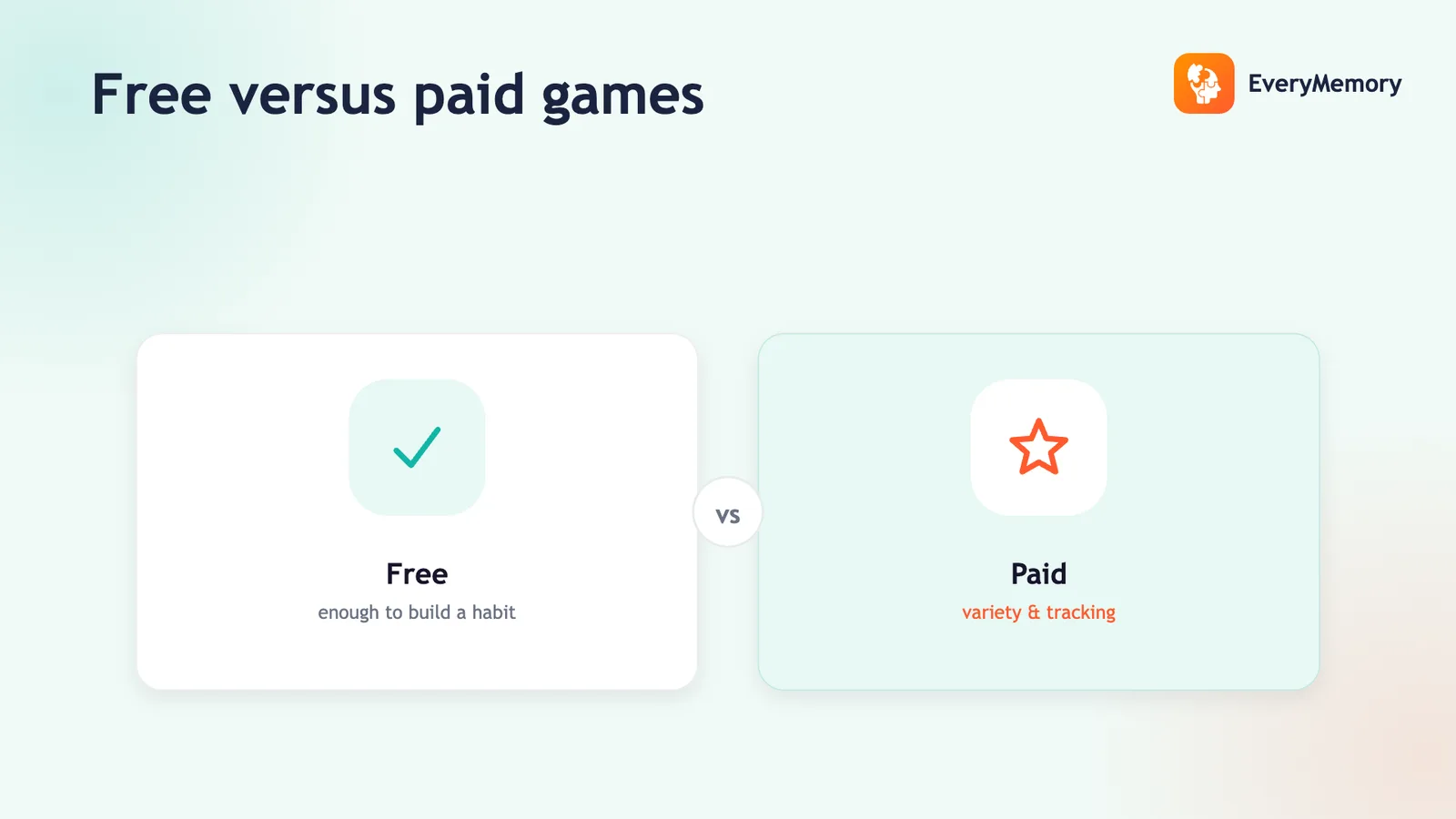
⚡ Quick answer
Free brain games are enough for casual practice and trying a format. Paying is only worth it when the subscription adds real value - adaptive difficulty, self-relative progress tracking, varied skill coverage and an ad-free experience. Never pay before you've tried the free tier, and avoid anything that paywalls all value upfront.
Key takeaways
- Free is enough for casual or one-off use; pay only for real added value.
- A worthwhile paid tier adds adaptivity, self-relative tracking, breadth and ad-free play.
- Both free and paid can hide gimmicks - try before committing.
- EveryMemory is free to start: judge the games and tracking before any subscription.
Brain games run the full pricing spectrum - completely free browser tools, free apps with optional upgrades, and full subscriptions. The honest answer to 'should I pay?' isn't a flat yes or no; it depends entirely on what the paid tier adds and whether you'll use it.
This guide breaks down what you genuinely get at each price point, where free is plenty, and what a subscription must offer to earn its keep - so you don't pay for a streak counter or skip the features that actually help.
What you get at each price point
Map your needs to the tier rather than defaulting to either extreme.
| Tier | Usually includes | Best for |
|---|---|---|
| Free browser tools | A few fixed-difficulty tests | One-off curiosity, quick benchmarks |
| Free app (with upgrade) | Core games, some tracking, ads | Trying a daily habit before paying |
| Paid subscription | Adaptive difficulty, full tracking, ad-free | Committed regular practice |
For free-only options, see best free brain games online and free brain training apps.
When free is genuinely enough
If you want to test a reaction time once, play a memory game on a lunch break, or just see whether the format clicks, free covers it completely. There's no benefit to paying for occasional, casual use, and plenty of solid free tools exist.
- You're curious and want a one-off benchmark.
- You play sporadically rather than daily.
- You're still deciding whether brain games suit you at all.
- You don't need progress tracking or adaptive difficulty yet.
What a paid tier must add to be worth it
A subscription should pay for substance, not cosmetics. The features that justify a price are mostly the ones that make practice effective over weeks rather than minutes.
- Adaptive difficulty that keeps every session appropriately hard.
- Self-relative progress tracking across many sessions - your own trend.
- Breadth across memory, attention, speed and flexibility, not one task reskinned.
- Ad-free, distraction-free play.
If a paid tier mostly unlocks a streak badge and removes ads, it's thin. If it unlocks genuine adaptivity and tracking, that's a fair trade. See are brain training apps worth it for the bigger value question.
Red flags on both sides
Free isn't automatically virtuous and paid isn't automatically better. Free tools can drown you in ads or sell fake percentiles; paid tools can charge a premium for the same gimmicks. The honest move is the same either way: try before you commit, and judge by whether difficulty adapts and tracking is self-relative.
EveryMemory follows that principle - it's free to start so you can play the real games and check the tracking before any subscription enters the picture. That's the order it should always go: value first, payment second.


