 EveryMemory
How to Improve Critical Thinking
Critical thinking is a set of habits - asking what the evidence is, separating claims from facts, and checking your own assumptions - that you can deliberately practise.
Part of the guide: How to Keep Your Brain Healthy: A Complete Lifestyle Guide →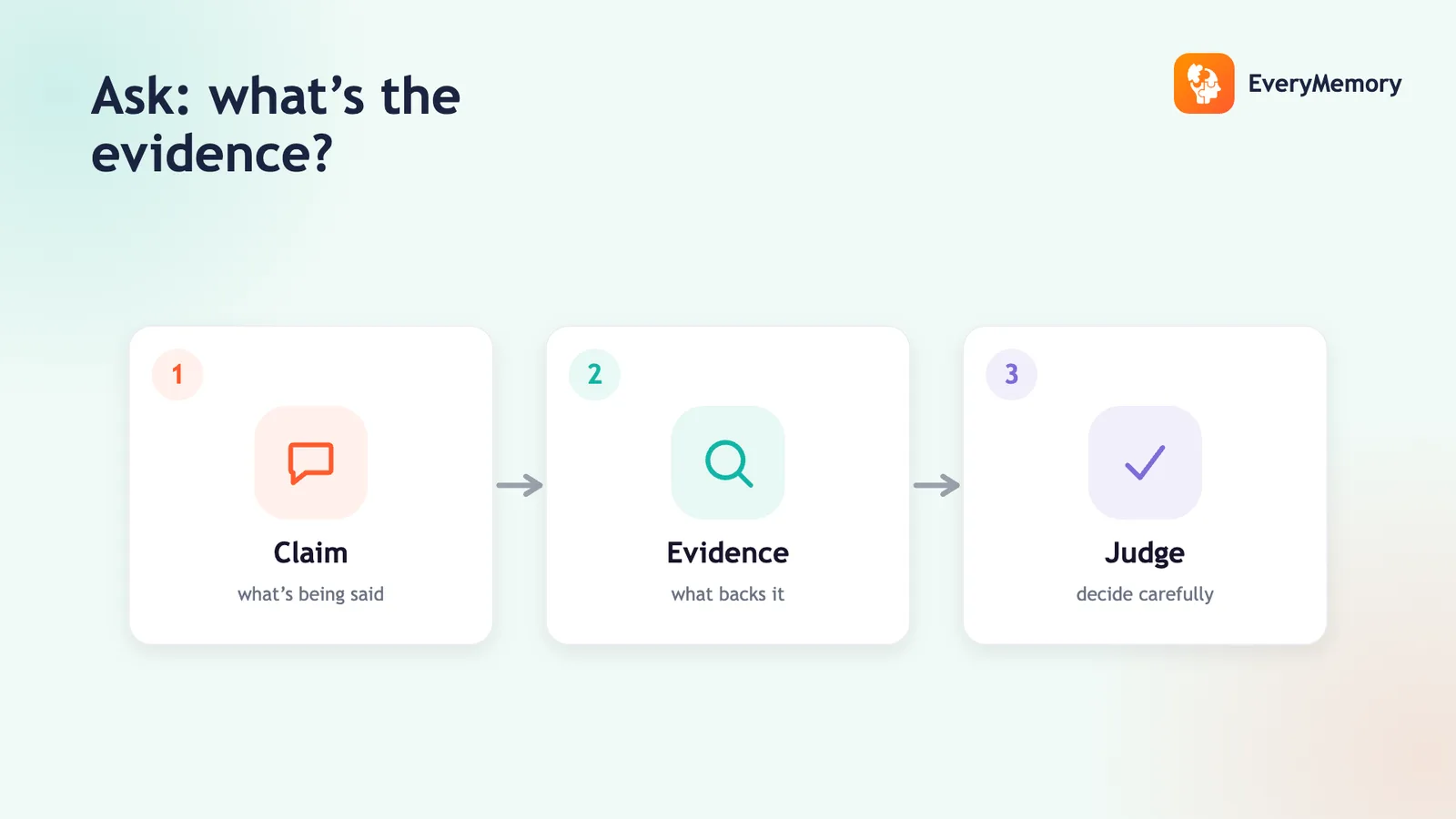
⚡ Quick answer
Improve critical thinking by building a few habits: ask what evidence supports a claim and how good that evidence is; separate facts from interpretations and opinions; learn to spot common fallacies like attacking the person or cherry-picking; and deliberately check your own assumptions, especially when a claim flatters what you already believe. Slowing down to question is most of the skill.
Key takeaways
- Ask what evidence supports a claim and how strong it really is.
- Separate facts, interpretations, and opinions - they wear the same clothes.
- Learn common fallacies (ad hominem, straw man, cherry-picking) by name.
- Check your own assumptions: ask 'what would change my mind?'
Critical thinking gets talked about as a personality trait - you either have a "questioning mind" or you don't. It's better understood as a set of habits you can name and practise: asking what the evidence is, telling claims apart from facts, noticing the usual ways arguments go wrong, and checking the assumptions you brought in.
None of this requires being clever. It requires slowing down at the moments where most thinking errors happen - when something confirms what you already believe, when a story is vivid, when you're sure. The skill is mostly catching yourself there.
Ask what the evidence actually is
The core move of critical thinking is simple and underused: when you meet a claim, ask what's behind it. Is there evidence, or just confident assertion? How strong is it - a controlled study, a single anecdote, a number with no source? Who's making the claim and what do they gain if you believe it?
Strong claims need strong evidence; a dramatic claim backed only by a story should raise your guard, not your belief. This one habit filters out a large share of what's wrong on the internet.
Separate facts, interpretations, and opinions
Arguments get muddled because three different things wear the same clothes. A fact can be checked. An interpretation is a reading of facts that could be read differently. An opinion is a preference. "Sales fell 10%" is a fact; "the product is failing" is an interpretation; "we should kill it" is an opinion built on the other two.
| Type | Test | Example |
|---|---|---|
| Fact | Can be verified or falsified | The report is 40 pages long |
| Interpretation | A reading of facts; others possible | The report is too detailed |
| Opinion | A preference or value judgment | They should have written less |
Learn the common fallacies
A handful of bad-argument patterns show up again and again. Knowing their names makes them easy to catch in the wild - and in your own reasoning:
- Ad hominem - attacking the person instead of their argument.
- Straw man - refuting a weaker version of what was actually said.
- False dilemma - presenting two options when more exist.
- Appeal to authority - "an expert said so" when the expert is outside their field or the claim is contested.
- Cherry-picking - citing the data that fits and ignoring the rest.
Check your own assumptions
The hardest part of critical thinking is turning it on yourself. We accept weak evidence instantly when it agrees with us (confirmation bias) and demand airtight proof when it doesn't. The fix is a deliberate counter-question: "What would change my mind?" If nothing could, you're not reasoning - you're defending.
Ask also: what's the strongest version of the opposing view, and what assumptions am I making that I haven't checked? This is uncomfortable, which is the tell that it's working. Pair it with the slow, deliberate attention covered in improving focus.
✅ Try this today - Steelman before you argue
Practise the hardest critical-thinking habit on something you disagree with:
- Pick a claim or article you instinctively disagree with.
- Write the strongest possible version of its argument - the steelman, not the strawman.
- List what evidence supports it and what would have to be true for it to hold.
- Only now write your response. You'll argue better and occasionally change your mind.


