 EveryMemory
Jigsaw Puzzles and the Brain
Jigsaw puzzles are a calming, hands-on workout for visual-spatial thinking. They're genuinely good engagement - here's an honest look at what they train and what they don't.
Part of the guide: How to Keep Your Brain Healthy: A Complete Lifestyle Guide →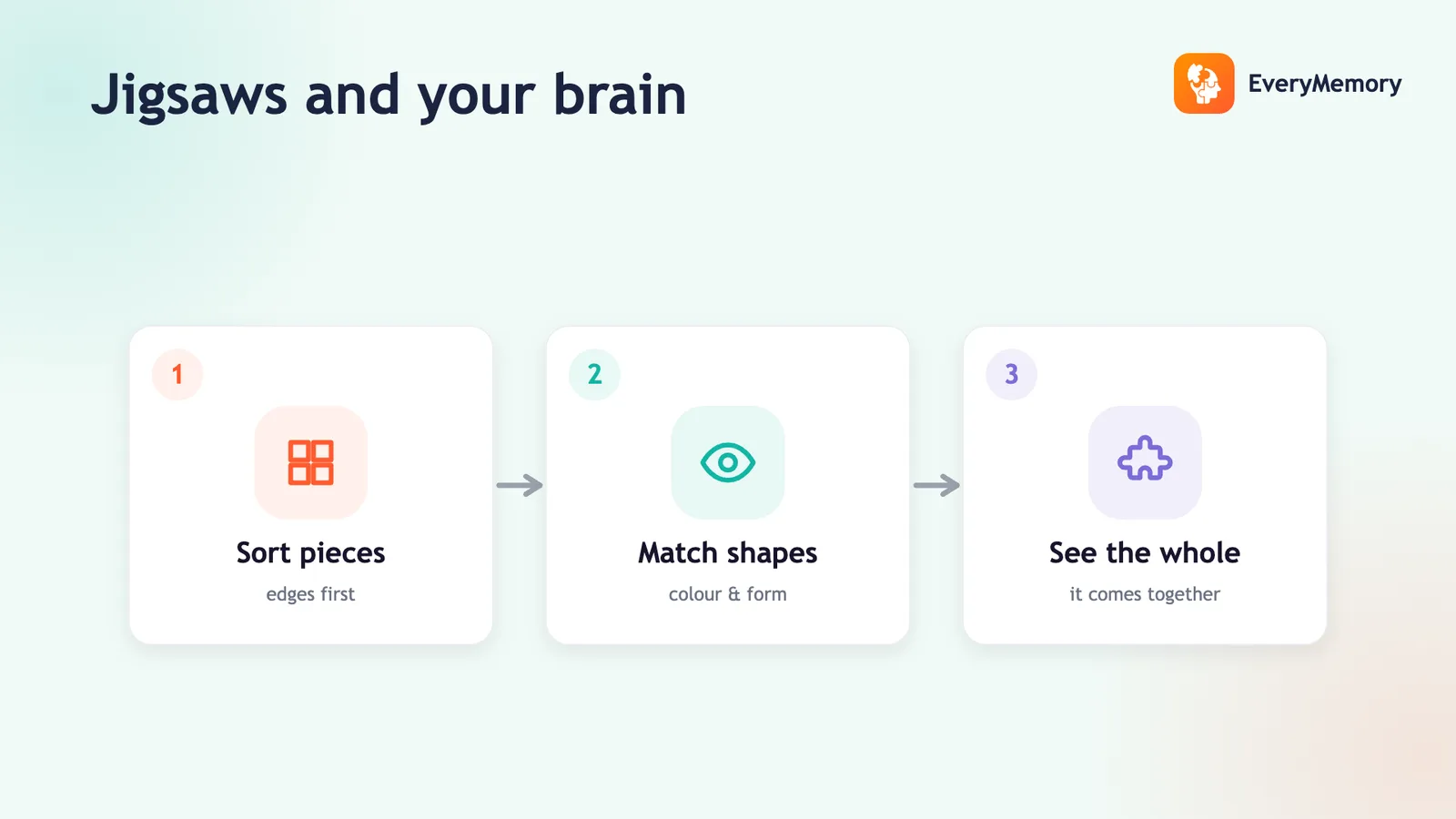
⚡ Quick answer
Jigsaw puzzles are good mental exercise for visual-spatial skills: judging shapes, colours, and how parts fit a whole. They're calming, absorbing, and a fine way to stay engaged. But the benefit is mostly puzzle-specific - they won't broadly raise intelligence or prevent decline. Enjoy them as relaxing, worthwhile engagement.
Key takeaways
- Trains visual-spatial reasoning and mental rotation
- Genuinely calming and absorbing - real stress relief
- Light on memory; benefit is puzzle-specific
- Balance with verbal, logic, and recall challenges
There's something deeply satisfying about a jigsaw: the quiet focus, the slow emergence of an image, the small click of a piece finding home. It feels like meaningful mental work, and it is - jigsaws are one of the most hands-on, visually demanding puzzles in common circulation.
What they're not is a brain upgrade in a box. As with every classic puzzle, the calm and the engagement are real, while the bigger claims about lasting cognitive benefit deserve a more careful look.
What a jigsaw actually exercises
A jigsaw is a visual-spatial problem. You're constantly matching subtle shape contours, reading shades of colour, and mentally rotating a piece to test where it belongs - all while holding the target image in mind. That's a workout in spatial reasoning and visual perception, with sustained attention underneath it the whole way.
- Visual-spatial reasoning - judging shape, fit, and orientation.
- Visual perception - distinguishing fine differences in colour and texture.
- Mental rotation - turning a piece in your mind before your hand.
- Sustained attention - staying with a slow, methodical search.
It's a different muscle from word and logic puzzles, which is exactly why variety matters. See mental stimulation and memory.
The honest limit and the underrated upside
The transfer story is the same as ever: doing jigsaws makes you better at jigsaws - quicker at sorting edges, sharper at reading contours - but it doesn't reliably upgrade unrelated abilities. There's no good evidence that jigsaws prevent cognitive decline, despite the comforting marketing on the box.
But jigsaws have a genuine, often-overlooked upside that doesn't depend on transfer at all: they're calming and absorbing. The flow state of a long puzzle is real stress relief, and lower stress is good for clear thinking in the moment. That's an honest benefit worth naming - just don't confuse "relaxing and engaging" with "reshapes your brain."
How jigsaws compare to other visual puzzles
| Puzzle | Mainly exercises | Honest note |
|---|---|---|
| Jigsaw | Visual-spatial reasoning, mental rotation | Calming; benefit is puzzle-specific |
| Spot the difference | Visual search, attention to detail | Trains noticing, not memory |
| Optical illusions | Attention, perception | Reveal how attention works, not a workout |
| Word search | Visual scanning, attention | Light on memory; mostly a search task |
Notice how many "brain" puzzles are really attention-and-perception tasks. For the search-heavy ones, see spot the difference and attention.
Making jigsaws part of a fuller routine
If you love jigsaws, lean into what they're best at - the calm focus and the spatial challenge - and step up the difficulty so they stay demanding rather than rote. Then balance them with verbal, logical, and memory challenges so you're exercising more than one corner of cognition.
That's the deliberate-versus-casual distinction again. A jigsaw is wonderful relaxation and visual practice; a structured routine fills in the abilities a jigsaw never touches. See daily brain exercises for a balanced approach.
⚠ When to talk to a professional
This is general educational information, not medical advice, and jigsaw puzzles are not a treatment for or protection against any condition. If you have a genuine or persistent concern about your memory or thinking, please speak with a doctor or qualified professional.