 EveryMemory
Memory Test for Seniors (Non-Medical Self-Check)
A friendly, non-medical memory self-check for older adults - a way to compare against your own past, not a screening. Here's how to do one gently, and what it can and can't tell you.
Part of the guide: Helping a Parent With Memory Changes: The Complete Family Guide →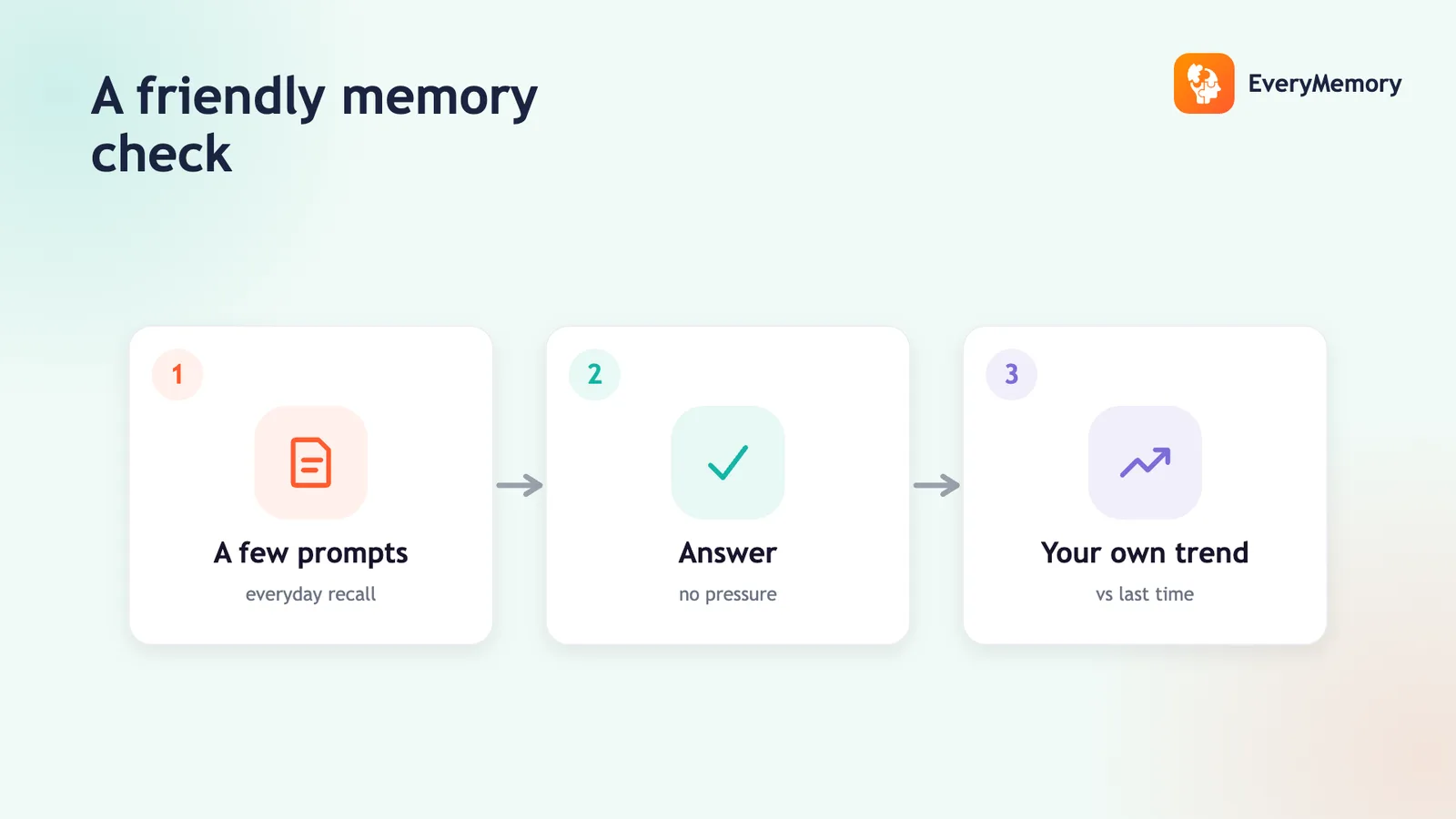
⚡ Quick answer
A memory test for seniors at home is a non-medical self-check, not a screening - it can't diagnose anything. Try recalling a short list, a few faces and names, or a story's details, and compare it to your own past performance just for interest. For any genuine concern about memory, see a doctor or qualified professional.
Key takeaways
- A home memory check is a fun, non-medical self-check - never a screening.
- Compare only to their own past, never to others or an 'average.'
- Play it together as a shared game; keep it short, warm, and correction-free.
- Genuine or persistent concerns belong with a doctor or qualified professional.
People often search for a "memory test for seniors" hoping for clarity. It's worth being honest up front: the kind you can do at home is not a screening and can't assess any condition. What it can be is a light, friendly self-check - a way for someone to compare how they do today against how they did before, for their own interest.
Done warmly, a self-check is a pleasant shared activity, not an exam. Done as a test set by someone else, it can feel like being put on the spot. This guide keeps it gentle, useful, and firmly non-medical - and points you to the right place if a real concern comes up.
What a home self-check is - and isn't
A home memory check is for fun and self-interest, like timing yourself on a crossword. It is not a clinical tool, and a low score on a kitchen-table game means nothing on its own - tiredness, distraction, stress, or simply not enjoying the activity all affect it. The only useful comparison is against your own past attempts, never against anyone else.
If you want the principle behind this in more depth, see what is a non-medical memory check. The honest framing keeps the activity pleasant and avoids needless worry.
Gentle self-check activities to try
These are light, enjoyable ways to take note of recall - best done as a shared game over tea, not as a graded test.
- List recall - read out ten everyday items, chat for two minutes, then write down what you remember.
- Faces and names - look at five photos with names, then match them again later.
- Story details - read a short paragraph, then answer a few questions about it.
- Number span - repeat back a string of digits, growing it one at a time.
- Where did it go - hide three small objects, do something else, then find them.
For more structured but still non-medical options, see how to test your memory and our gentle free memory test.
Doing it kindly, not as an exam
The tone is everything. A memory check should never feel like a spotlight. Frame it as a game you're both playing - "let's see how we each do" - and take your turn too. Keep it short, light, and free of corrections. If a word won't come, that happens to everyone; smile and move on.
| Do | Avoid |
|---|---|
| Play it together as a shared game | Setting it like a one-sided test |
| Compare to their own past, gently | Comparing them to others or an "average" |
| Keep it short and warm | Long sessions that feel like an exam |
| Laugh off the misses | Highlighting or correcting every slip |
Tracking over time, the right way
If someone enjoys the self-check, a gentle way to track it is to repeat the same activity occasionally and note their own trend - purely for their own interest, like watching a personal best. Some apps make this comfortable by remembering past sessions for you, so there's no scorekeeping pressure.
EveryMemory works this way: it compares you only to your own earlier sessions, never to a benchmark or anyone else. It's a friendly daily activity, not a screening tool. If a real or persistent concern ever surfaces - not just an off day - that's a conversation for a professional, which the next section covers.
✅ Try this today - A two-minute, low-pressure list check
Play it together - you take a turn too.
- Pick ten everyday items, like "apple, key, hat, train..."
- Read the list aloud once, slowly.
- Chat about something else for two minutes.
- Each write down as many items as you remember.
- Compare for fun - and note your own count if you want to try again another day.
⚠ When to talk to a professional
A home memory test is a fun, non-medical self-check, not a screening or diagnostic tool, and it cannot assess any condition. If you have a genuine or persistent concern about your own or a family member's memory or thinking, please speak with a doctor or qualified professional.


