 EveryMemory
Helping a Parent With Memory Changes: The Complete Family Guide
A compassionate, practical hub for families navigating a parent's memory changes - from first conversations to doctor visits, daily activities, and caring for yourself.

⚡ Quick answer
Helping a parent with memory changes starts with calm observation - noting specific changes without alarm - and gentle, dignified support that preserves their independence. Talk openly but without scaring them, reduce the daily memory load with simple practical tools, do enjoyable activities together, and when the time is right, prepare carefully for a doctor visit. Throughout it all, your own wellbeing matters too.
Key takeaways
- Start with calm, specific observation - noting patterns over several weeks rather than reacting to individual slips.
- Open the conversation with care rather than evidence: one observation, a gentle question, and plenty of room to listen.
- Reduce the daily memory load with shared calendars, whiteboards, and consistent homes for important items - set up together.
- Your wellbeing matters too: share the load, acknowledge what is hard, and take caregiver fatigue seriously.
One afternoon you notice that your parent asked the same question twice within twenty minutes. Or they hesitate over a name they have known for decades, or seem briefly confused about which day it is. You do not want to overreact, but you cannot quite unsee it either. That quiet, private worry is where this guide begins.
Helping a parent through memory changes is one of the most emotionally complex things a family can face - part love, part logistics, part learning to let go of the idea that you can fix it. This hub brings together everything you need: how to notice what is actually changing, how to open the conversation gently, what to do day to day, activities to do together, how to prepare for and attend a doctor visit, and how to make sure you are not quietly running yourself into the ground.
Noticing changes without overreacting - or underreacting
The first challenge is calibrating what you are actually seeing. Some degree of slower recall and occasional forgetfulness is a normal part of ageing - words that take a moment longer to surface, needing to read a shopping list rather than holding it in your head, misplacing glasses more than you used to. These slips feel different from changes that are new, getting more frequent, or beginning to affect everyday life.
What tends to be worth watching more carefully: forgetting recent conversations or events (rather than distant ones), getting disoriented in familiar places, repeatedly asking the same question within a short window, difficulty with tasks that used to be automatic. The important word is pattern. A single bad day proves nothing. A consistent change across several weeks tells you something worth noting.
Our guide on how to help an aging parent with memory concerns walks through the early signs and offers a calm framework for interpreting what you observe - including the practical scaffolding (shared calendars, consistent places for keys and glasses) that can quietly reduce the memory load before any conversation is needed.
Starting the conversation gently - and without causing fear
Most adult children sit on their worry far longer than they should, because the conversation feels so loaded. Your parent may hear "I've noticed some changes" as "I think you're losing your mind" even if that is the last thing you mean. The fear underneath - of losing independence, of being a burden, of a label that can't be undone - is real and worth taking seriously.
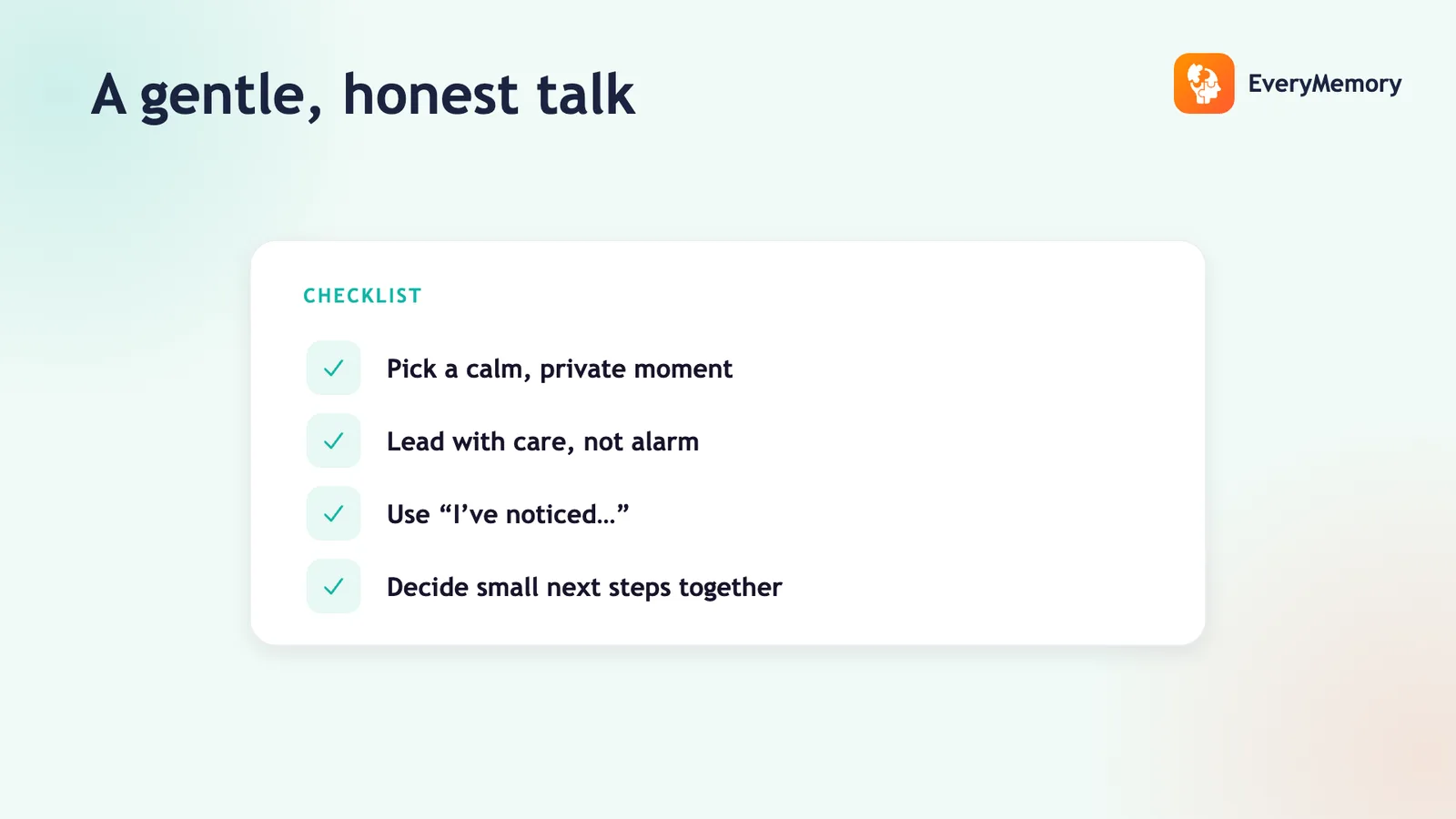
The most effective approach is to lead with care rather than evidence. Describe one specific thing you have noticed, not a list of every incident. Ask questions more than you make statements. Choose a calm, private moment, with no audience and no agenda beyond opening a door. And frame the conversation around wanting to understand rather than wanting to act - the first talk does not need to produce a plan.
There is detailed guidance on specific language, timing, and what to do if your parent gets upset or shuts the conversation down in our piece on how to talk about memory without scaring a parent. It also covers what to do if your parent is in denial, and how to gently return to the topic without pushing.
What to track - and why a written record matters
Once you have begun paying attention, the temptation is to keep it all in your head. This is worth resisting. Memory is an unreliable record-keeper, especially for gradual patterns that unfold over weeks. We remember the dramatic moments and smooth over the quieter, cumulative ones. A brief written log changes this: a few lines every couple of days, noting what you observed, when, and any context.
This is not about building a case against your parent. It is about making sure that if and when you do see a professional, you arrive with specifics rather than impressions. 'She asked the same question six times on Tuesday, twice on Thursday' is far more useful to a clinician than 'she's been repeating herself a lot'. Patterns also often emerge in writing that are invisible day to day - changes that are worse when she's tired, better after a walk, more noticeable since a recent illness.
What to track includes: repeated questions or stories, orientation (time, date, familiar places), daily tasks, language difficulties, sleep, mood, medications, and anything safety-relevant. The full approach - including how to present your notes at an appointment without alarming your parent - is covered in what to track before talking to a doctor.
If your parent keeps asking the same question repeatedly, see our specific guide on what to do if mom keeps repeating questions - it covers how to respond with patience in the moment, what scripts help when you feel worn down, and the particular patterns that are worth raising with a professional.
Supporting day to day: practical help that preserves dignity
The most sustainable daily support works by reducing the demand on memory rather than compensating after the fact. Before reaching for correction or reminders, look for structural changes that quietly make life easier:
- A shared calendar you both have access to, so appointments do not depend on memory alone.
- A small whiteboard in the kitchen showing the day, who is coming to visit, and what is for dinner. Visible answers reduce anxious questions.
- Fixed, obvious homes for the items most often misplaced - keys, glasses, medication, phone. Set these up together so the system feels like theirs.
- A gentle daily rhythm: familiar routines reduce the cognitive load of constant decision-making and provide a natural scaffold for the day.
- Simplified finances where appropriate - direct debits for regular bills, a clearly organised folder for paperwork. This is one of the areas where things can go quietly wrong.
The principle throughout is partnership, not rescue. Let your parent keep doing everything they can still do well. Offer to set something up together rather than doing it for them. The moment support starts to feel like being managed, it tends to be resisted - and the resistance is usually a sign that independence matters to them, which is something to work with rather than around.
For activities that specifically support memory while keeping visits feeling like visits rather than therapy sessions, our guide on memory activities to do with an older parent is a practical collection: card games, walks with observation prompts, cooking a favourite recipe from memory, photo walks. These are not interventions - they are good ways to spend time together that happen to support recall.
Brain games and regular mental engagement
Keeping the mind engaged - with real novelty, genuine challenge, and enough variety to stay interesting - is something families often want to support but are not sure how to introduce without it feeling patronising. The best starting point is usually something your parent already enjoys: card games, crosswords, a puzzle on the kitchen table, a regular walk on a slightly different route.
What makes an activity genuinely useful is that it requires real mental effort, offers a degree of novelty, and is enjoyable enough to do consistently. Social context amplifies this: a card game with another person exercises memory, attention, and language all at once, and the shared enjoyment makes it more likely to become a regular habit.
Our guide to best brain games for elderly parents covers the specific options that work well for older adults - from classic card games and word puzzles to jigsaw puzzles, music, and digital tools - with guidance on what to look for and how to make it a regular part of the week rather than an occasional effort.
Preparing for and attending a doctor visit
Encouraging a parent to see a doctor about memory can be one of the hardest steps. Many older adults fear that booking an appointment means admitting something is seriously wrong, or that it will set something irreversible in motion. Framing it as a routine health check - one that often ends in reassurance - tends to be more effective than framing it as a response to crisis.
A little preparation before the appointment makes it significantly more useful. Bring a complete medication list (prescription, over-the-counter, supplements), your written notes on what you have observed, a note of any significant recent events (bereavement, poor sleep, a new medication), and a short list of questions you want answered. Consider whether to bring a companion - having someone with you helps both for emotional support and for remembering what was discussed. If you do attend, your role is to be a calm, supportive presence rather than a spokesperson: answer questions when invited, but let the professional lead and let your parent speak for themselves.
For a complete, calm picture of what a memory check-up actually involves, our guide on what to expect at a memory check-up covers the typical shape of an appointment, why going early nearly always brings reassurance, and how to handle the outcome whatever it turns out to be.
If you are preparing specific questions, questions to ask a doctor about memory gives you a clear list - from what might explain the changes to what a referral would involve, and how to make sure you leave the room with answers rather than open-ended worry. And if your parent has already been referred for a more formal assessment, supporting a parent through a memory assessment walks you through both the practical preparation and the emotional navigation before, during, and after the day.
Caring for yourself as the carer
It is easy to write this section last, as if it is an afterthought. It is not. Caregiver wellbeing is a practical foundation for everything else in this guide. A carer who is running on empty is less patient, less consistent, and less able to be genuinely present - and the depletion tends to build gradually and invisibly until it becomes a crisis.
Start by acknowledging that what you are doing is genuinely hard. Watching a parent change, managing the logistics, carrying the emotional weight of uncertainty - this is not small. Allow yourself to find it difficult without treating that as a failure.
Share the load wherever possible. If siblings are involved, have an honest conversation about who is doing what, and try to avoid one person quietly taking on everything. If your parent has other people in their life - friends, neighbours, a faith community - these connections matter for both of them.
Watch for the signs that you are not coping well: persistent poor sleep, withdrawing from your own friendships, finding yourself short-tempered in ways that are out of character, feeling that the worry never switches off. These are signals worth taking seriously, not pushing through. Talking to someone - a friend, a GP, a counsellor, a carer support service - is not a luxury. It is part of making this sustainable.
Explore the full guide
Each section of this hub has a dedicated deep-dive article. Work through the ones most relevant to where you are right now:
- How to help an aging parent with memory concerns - the practical foundation: reducing memory load, handling repeated questions, and when to involve a professional.
- How to talk about memory without scaring a parent - specific language, timing, and how to handle denial or resistance.
- What to do if mom keeps repeating questions - calm responses, the whiteboard technique, and what patterns are worth watching.
- Memory activities to do with an older parent - card games, photo walks, walks with observation prompts, and more.
- What to track before talking to a doctor - a simple two-week log template and how to present your notes clearly.
- Best brain games for elderly parents - what actually works, how to choose, and how to make it a regular habit.
- What to expect at a memory check-up - a calm, step-by-step guide to the appointment itself.
- Questions to ask a doctor about memory - a ready-made list so you leave the room with answers.
- Supporting a parent through a memory assessment - how to be a helpful presence before, during, and after a formal assessment.
✅ Try this today - Three gentle first steps for this week
You do not need to do everything at once. Start here:
- Write down two or three specific things you have noticed - with approximate dates - in a note on your phone. Do not interpret them yet, just record them. This is the beginning of a log that will be far more useful than memory alone.
- Set up one shared system: a simple whiteboard in the kitchen showing the day and any plans, or a shared calendar you can both see. Offer to do it together, framing it as something helpful for both of you.
- If you have been sitting on a worry for a while, choose a calm moment this week to open the conversation gently. Lead with care - 'I've noticed a few things and I want to make sure you're alright' - and leave plenty of room to listen.
⚠ When to talk to a professional
This guide contains general, non-medical information and practical support guidance only. It is not a substitute for professional medical advice. If you notice sudden, rapid, or significantly worsening changes in a parent's memory or thinking - or any change that is affecting their safety - please speak with a qualified healthcare professional promptly rather than waiting.