 EveryMemory
Memory Training for Productivity: Does It Help?
Focus and working memory are the engines of productive work - meetings you absorb, names you recall, tasks you hold in mind. How training them gives a real edge.
Part of the guide: Brain Exercises for Seniors: The Complete Guide →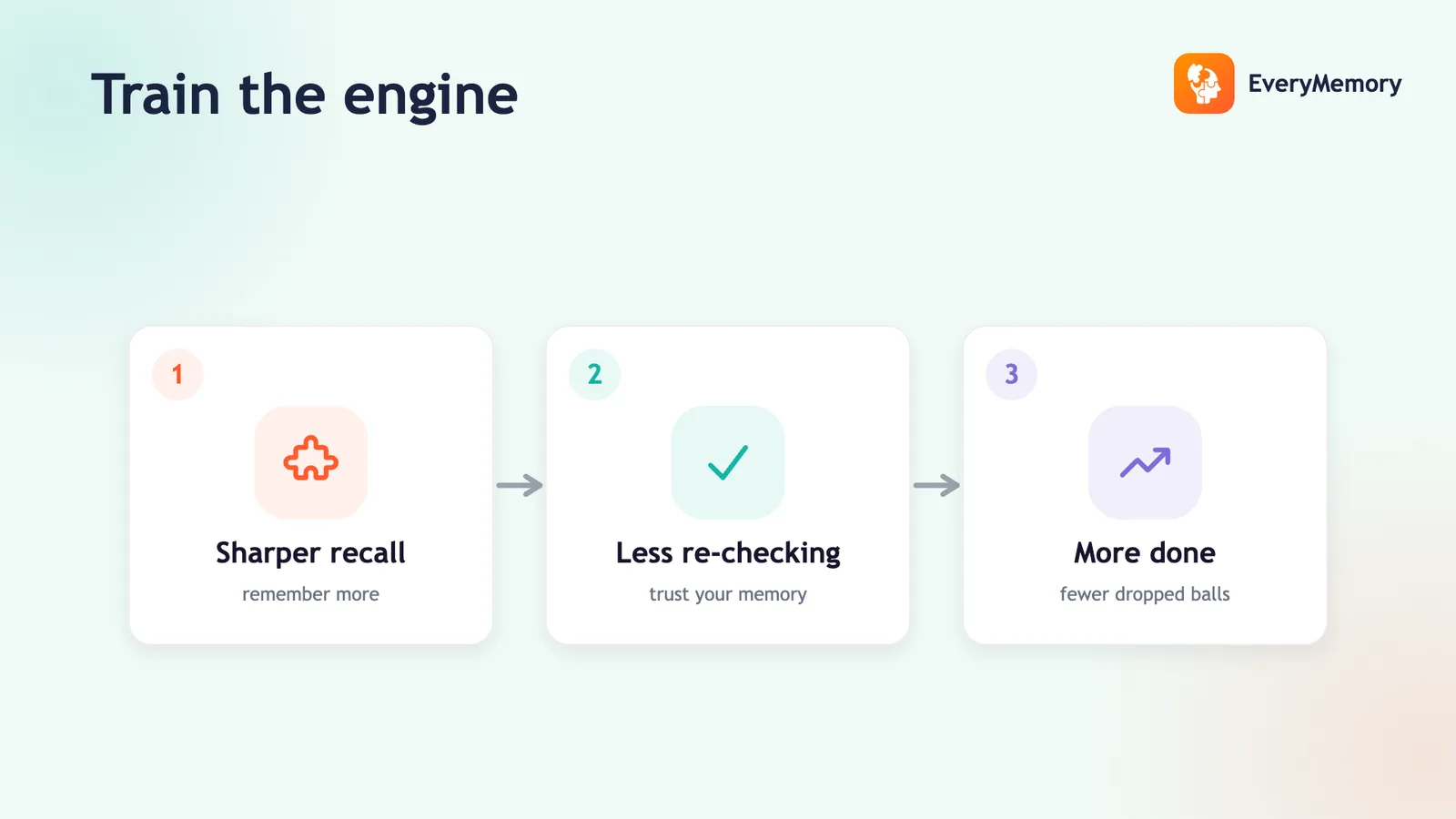
⚡ Quick answer
Training your memory and attention can give a real productivity edge, because focus is the gateway to everything you do - meetings you absorb, names you recall, tasks you hold in mind. Short daily attention and working-memory practice strengthens the concentration that productivity depends on. It won't replace good habits, but a sharper attention span makes every work hour count for more.
Key takeaways
- Attention and working memory are the hidden engine under productive work - absorbing meetings, recalling names, holding tasks.
- Short regular training reliably strengthens those skills, giving steadier focus and more headroom.
- It sharpens specific skills, not overall intelligence - keep expectations realistic.
- Train a few focused minutes most days, and pair it with removing distractions and protecting sleep.
Productivity advice is usually about systems and habits - but underneath them sits something more basic: your attention and working memory. They decide how much of a meeting you absorb, whether you recall the name and the action item, and how long you can hold a problem in mind.
Here's how training those gives a genuine, if modest, productivity edge.
Attention and working memory drive productive work
Almost every productive act runs on two abilities: attention (taking in and staying with the right thing) and working memory (holding and using information while you work). When these are sharp, meetings stick, names come easily, and you can hold a complex task in mind; when they're frayed by distraction and fatigue, everything gets harder. They're the hidden engine under your systems and habits.
What training actually helps
Short, regular practice reliably strengthens the specific skills it trains - sustained attention, single-tasking, and working-memory capacity. That carries into the workday as a steadier focus and a little more headroom to juggle without dropping things. Be realistic, though: it sharpens these skills, not your overall intelligence (do brain games really work?).
How to train it
A few focused minutes most days is the recipe - single-tasking practice, sequence and mental-math drills, and recall games that make you retrieve rather than react. Consistency matters more than length (daily brain exercises). A short daily app session is an easy way to keep it up without planning.
Pair it with good work habits
Training is the warm-up, not the whole game. It works best alongside the basics that protect attention - removing distractions (how to avoid distractions), single-tasking, and protecting sleep. Train the engine, then give it good conditions to run in.