 EveryMemory
Mental Math Tricks
A handful of mental-math methods - working left to right, rounding then adjusting, breaking numbers apart - make everyday calculation fast and reliable without a calculator.
Part of the guide: Brain Exercises for Seniors: The Complete Guide →
⚡ Quick answer
The most useful mental math tricks are: add and subtract left to right instead of right to left; round to an easy number then adjust (49 × 6 = 50 × 6 − 6); break numbers apart (16 × 7 = 10 × 7 + 6 × 7); and multiply by 11 by adding the two outer digits in the middle (35 × 11 = 385). Each keeps fewer digits in working memory.
Key takeaways
- Work left to right, not right to left - it matches how you think numbers.
- Round to an easy number, then adjust (49 × 6 = 50 × 6 − 6).
- Break numbers apart and multiply each piece, then add.
- Memorize a few shortcuts: × 11, × 5, × 9, and percentage swapping.
Mental math isn't a talent some people are born with - it's a small set of methods that beat the way most of us were taught. School arithmetic works right to left, carrying digits, which is fine on paper and clumsy in your head. The mental-math approach works left to right and breaks numbers into friendly pieces.
You don't need many tricks. Four or five cover most everyday situations - splitting a bill, checking a total, estimating a discount - and each one reduces the load on your working memory so you make fewer mistakes.
Work left to right, not right to left
Paper arithmetic starts at the ones column and carries leftward. In your head that's backwards - you build the small part of the answer first and have to hold it while you work toward the big part. Reverse it. For 47 + 38, add the tens (40 + 30 = 70), then the ones (7 + 8 = 15), then combine: 85.
This matters because you say and think numbers left to right, biggest part first. Working the same direction means you can start stating the answer almost immediately and hold less in memory along the way.
Round and adjust
Ugly numbers get easy when you round them to a friendly one and correct afterward. To compute 49 × 6, do 50 × 6 = 300, then subtract the one extra 6: 294. For 197 + 348, add 200 + 348 = 548, then take back the 3: 545.
This is also the foundation of good estimation. A quick rounded answer tells you whether the exact one is even plausible - invaluable for catching a slipped decimal point on a bill or invoice.
Break numbers apart
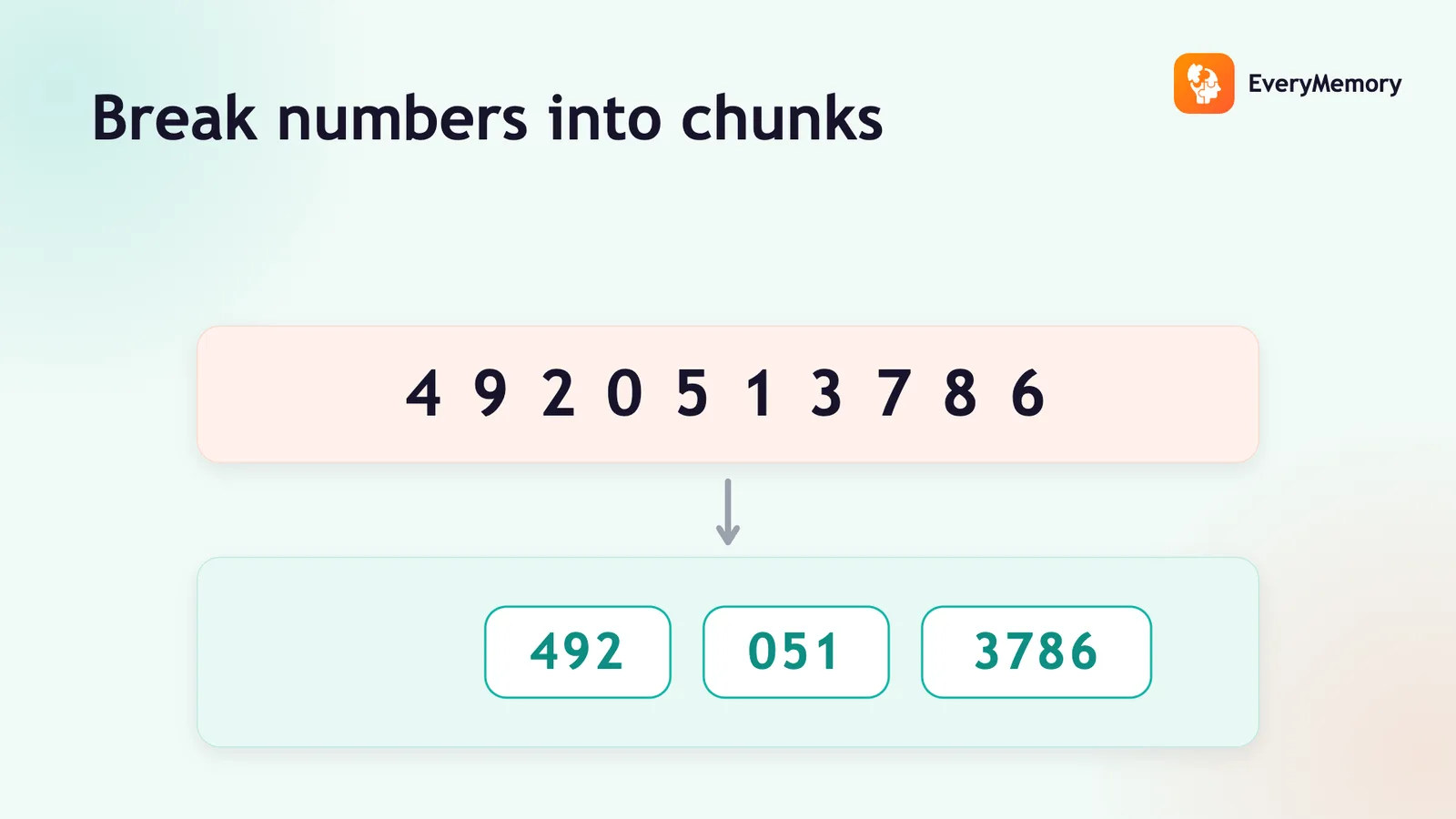
Most multiplication becomes easy if you split one number into parts you can handle, multiply each, and add. This is the same chunking idea that helps memory - see the chunking technique - applied to arithmetic.
| Problem | Break it apart | Result |
|---|---|---|
| 16 × 7 | (10 × 7) + (6 × 7) = 70 + 42 | 112 |
| 23 × 4 | (20 × 4) + (3 × 4) = 80 + 12 | 92 |
| 8 × 45 | 8 × 40 + 8 × 5 = 320 + 40 | 360 |
| 14 × 12 | (14 × 10) + (14 × 2) = 140 + 28 | 168 |
A few clean shortcuts worth memorizing
Some patterns are worth knowing outright because they come up often:
| Trick | How | Example |
|---|---|---|
| × 11 (two-digit) | Add the two digits, put the sum in the middle | 35 × 11 → 3_(3+5)_5 = 385 |
| × 5 | Multiply by 10, halve it | 48 × 5 = 480 ÷ 2 = 240 |
| × 9 | Multiply by 10, subtract one of the number | 9 × 7 = 70 − 7 = 63 |
| Percentages | x% of y equals y% of x | 8% of 50 = 50% of 8 = 4 |
| 15% tip | Take 10%, add half of it | 10% of 60 = 6, + 3 = 9 |
✅ Try this today - Drop the calculator for a week
Mental math improves quickly with low-stakes daily reps:
- For one week, work out restaurant bills, tips, and shopping totals in your head before checking.
- Use left-to-right addition and round-and-adjust on the harder ones.
- Estimate first (round everything), then refine - the estimate catches big errors.
- Verify with your phone only after you've committed to an answer. The gap shrinks fast.