EveryMemory
Chunking Technique Explained Simply
Chunking is how your brain already handles phone numbers and PIN codes. Here's how to use it deliberately to remember almost anything.
Part of the guide: How to Improve Your Memory: The Complete Beginner's Guide →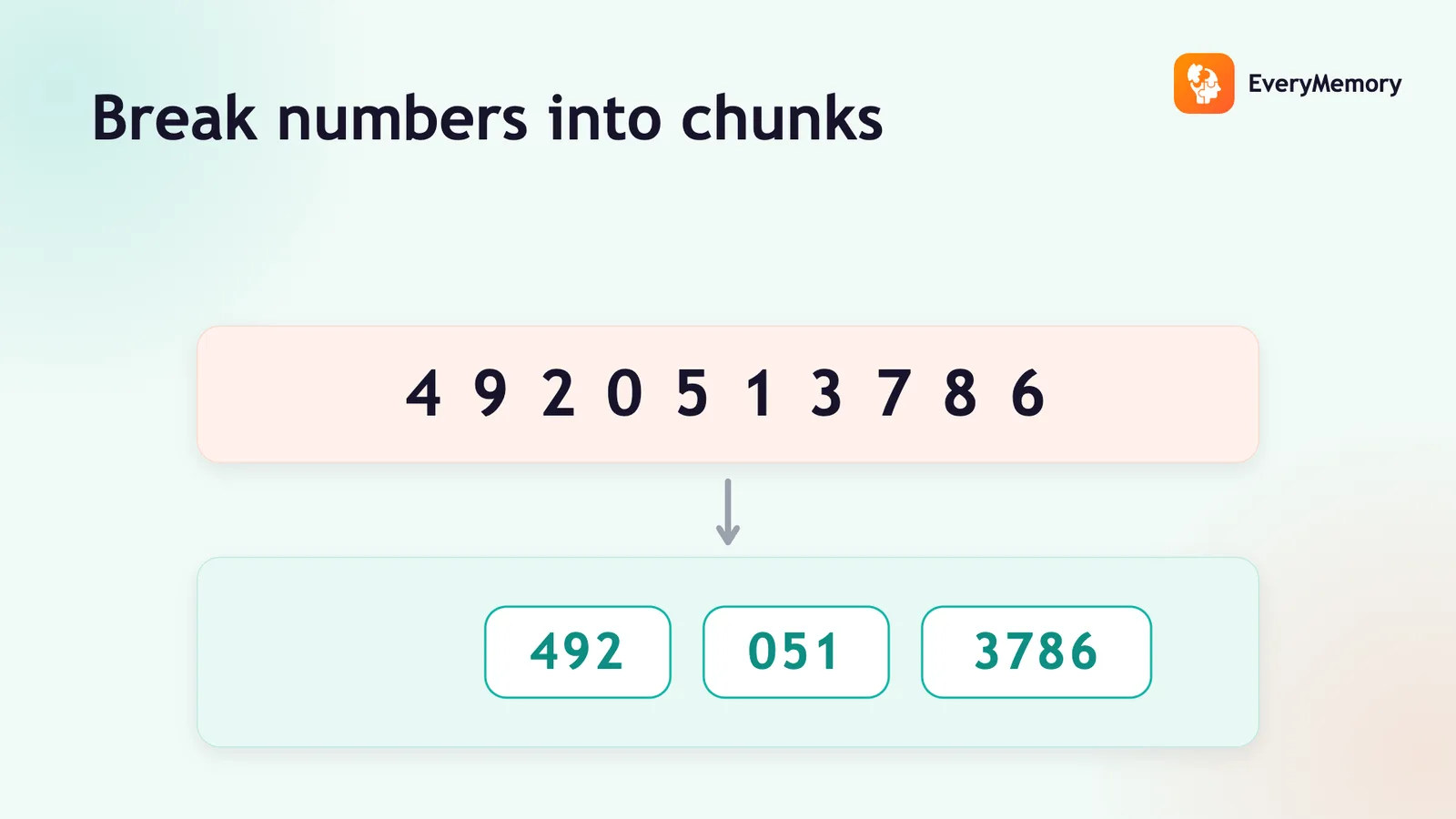
⚡ Quick answer
Chunking means grouping individual pieces of information into meaningful clusters so your brain handles fewer items at once. Instead of remembering eight separate grocery items, you group them into three categories: dairy (milk, cheese, butter), produce (apples, spinach), and pantry (pasta, olive oil). Three chunks are far easier to hold than eight loose items.
Key takeaways
- Group items into two to four meaningful clusters and store the group label in memory rather than each item individually.
- A ten-item errand list becomes three chunks - errands, shopping, admin - reducing what you need to hold to just three words.
- Before leaving the house, rehearse tomorrow's tasks by group label, then unpack the items from each label.
- Chunking works best for lists, numbers, and step-by-step tasks; pair it with visual association for structureless information.
You already use chunking every time you read a phone number. You don't hold 07700900461 as eleven separate digits - you group them into 077 009 004 61 or some similar cluster and hold those four chunks instead. That automatic grouping is chunking, and it is one of the most powerful and least intimidating memory techniques available.
The good news is that this skill works just as well when you apply it deliberately to shopping lists, medication schedules, names, stories, and anything else that tends to slip away in a busy day. This article explains how chunking works and gives you a practical method for using it on purpose.
Why your working memory needs chunking
Working memory - the mental workspace where you hold information while you are actively using it - has a limited capacity. Research consistently shows that most people can hold about four to seven items at once before things start dropping out. This is not a flaw in memory design; it is a feature that forces the brain to compress and organise information efficiently.
Chunking is the most natural way to expand what fits. When you group three items into one meaningful cluster, you've turned three "slots" into one. A list of nine items becomes three chunks of three - and three things fit in working memory far more comfortably than nine.
This is why phone numbers and PINs are formatted in groups. The format itself is a chunking aid built into the system, because the people who designed it knew about working memory limits.
The two kinds of chunking
Chunking works in two ways, and understanding both doubles its usefulness:
- Grouping by category. Put similar things together. A shopping list of apples, milk, steak, broccoli, cheese, chicken, and grapes becomes three groups: produce (apples, broccoli, grapes), dairy (milk, cheese), and meat (steak, chicken). You hold three category labels and each label unlocks its members.
- Grouping by meaning or story. Link items together into a mini-narrative or pattern. "Pick up prescription, call pharmacy, check insurance" becomes one chunk: "sort out the medication situation". The meaning-chunk is one item to hold, not three.
The second type is especially powerful for tasks and errands, because a short phrase like "sort out the car" can hold half a dozen sub-tasks under one label. Your brain stores the label, and the label unpacks on demand.
How to chunk deliberately: a step-by-step method
Here is a practical routine for applying chunking to any list or set of tasks:
- Write out the full list. Don't try to chunk in your head first. Get everything out on paper or on screen.
- Look for natural groupings. Ask: what belongs together? What shares a theme, a location, a time, a category? Draw circles or brackets around clusters.
- Give each group a label. One or two words that capture the whole group. This label is what you will actually hold in memory - the items hang off it.
- Rehearse the labels, not the items. Say the group labels to yourself two or three times. Then recall the items from each label. This is far more efficient than rehearsing the full list item by item.
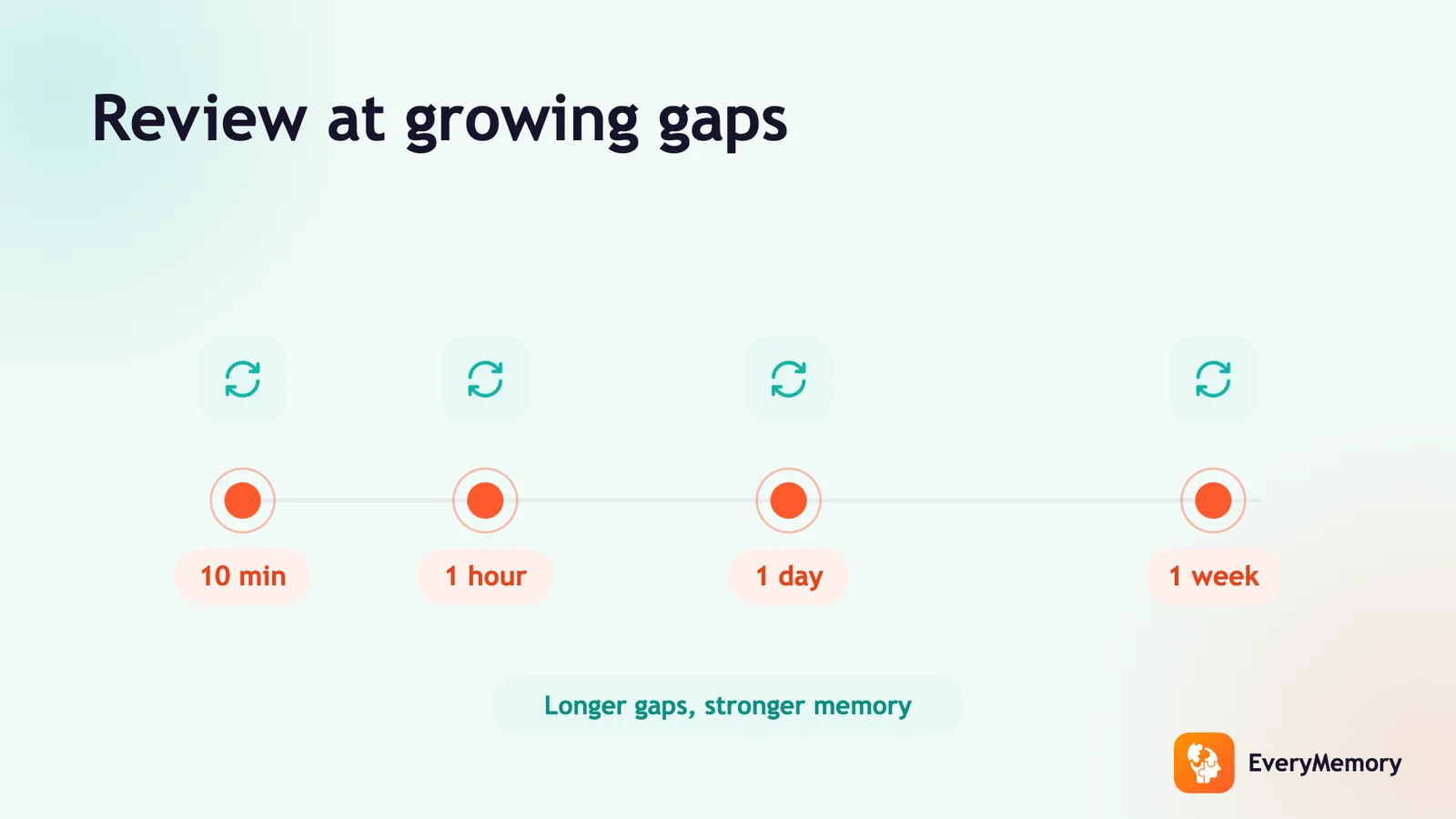
- Review once more after a gap. Ten to fifteen minutes later, run through the labels again. This brief spaced review locks the chunks in place.
This method works for grocery lists, to-do lists, names, steps in a process, and almost any other kind of information you need to hold for more than a few minutes.
Worked example: a ten-item errand list
Suppose you need to remember: post office, dry cleaner, bank, pharmacy, dentist call, milk, bread, eggs, thank-you card, library book return.
Step one - spot the categories: errands out (post office, dry cleaner, bank, pharmacy), food shopping (milk, bread, eggs), admin tasks (dentist call, thank-you card, library book return).
Step two - label the chunks: "errands", "shopping", "admin".
Step three - rehearse: errands (four stops), shopping (three items), admin (three tasks).
You are now holding three items instead of ten. At the bank, the "errands" label reminds you the dry cleaner and post office are also on this pass. In the supermarket, "shopping" unpacks naturally.
For a more complete practice routine, the short-term memory exercises for beginners include chunking drills you can run in under ten minutes.
Where chunking works and where it has limits
Chunking is one of the most versatile memory techniques, but it works best when the information has some natural structure to group by. It is excellent for:
- Shopping and errand lists
- Medication or supplement schedules
- Step-by-step processes
- Numbers and codes
- Key points in a conversation you want to remember
It is less helpful for random, structureless information that genuinely has no logical groupings. In that case, combining chunking with an associative technique like the ones described in memory association gives better results - create a story or visual link to connect the chunks.
It is also worth noting that chunking becomes easier when you are rested and not rushing. Fatigue and distraction shrink working memory capacity, which means the chunks themselves are harder to hold. Short regular breaks and decent sleep do more for working memory than any technique can compensate for.
Building chunking into daily life
The most effective way to use chunking is to make it a default habit rather than an occasional trick. A few simple practices help:
- Before leaving the house, mentally rehearse the day's tasks by group, not item by item.
- When someone gives you verbal information - directions, a list of things to pick up - pause and chunk it silently before confirming. "So that's three things about the left turn, two things about parking - got it."
- Use natural category words as memory anchors. "Health" holds all the medical tasks. "Home" holds all the household jobs.
- Pair chunking with a simple daily memory routine to make the practice consistent without adding much time to your day.
Over a few weeks of deliberate use, chunking shifts from something you have to consciously do to something your brain does automatically whenever new information arrives. That is when it becomes genuinely useful.
✅ Try this today - Chunk tomorrow's to-do list
Tonight before bed, try this:
- Write down everything you need to do or remember tomorrow - don't filter, just list.
- Read through the list and circle items that belong together. Aim for two to four groups.
- Write a one-word or two-word label for each group.
- Close the notebook. Say the group labels to yourself. Then say the items in each group from memory.
- Tomorrow morning, recall the labels first, then unpack the items. Notice how much easier it is than trying to hold the full list.