 EveryMemory
Working Memory Games
Working memory games train your brain's mental scratchpad - holding and juggling information for a few seconds. Here are the mechanics that actually work and what to honestly expect.
Part of the guide: Brain Exercises for Seniors: The Complete Guide →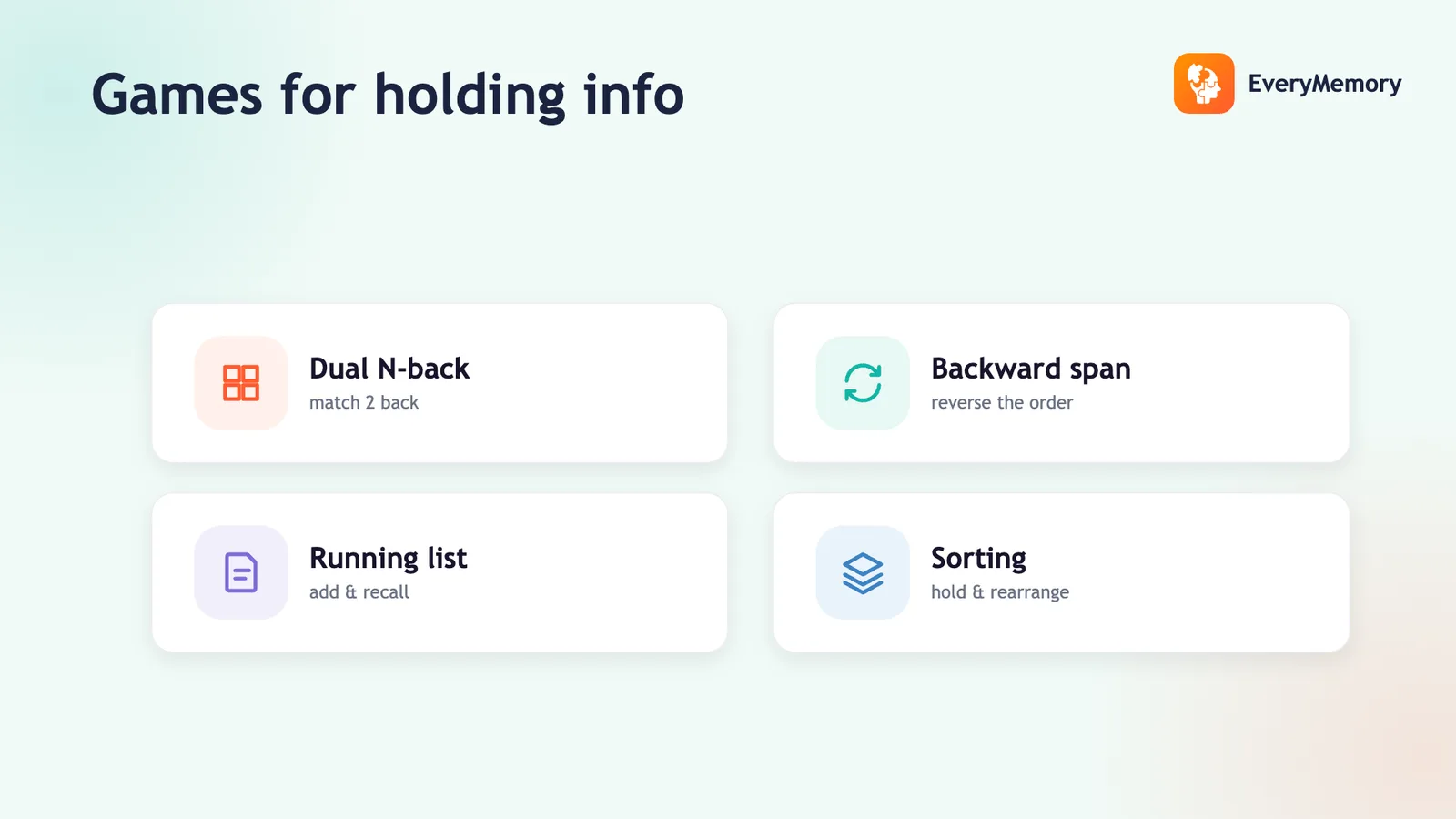
⚡ Quick answer
Working memory games train your brain's short-term workspace - the ability to hold and manipulate information for a few seconds. The most effective mechanics are n-back, backward digit span, and dual tasks, which force you to update or rearrange what you're holding. Expect to get better at those tasks; broad IQ gains are not realistic.
Key takeaways
- Working memory is holding AND manipulating info, not just storing it
- N-back, backward span, and dual tasks are the mechanics that load it
- You improve at the games and close cousins - not your IQ
- Short, frequent, varied sessions beat occasional marathons
Working memory is the small, busy workspace you use to hold a few pieces of information in mind and do something with them - keeping a phone number alive while you find a pen, following multi-step directions, or holding the start of a sentence while you finish reading it. It's limited, it fades in seconds, and it does a lot of quiet work.
Working memory games target that exact workspace. The good ones don't just ask you to memorise - they force you to hold something and manipulate it at the same time, which is the load that defines working memory. The trick is choosing games built on the right mechanics and being honest about what they'll change.
What working memory actually is
Working memory is more than short-term storage. Storage is holding a list still; working memory is holding it and working on it - reversing it, updating it, ignoring part of it. That manipulation is the whole point, and it's why simply re-reading a list isn't really working-memory training.
If the storage-versus-manipulation distinction is fuzzy, working memory vs short-term memory lays it out clearly. To see roughly where you stand right now, a quick working memory test gives you a baseline to compare against later.
The mechanics that actually train it
Not every "memory game" loads working memory. These mechanics do, because each one demands holding plus manipulating:
- N-back - watch a stream and respond when the current item matches the one N steps back, constantly updating what you hold. See what is the n-back task.
- Backward span - repeat a sequence in reverse, which forces you to manipulate, not just store.
- Dual tasks - track two streams at once, splitting and protecting limited capacity.
- Running memory - recall only the last few items of an unpredictably long list, so you keep dropping and replacing.
The common thread is updating under pressure. If a game lets you sit still and rehearse, it's exercising storage, not the live juggling that defines working memory.
Game versus everyday benefit
| Game mechanic | What it trains | Everyday version |
|---|---|---|
| N-back | Continuous updating | Following a fast conversation without losing the thread |
| Backward span | Mental rearranging | Repeating a postcode back in order to confirm it |
| Dual task | Splitting attention | Cooking while tracking a timer and a child |
| Running memory | Drop-and-replace | Holding the last few turns of directions while driving |
These everyday versions are where the skill shows up - but the honest caveat is that practice transfers narrowly. Getting good at n-back makes you good at n-back and similar holding-and-updating tasks; it doesn't reliably spill into unrelated abilities.
What to honestly expect
You will improve at the games you practise, often quickly, and at closely related tasks that share the same demand. That near-transfer is real and worth having. What the evidence does not support is the bigger promise - that training working memory makes you broadly smarter or raises your IQ. The honest summary lives in do brain games really work.
So treat working memory games as targeted practice for a specific, useful skill, not a shortcut to general intelligence. Short, frequent sessions beat occasional marathons, and variety keeps you from simply memorising one game's quirks. For a broader menu, the brain training games list shows how working memory drills sit alongside other skills.
✅ Try this today - A 2-minute backward-span drill
Backward span is one of the purest working-memory loads - no app required.
- Read a random 4-digit number once, then look away and say it backward.
- If that's easy, add a digit; keep going until you slip twice in a row.
- Note the longest length you can reliably reverse - that's your span today.
- Try again tomorrow at the same time of day and watch your own trend.
- Mix in letters or short words to keep the drill from going stale.