 EveryMemory
Are Brain Games Worth It?
Are brain games worth it? Honestly, yes for skill practice and habit, no for IQ or decline-prevention promises. Here's a balanced verdict and how to tell which apps deliver.
Part of the guide: How to Keep Your Brain Healthy: A Complete Lifestyle Guide →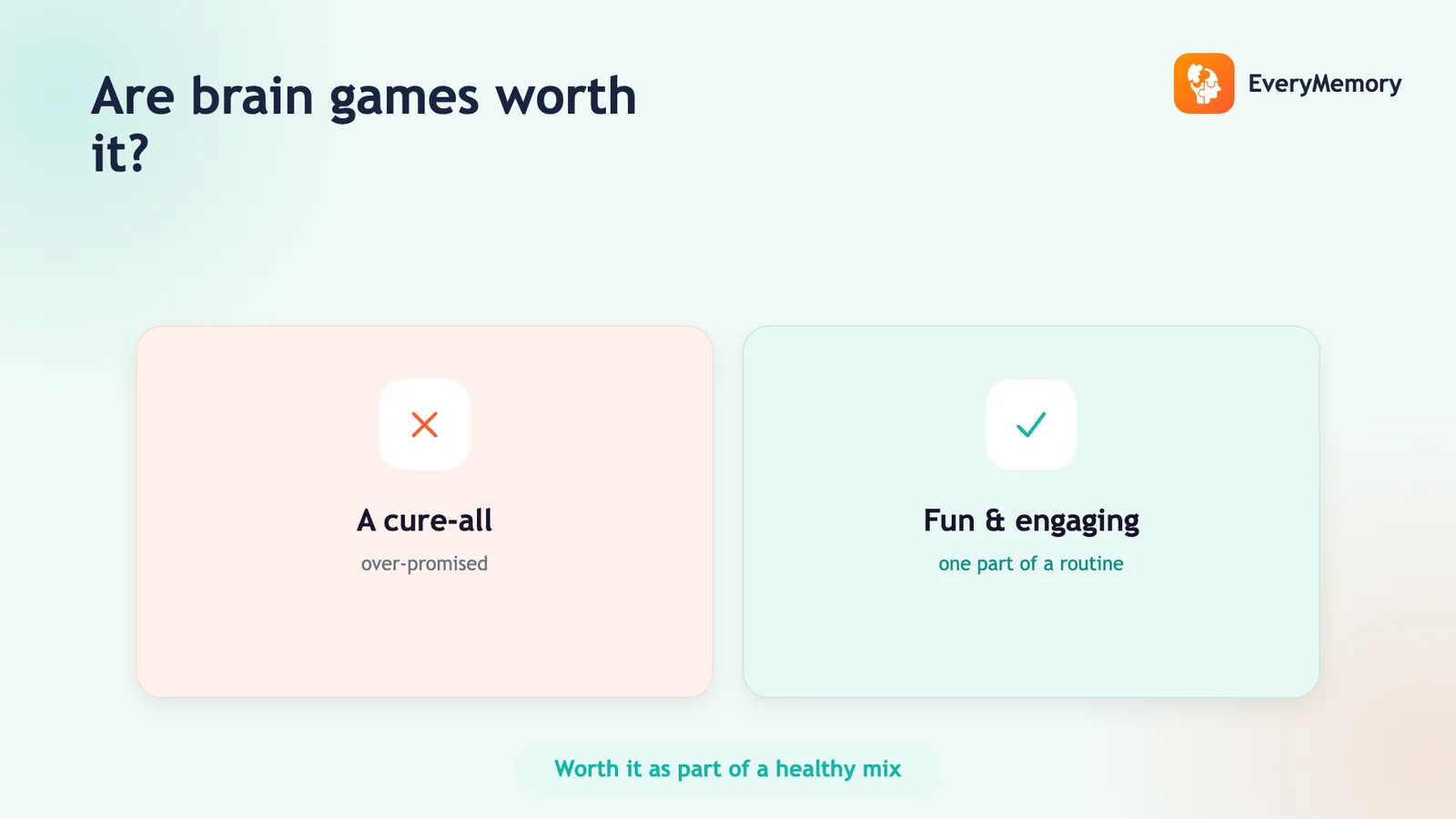
⚡ Quick answer
Brain games are worth it for enjoyable practice of specific skills and for building a steady mental habit - both well supported. They're not worth it if you expect a higher IQ, broad 'smarter overall' gains, or protection against decline; those claims outrun the evidence. Judge value by the trained-skill benefit and the habit, not the marketing.
Key takeaways
- Worth it for trained-skill practice and a steady habit - both well supported.
- Not worth it for IQ gains or decline prevention; those claims outrun the evidence.
- Fake percentiles, brain-age and medical claims are the clearest signs to skip an app.
- Set realistic expectations; EveryMemory delivers on honest terms, free to start.
'Are brain games worth it?' deserves an honest answer rather than a sales pitch in either direction. They're neither the miracle the flashiest apps imply nor the pure waste the cynics claim. The truth sits in the middle, and which side you land on depends entirely on what you expect from them.
This is a balanced verdict: where brain games genuinely earn their place, where the popular promises fall apart, and how to tell an app that delivers honest value from one selling a story. No fabricated stats, no hype - just what the evidence and common sense support.
The honest verdict at a glance
Split the question by goal and the answer becomes clear.
| If your goal is... | Worth it? | Why |
|---|---|---|
| Practising a specific skill | Yes | Reliable improvement on trained tasks |
| Building a daily mental habit | Yes | Structure and enjoyment keep you consistent |
| Raising your IQ | No | Broad transfer is weak and short-lived |
| Preventing cognitive decline | No | Not supported; a medical matter, not an app's |
| A fun, low-stakes challenge | Yes | Genuinely engaging on its own terms |
For the research detail behind this, see do brain games really work and are brain training apps worth it.
Where brain games genuinely earn their place
Two benefits are solid. First, the trained-skill effect: practise a memory or speed game and you reliably get better at it and closely related tasks. That improvement is real, even if it's narrower than the ads suggest. Second, habit and engagement: a structured, enjoyable daily challenge is a low-cost way to spend a few minutes mindfully, and consistency is where any benefit lives.
Add the motivational value of watching your own progress, and you've got a defensible case for brain games - provided your expectations are set at the right level.
Where the promises fall apart
The popular claims that don't hold up all share a pattern: they promise broad transfer from a narrow activity. 'Raise your IQ', 'become smarter overall', 'prevent decline' - each leaps from 'better at the game' to a sweeping life benefit the evidence doesn't back.
Worse, some apps wrap these promises in fake percentiles, brain-age scores or implied medical claims to make them feel authoritative. Those are the clearest signals an app isn't worth your money. Cognitive decline in particular is a medical matter, not something an app can address. The more grandiose the promise, the more sceptical you should be.
How to get your money's worth
If you go in for the honest benefits, here's how to maximise them.
- Set realistic expectations: trained-skill gains plus a good habit, not a brain upgrade.
- Pick an app with adaptive difficulty so practice stays effective.
- Choose self-relative tracking - your trend, not a fake percentile.
- Avoid apps making IQ, brain-age or decline-prevention claims.
- Try it free first, and only pay if you'll use it regularly.
EveryMemory is built around exactly these honest principles - adaptive games, self-relative tracking, no fake percentiles or medical claims - and it's free to start, so you can decide if it's worth it on your own terms.


