 EveryMemory
Attention Span: What It Is and How to Improve It
There's no single 'normal' attention span, and the famous 8-second claim is a myth. What attention span really is, why it feels shorter now, and how to lengthen it.
Part of the guide: Brain Exercises for Seniors: The Complete Guide →
⚡ Quick answer
Your attention span is how long you can stay focused on one thing before your mind drifts. There's no single 'normal' number - it depends on the task, your interest, your sleep, and how many distractions are nearby. It feels shorter today mostly because of constant interruptions, not because something is wrong. You lengthen it by removing distractions and practising single-tasking.
Key takeaways
- Attention span is how long you can sustain focus on one task - there's no single 'normal' number; it depends on task, interest, sleep and distractions.
- The '8-second attention span, shorter than a goldfish' claim is a myth from a marketing report with no credible source.
- Focus feels shorter today mainly because of constant interruptions and task-switching, not a broken brain.
- Lengthen it by removing distractions (not resisting them), single-tasking in short timed blocks, and protecting sleep.
People worry that their attention span is shrinking - that they can't focus the way they used to. Usually the problem isn't a shorter attention span at all; it's an environment engineered to interrupt you every few minutes.
Here's what attention span actually is, why the numbers you've heard are mostly made up, and the changes that genuinely lengthen it.
What attention span actually means
Attention span usually refers to sustained attention - how long you can keep focus on a single task without your mind wandering off. It's not one fixed setting. The same person can lose focus after two minutes of a dull form and stay locked in for an hour on something absorbing.
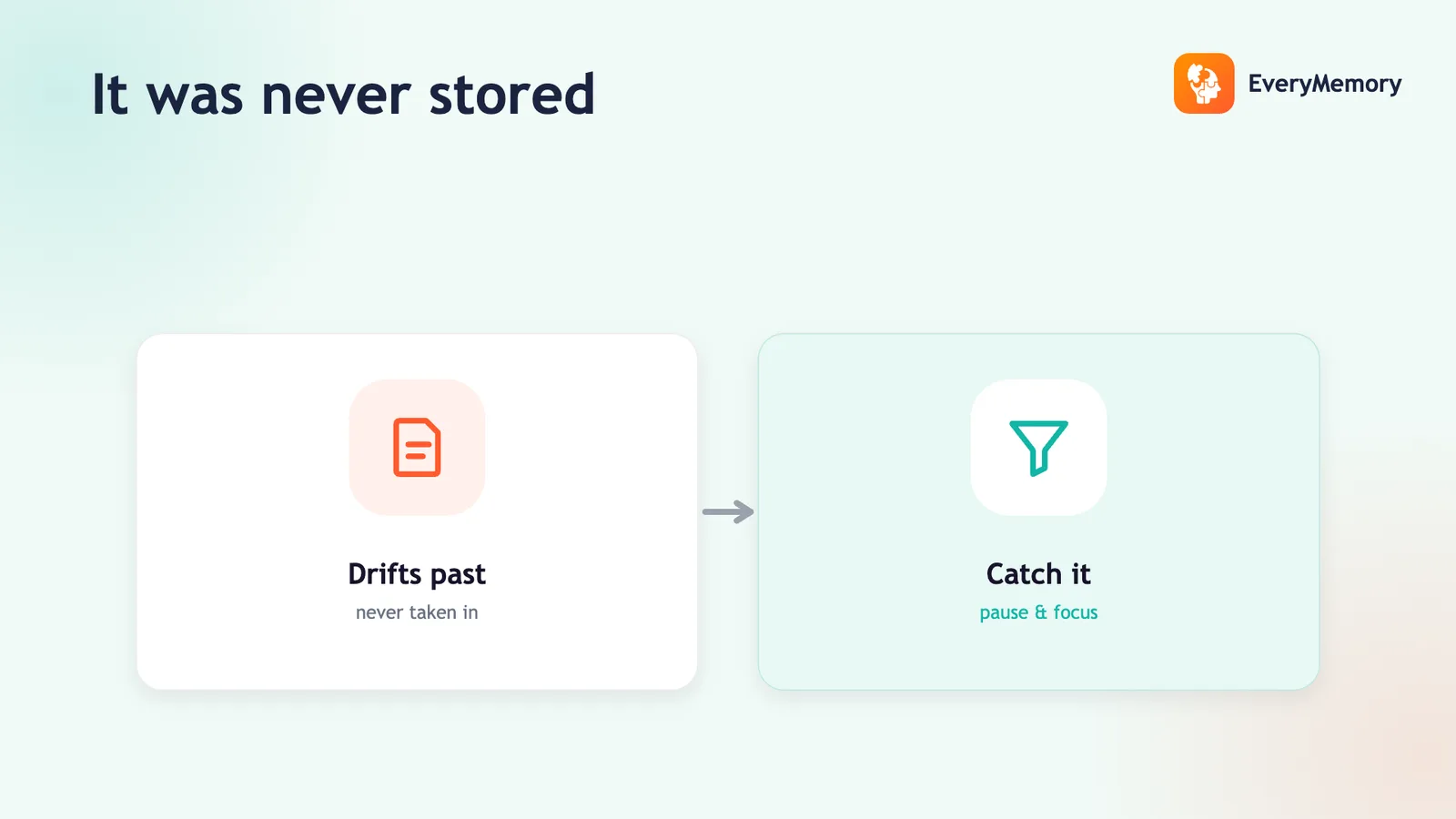
Attention is also the gateway to memory: if you don't attend to something, it never encodes. That's why poor focus and poor memory so often arrive together - see why you forget things so quickly.
Is there a 'normal' attention span?
You've probably read that the human attention span has fallen to eight seconds - shorter than a goldfish. It's a myth. The claim traces back to a marketing report with no solid source, and attention simply doesn't work as one fixed number. Sustained attention varies enormously by task, motivation, age, sleep, and setting.
So "what's a normal attention span?" doesn't have a clean answer - and chasing one isn't useful. What's useful is noticing the conditions under which your focus holds or breaks.
Why focus feels shorter now
If concentration feels harder than it used to, the usual culprits aren't medical:
- Constant interruptions - notifications and pings train you to break focus every few minutes.
- Task-switching cost - every switch leaves 'attention residue' on the last task, so you never fully arrive at the new one.
- Always-available novelty - a phone offers an easier hit than the task in front of you, so you reach for it at the first dull moment.
- Tiredness and stress - both shrink the mental resources focus depends on.
None of these means your brain is broken. They mean your environment is working against you - which you can change.
How to lengthen your attention span
- Remove the distractions, don't resist them. Phone in another room, notifications off, one tab. Willpower loses to a buzzing phone; distance wins.
- Single-task on purpose. Pick one thing and let it be the only thing. Multitasking is really fast switching, and it shortens effective focus.
- Work in timed blocks. Set 15–25 minutes of focus, then a real break. Short, protected blocks beat vague all-day intentions.
- Let your mind settle. Focus doesn't snap on instantly; give a task a few minutes before deciding it's boring.
- Protect sleep. Sustained attention is one of the first things to suffer when you're underslept.
Building focus is itself trainable - the focus and attention workout turns it into a short daily practice.
When poor focus is worth a closer look
Everyday focus that wanders on tired or busy days is normal. It's reasonable to speak with a qualified professional if concentration changes noticeably and persistently, starts to disrupt work or daily life, or appears suddenly alongside other changes - rather than assuming it's just 'a short attention span'.
✅ Try this today - a 10-minute focus block
Prove that your attention span stretches when the room does:
- Put your phone in another room and close everything but one task.
- Set a timer for 10 minutes and work on only that.
- When your mind drifts, note it and return - drifting is normal, returning is the rep.
- Take a short break, then notice how much further you got than in a distracted hour.