 EveryMemory
Focus and Attention Brain Workout
Practical attention drills you can do in ten minutes a day to sharpen focus, reduce distractibility, and support everyday memory - with clear steps and a habit plan.
Part of the guide: Brain Exercises for Seniors: The Complete Guide →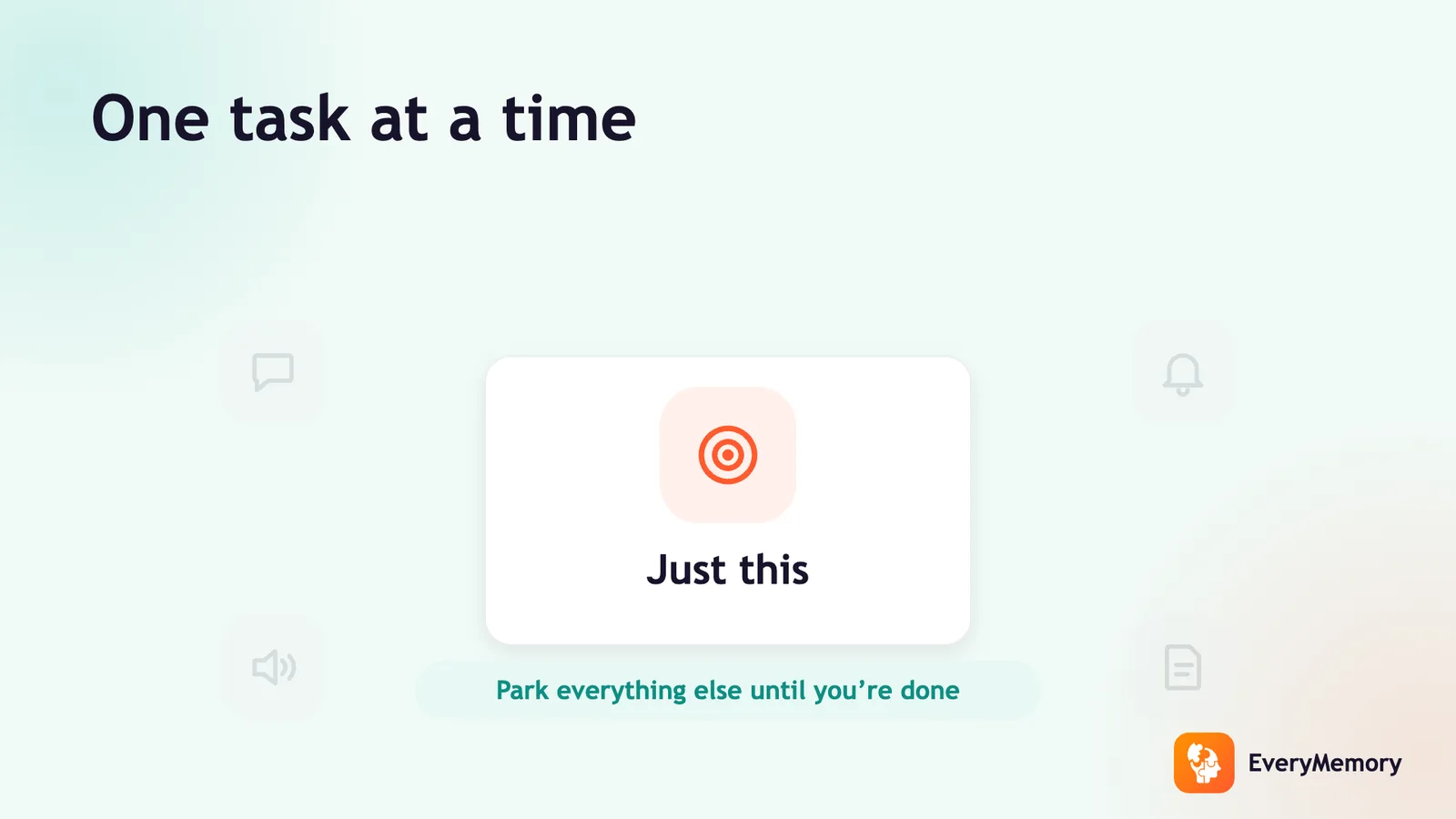
⚡ Quick answer
A focus and attention brain workout is a short daily practice of drills that challenge you to hold concentration, switch attention deliberately, and resist distractions. These exercises train the same cognitive control that makes everyday tasks easier - following a conversation, remembering what someone just said, and staying on track with a complex task. Ten consistent minutes a day produces noticeable improvement within two to three weeks.
Key takeaways
- Most everyday forgetting is a failure to encode, not a failure to retrieve - sharpening attention is one of the most direct routes to better recall.
- Three ten-minute drills cover the main attention skills: sustained focus, selective attention, and controlled divided attention.
- Noticing when your mind wanders and gently returning - not avoiding the drift - is the core exercise in the sustained-attention drill.
- Small real-life habits, like saying aloud where you put something, apply the same focused-encoding skill outside of formal drills.
Memory and attention are more closely linked than most people realise. Most of what we call "forgetting" is actually a failure to encode in the first place - the information never made it into storage because something else had our attention at that moment. Sharpening focus, then, is one of the most direct routes to a better everyday memory.
A focus and attention brain workout is a short set of deliberate mental exercises that train your brain to stay on a single task, resist distraction, and process information quickly under mild pressure. Done for ten minutes a day, these drills make a measurable difference in how well you absorb new information, follow conversations, and stay present in complex situations. No apps, no special materials - just a few minutes and some structured effort.
Why attention is the foundation of memory
Think of attention as a gate. For any piece of information to reach short-term memory - and from there, long-term memory - it first has to pass through that gate. If your attention is split across three things at once, the gate is half-closed. Details slip through without being stored, and later you search for a memory that was never fully formed.
This is why doing too many things at once reliably produces the feeling of a poor memory. It is not that your memory is failing; it is that divided attention prevents encoding from happening in the first place. Training attention means practising keeping that gate open and under your deliberate control.
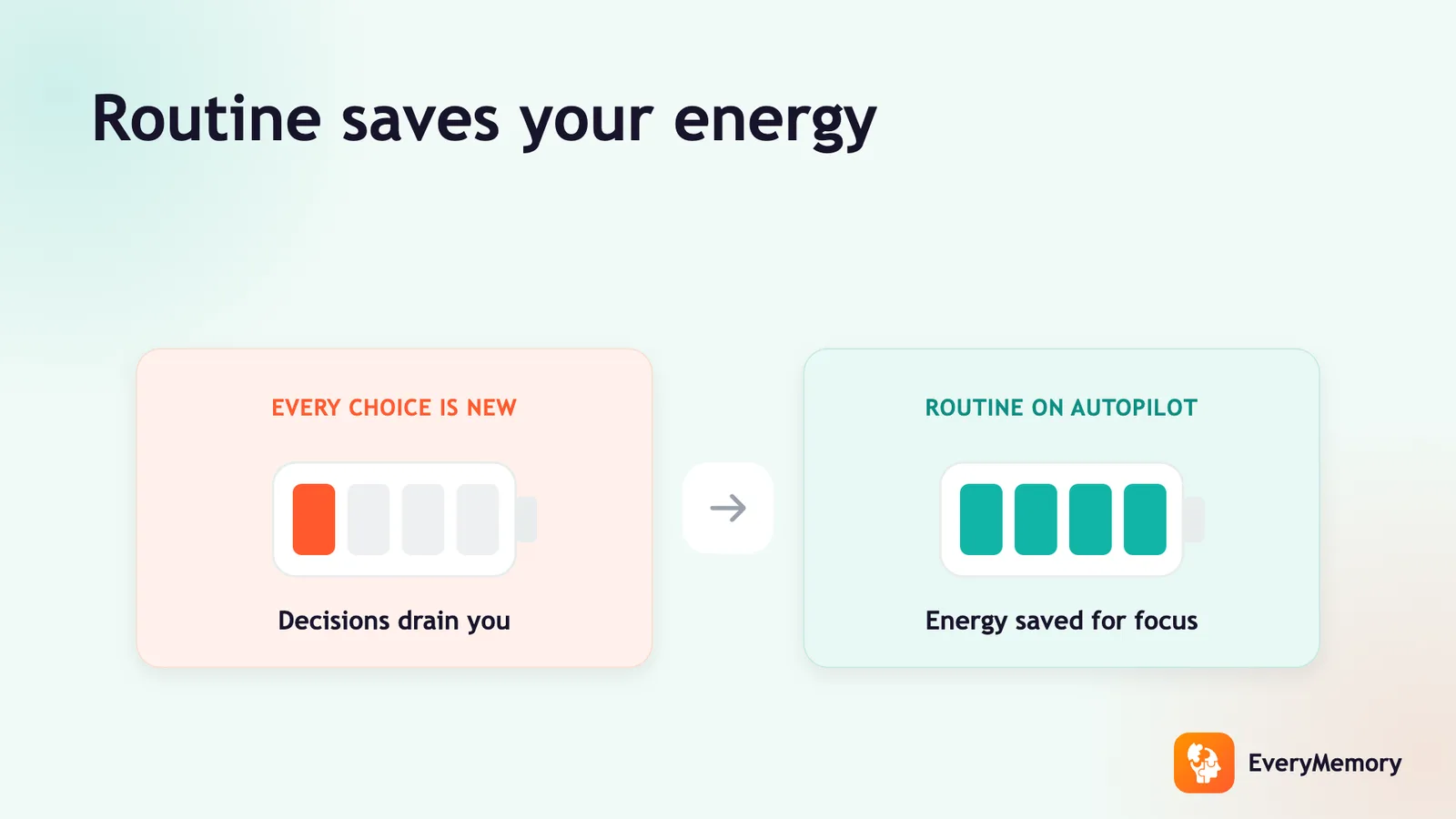
The connection between attention and memory also means that routine matters enormously for focus: a predictable daily structure reduces the background cognitive load that eats into your available attention before the day has really begun.
Three drills that build real focus
These three exercises can be done in sequence for a ten-minute workout, or individually on days when time is short. Each targets a slightly different aspect of attention.
- Sustained attention: the ticking clock. Set a timer for three minutes. Fix your gaze on a single point - a mark on the wall, the second hand of a clock - and keep your attention there for the full three minutes. Each time your mind wanders and you notice it, bring it back without frustration. Count the number of times you redirect. Over days, the count usually falls.
- Selective attention: the text scan. Open any book or newspaper to a full page of text. Set a timer for two minutes. Scan the page and circle, tap, or count every instance of a single letter - say, the letter "e." Speed and accuracy both matter. Score yourself by how many you found versus how many existed. This mimics the kind of selective attention required when following a fast-paced conversation.
- Divided attention under control: the counting tap. Count slowly to twenty in your head while simultaneously tapping a steady, quiet rhythm with one finger on a table. The goal is to maintain both tasks without one disrupting the other. This sounds trivial but is harder than it seems, and it trains the cognitive resource-sharing that everyday multitasking actually requires.
How to make each drill easier or harder
The right level of challenge is the one where you feel mild effort but not discouragement. Adjust each drill to match where you are today.
- Sustained attention - easier: Reduce the timer to ninety seconds. Harder: extend to five minutes, or try keeping attention on your breath rather than a visual point, which removes the external anchor.
- Selective attention - easier: Scan for a very common letter like "t" on a large-print page. Harder: scan for two different letters alternately, switching between them every thirty seconds.
- Divided attention - easier: Count only to ten. Harder: count to thirty, or replace the counting with reciting the months of the year forwards while tapping a rhythm.
Once these three feel comfortable, the pattern memory exercise is a natural next step - it adds a visual component to attentional challenge and begins to overlap with short-term memory training proper.
If you are building a broader programme, these drills fit neatly into the daily brain training routine, which rotates attention, visual, and verbal exercises across the week.
Attention and everyday life: what to notice
Beyond timed drills, there are low-effort ways to train attention in the flow of a normal day. The goal is to catch yourself on autopilot and bring deliberate focus back, even for a moment.
- When someone is speaking to you, make a deliberate choice to listen only - no glancing at your phone, no planning your reply. After they finish, summarise the key point silently. This is one of the most effective real-world attention exercises.
- When you put something down, say out loud where you are putting it. "Keys on the hook by the door." This forces brief, deliberate attention at the exact moment encoding needs to happen.
- During any routine task - washing dishes, folding laundry - try to do it as the only thing you are doing. No radio, no inner planning. Notice the sensory details. This is a gentle mindfulness practice and a direct attention drill in one.
Poor focus is often worsened by things outside the drills. Too little sleep, dehydration, and high stress all measurably reduce attentional capacity - see our pieces on sleep and memory and hydration and focus in older adults.
Tracking progress and staying consistent
Track three numbers: the redirect count for the sustained drill (falling over days), accuracy for the text scan, and the furthest point you reach before one task disrupts the other. The weekly memory check-in template has a section for attention observations so you can watch focus and memory improve together.
Attach the ten-minute workout to a fixed daily moment - after morning coffee, before lunch, or before your evening wind-down. Once routine, it costs almost no willpower to maintain. For a complete beginner programme combining attention, recall, and visual training from day one, the 7-day memory training plan for beginners is a practical place to start.
✅ Try this today - The two-minute letter scan
Try this right now with any printed page or screen text:
- Open any book, newspaper, or printed document to a full page of text. Set a timer for two minutes.
- Scan the page as quickly as you can and count every time you see the letter "s" - uppercase or lowercase. Tap your finger or use a tally mark for each one. Try to be both fast and accurate.
- When the timer goes off, note your count. Tomorrow, use a fresh page and the same letter and see whether your count is closer to the true total. Over a week, your speed and accuracy will both improve.