 EveryMemory
Auditory Memory Test: How It Works
An auditory memory test plays a sequence of sounds, words, or tones you hear once and repeat - measuring how well you hold information that arrives through your ears.
Part of the guide: Understanding Memory Loss and Forgetfulness: A Calm, Reassuring Guide →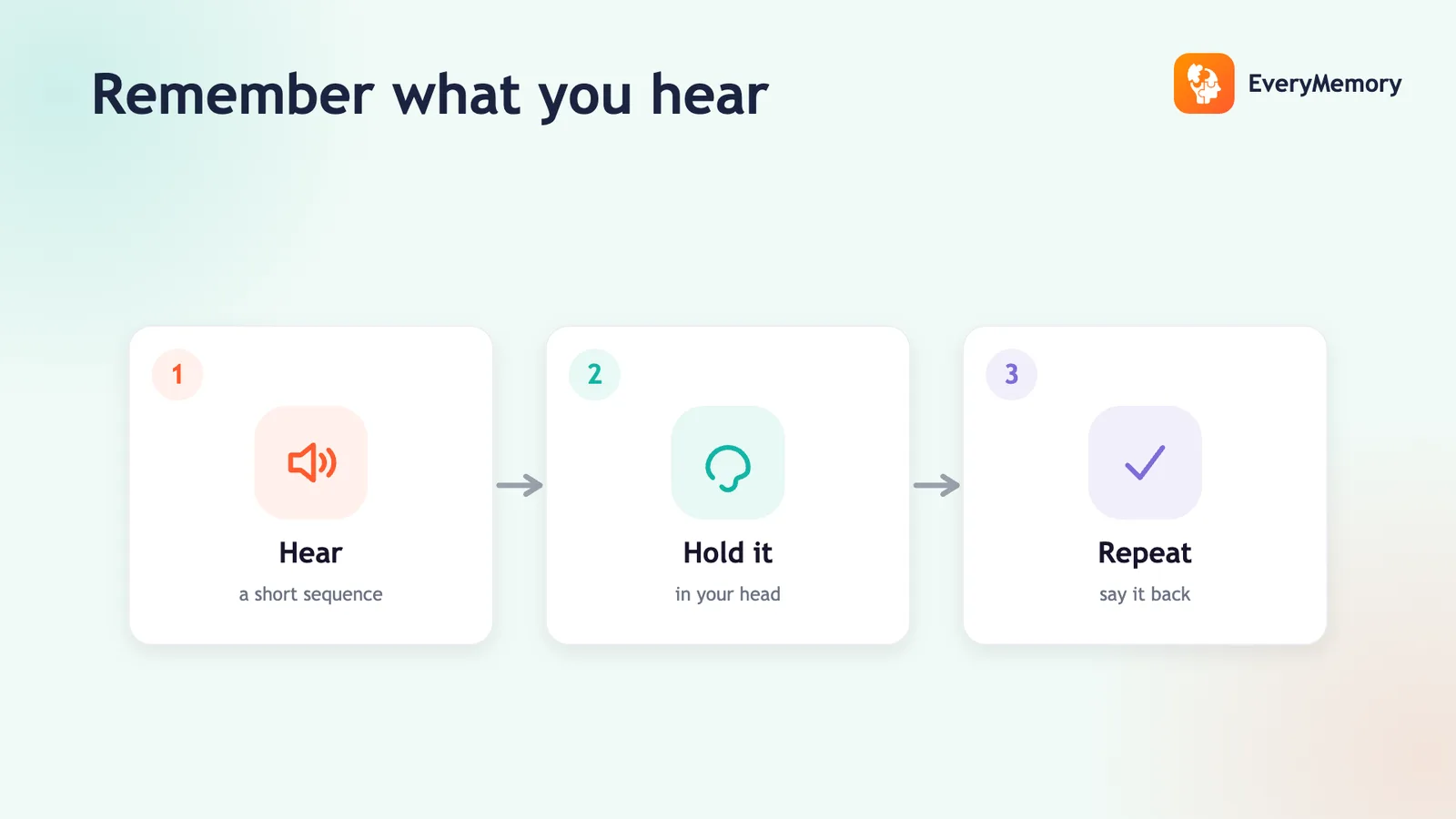
⚡ Quick answer
An auditory memory test plays a sequence of sounds, words, or digits that you hear once and then repeat back, usually in order. It measures auditory short-term and working memory - how well you hold and reproduce information delivered through hearing. It's a non-medical self-check, not a hearing test or a diagnosis.
Key takeaways
- Plays sounds, words, or digits you hear once and repeat - testing the ear-based channel.
- Sound is fleeting, so it leans on a brief echoic store and active rehearsal.
- Noise, volume, accents, and hearing itself confound the score - test in a quiet room.
- It's a memory self-check, not a hearing test or a diagnosis.
An auditory memory test delivers its material through your ears instead of your eyes. It might play a string of spoken digits, a list of words, or a rising sequence of tones, and ask you to repeat them back in order. Because sound is fleeting - it's gone the instant it's spoken - these tasks lean heavily on how well you can hold what you just heard before it fades.
That channel matters more than it sounds. A lot of everyday memory is auditory: a phone number read aloud, directions, a name at an introduction. Testing memory through hearing isolates that route and shows how well you retain information you can't go back and re-read.
How it differs from visual tests
Visual memory tests let you scan an image and, in a sense, hold a picture. Auditory tests don't give you that - sound arrives one moment at a time and disappears, so you rely on a brief 'echoic' store and on rehearsing what you heard. This is why a list read aloud feels different to remember than the same list seen on screen.
The two channels overlap but aren't identical, which is why a fuller self-check samples both. See visual memory test for the eyes-based counterpart and how the results can differ.
What auditory memory tests measure
Most tap auditory short-term memory - holding a short sequence briefly - and, in harder versions, working memory, where you manipulate what you heard (repeating a list backward, say). Spoken digit span is the classic example; word-list recall and tone-sequence tasks are common variants.
| Task | What you hear | Mainly measures |
|---|---|---|
| Spoken digit span | A string of digits | Auditory short-term span |
| Word-list recall | A list of spoken words | Verbal memory and recall |
| Tone sequence | A rising pattern of tones | Non-verbal auditory order |
What can throw the result off
Auditory tests are sensitive to the listening environment in a way visual ones aren't. Background noise, low volume, an unfamiliar accent, or muffled audio all add difficulty that has nothing to do with your memory. A poor score in a noisy room mostly reflects the room.
Hearing itself is a confound too: if a sound never lands clearly, no amount of memory can recover it. That's one more reason these are casual self-checks, not assessments - and not a substitute for a real hearing test. See types of memory tests for context.
Reading your score honestly
Test in a quiet space, at a comfortable volume, and run a few trials - order effects and a single mishearing can swing the result. Then compare your own performance over time, under similar conditions, rather than to anyone else.
Auditory memory is one window, not the whole view. Pairing it with a visual or working-memory check gives a rounder picture - see working memory test.
✅ Try this today - A DIY spoken-list check
All you need is a friend and a quiet room.
- Have someone read you a list of seven unrelated words, one per second.
- Wait five seconds, then recall as many as you can in any order.
- Note how many you got; most people land around five to seven.
- Try it again in a noisy room and watch the count drop - that's the environment, not your memory.
⚠ When to talk to a professional
An auditory memory test is a fun, non-medical self-check, not a hearing test or a diagnostic tool. A low score may reflect noise or hearing rather than memory - if you're concerned about either, speak with a qualified professional.