 EveryMemory
Best Memory Test Apps: What to Look For
The best memory test apps share a few honest traits: clear tasks, self-relative scoring, no fake percentiles and no medical claims. Here's the checklist to judge them by.
Part of the guide: How to Keep Your Brain Healthy: A Complete Lifestyle Guide →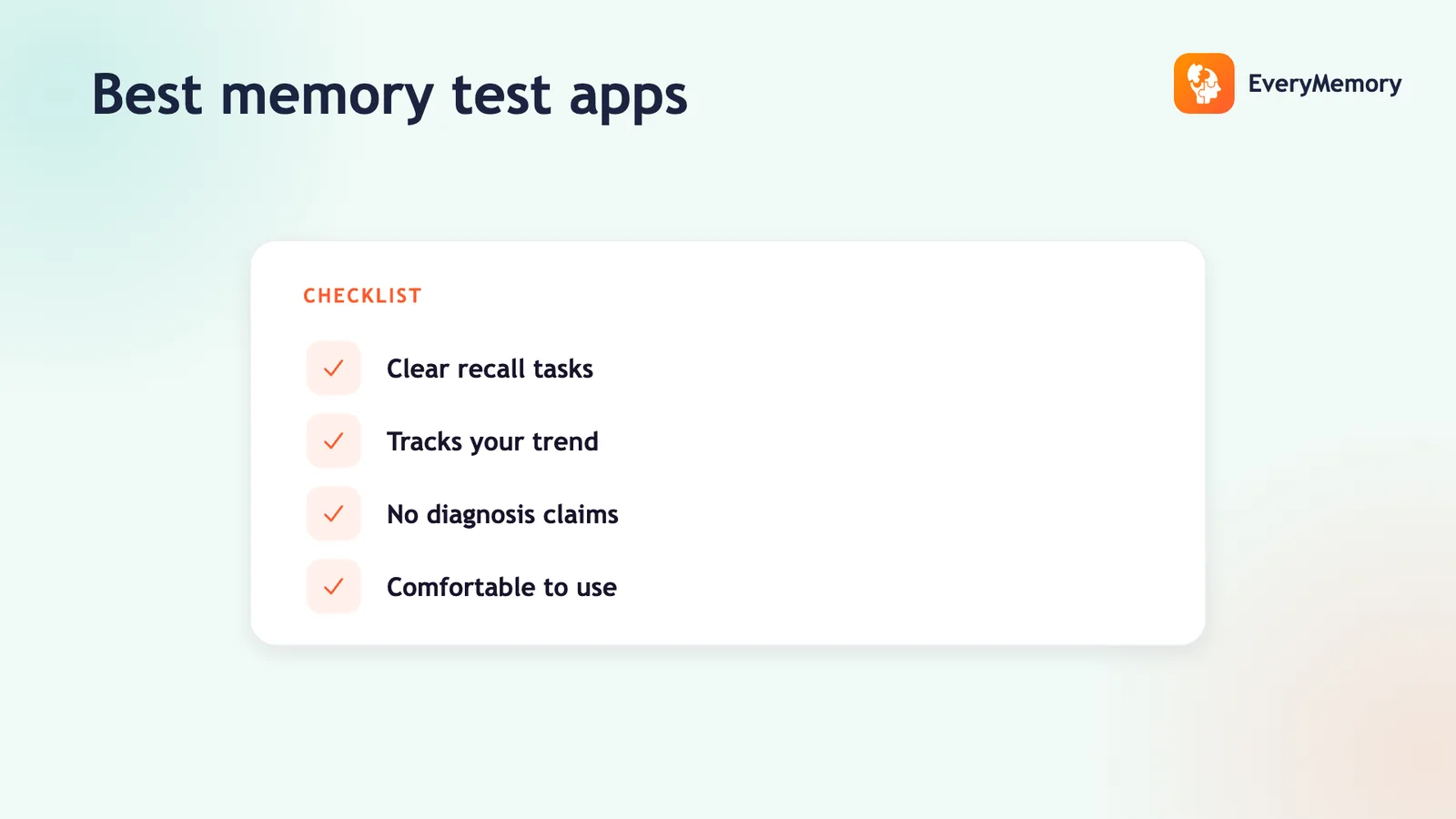
⚡ Quick answer
The best memory test apps use clear, repeatable tasks (recall, pattern and sequence memory), score you against your own past results rather than fake percentiles, and stay explicitly non-medical - no 'brain age', no diagnosis. They're free to try, so you can check the tasks make sense before committing.
Key takeaways
- Best apps use clear repeatable tasks and self-relative scoring, not fake percentiles.
- No phone test can diagnose - 'brain age' framing is a red flag.
- Take it more than once and watch your own trend across weeks.
- EveryMemory scores you against your own baseline; non-medical, free to start.
Search for a memory test app and you'll find everything from genuinely useful self-checks to anxiety-bait that flashes a 'brain age' and a sales page. The format is so easy to fake that the quality varies more here than almost anywhere in the brain-game world, which makes knowing what to look for essential.
This guide deliberately avoids ranking named apps with invented scores. Instead it gives you the criteria that distinguish an honest memory test from a gimmick, plus how to read your own results without reading too much into them.
The criteria checklist
Run any candidate through this. The apps worth your time tick the left column; the ones to skip lean on the right.
| Criterion | Good memory test app | Skip it |
|---|---|---|
| Tasks | Clear, repeatable recall tasks | Vague, unexplained mini-games |
| Scoring | Versus your own baseline | Fake global percentile |
| Framing | Explicitly non-medical | 'Brain age' / diagnosis vibe |
| Repeatability | Re-take and track a trend | One dramatic result, then upsell |
| Access | Free to try | Paywall before any result |
For a browser version of the same idea, see memory test online, and compare the field with best memory game apps.
What a memory test can and can't tell you
An app can give you a useful, self-relative snapshot: how well you held a sequence today versus last week, whether your recall feels sharper after a good night's sleep. That trend is genuinely informative and motivating.
What it can't do is diagnose anything. No phone test can tell you whether a memory change is meaningful clinically - that's a conversation for a professional. The honest apps say so plainly. If an app implies it can detect decline or 'brain age', that overreach is itself the red flag.
Why self-relative beats percentiles
Percentiles compare you to a crowd taking the test under unknown conditions on unknown devices - noisy, self-selected and often meaningless. A single number like 'top 12%' feels precise but carries little real signal.
Self-relative scoring sidesteps all of that. By measuring you against your own previous attempts, a good app gives you a clean read on your direction of travel, which is the only comparison that's both fair and useful. It also removes the discouragement of being ranked against strangers.
How to take a memory test well
The result is only as good as the conditions. A few habits make your trend line trustworthy.
- Test at a consistent time of day, ideally when rested.
- Remove distractions - quiet room, notifications off.
- Take it more than once before drawing conclusions; single scores are noisy.
- Watch the trend across weeks, not one dramatic result.
- Treat surprises as a prompt to talk to a professional, never as a diagnosis.


