 EveryMemory
Chess and the Brain
Chess is a deep workout in planning and pattern recognition, and it's wonderfully absorbing. But the famous "chess makes you smarter" claim is shakier than it sounds - here's the honest version.
Part of the guide: How to Keep Your Brain Healthy: A Complete Lifestyle Guide →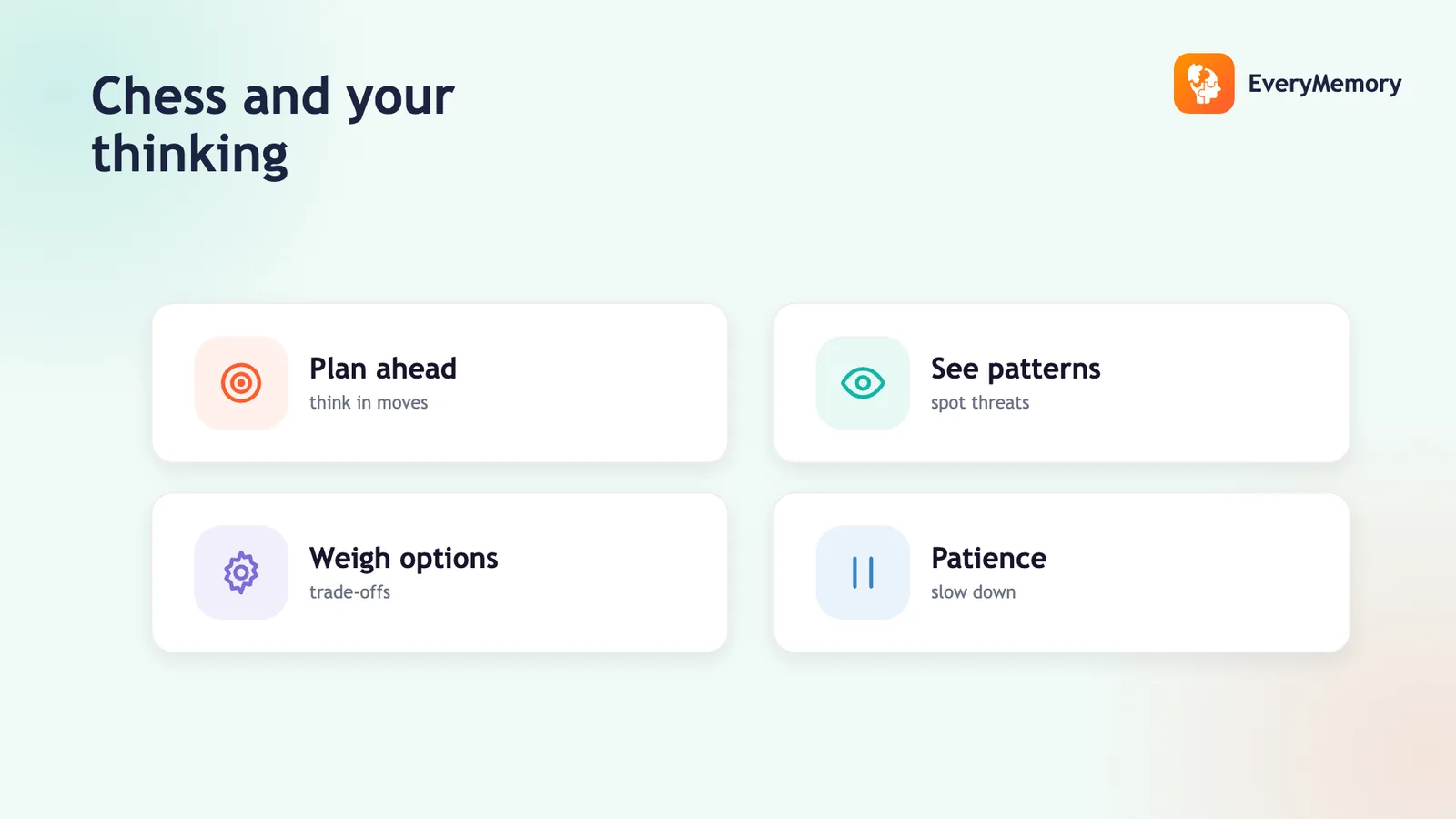
⚡ Quick answer
Chess is excellent mental engagement: it trains planning, pattern recognition, and thinking several moves ahead, and skilled players build a huge library of remembered positions. But research shows the broad "chess makes you smarter" effect is small and inconsistent - chess mostly makes you better at chess. Play it because it's deep and absorbing.
Key takeaways
- Deep workout in planning and pattern recognition
- 'Chess makes you smarter' effects are small and inconsistent
- Master memory is domain-bound, not a general superpower
- Wonderful hobby; train breadth alongside it
Chess carries an aura of pure intelligence. We picture the great players as minds running at a higher clock speed, and we assume that playing must make us smarter by association. It's an appealing story, and chess genuinely is one of the richest mental challenges a board can offer.
But the leap from "chess is demanding" to "chess upgrades your general intelligence" is exactly the kind of leap the evidence keeps refusing to make. So let's separate what chess unmistakably trains from what it's wrongly credited with.
What chess actually exercises
Chess is a planning machine. Every move forces you to imagine consequences, weigh trade-offs, and update a plan as your opponent fights back. Strong players don't calculate every line - they recognise patterns, structures they've seen thousands of times, and that recognition is a form of deep, domain-specific memory.
- Planning and foresight - projecting several moves and responses ahead.
- Pattern recognition - reading familiar structures at a glance.
- Working memory - holding candidate lines in mind while you compare them.
- Self-control - resisting the tempting move that loses to a quiet reply.
Those skills are real and demanding. For the underlying ability, how to improve problem solving skills unpacks the planning side.
The honest limit: "chess makes you smarter" is overstated
This is the claim worth handling carefully. Reviews of chess-in-schools studies - where kids are actually taught chess and measured - find the effects on general maths, reading, or intelligence are small, often inconsistent, and tend to shrink once you compare against an equally engaging alternative activity. Much of the apparent benefit may simply be the boost any motivating, structured pursuit provides.
And the famous chess memory feats are domain-bound: masters can reconstruct a real game position almost perfectly, but show them random pieces scattered illegally and their memory drops to ordinary. That's the signature of expertise, not a souped-up general brain. Chess builds a magnificent chess mind - which is a wonderful thing to have, just not a transferable superpower.
What chess can and can't claim
| The claim | The honest version |
|---|---|
| "Chess makes kids smarter." | Effects on general ability are small and often inconsistent. |
| "Masters have superhuman memory." | Only for legal positions - random ones reset them to average. |
| "Chess prevents decline." | It's great engagement; no evidence it prevents decline. |
| "It trains your whole brain." | Mainly planning and pattern skills, deeply but specifically. |
Again, none of this is a reason not to play. Chess is one of the most rewarding mental hobbies there is - the honesty is just about why.
How to get the most from chess
If you want chess to keep stretching you, study positions rather than only blitzing games, review your losses to find the pattern you missed, and play opponents who beat you a little. Real learning lives just past comfortable. And because chess trains one rich but narrow domain, pair it with other kinds of mental work so you're building breadth, not just depth.
That balance is the case for structured training alongside your hobby. See keep your brain active for how varied challenge beats deep repetition of a single game.
⚠ When to talk to a professional
This is general educational information, not medical advice, and chess is not a treatment for or protection against any condition. If you have a genuine or persistent concern about your memory or thinking, please speak with a doctor or qualified professional.


