 EveryMemory
Fun Brain Quizzes to Challenge Your Mind
Fun brain quizzes - the tray game, spot-the-change, odd-one-out - make a light challenge of memory and attention, and you can play several right now.
Part of the guide: Understanding Memory Loss and Forgetfulness: A Calm, Reassuring Guide →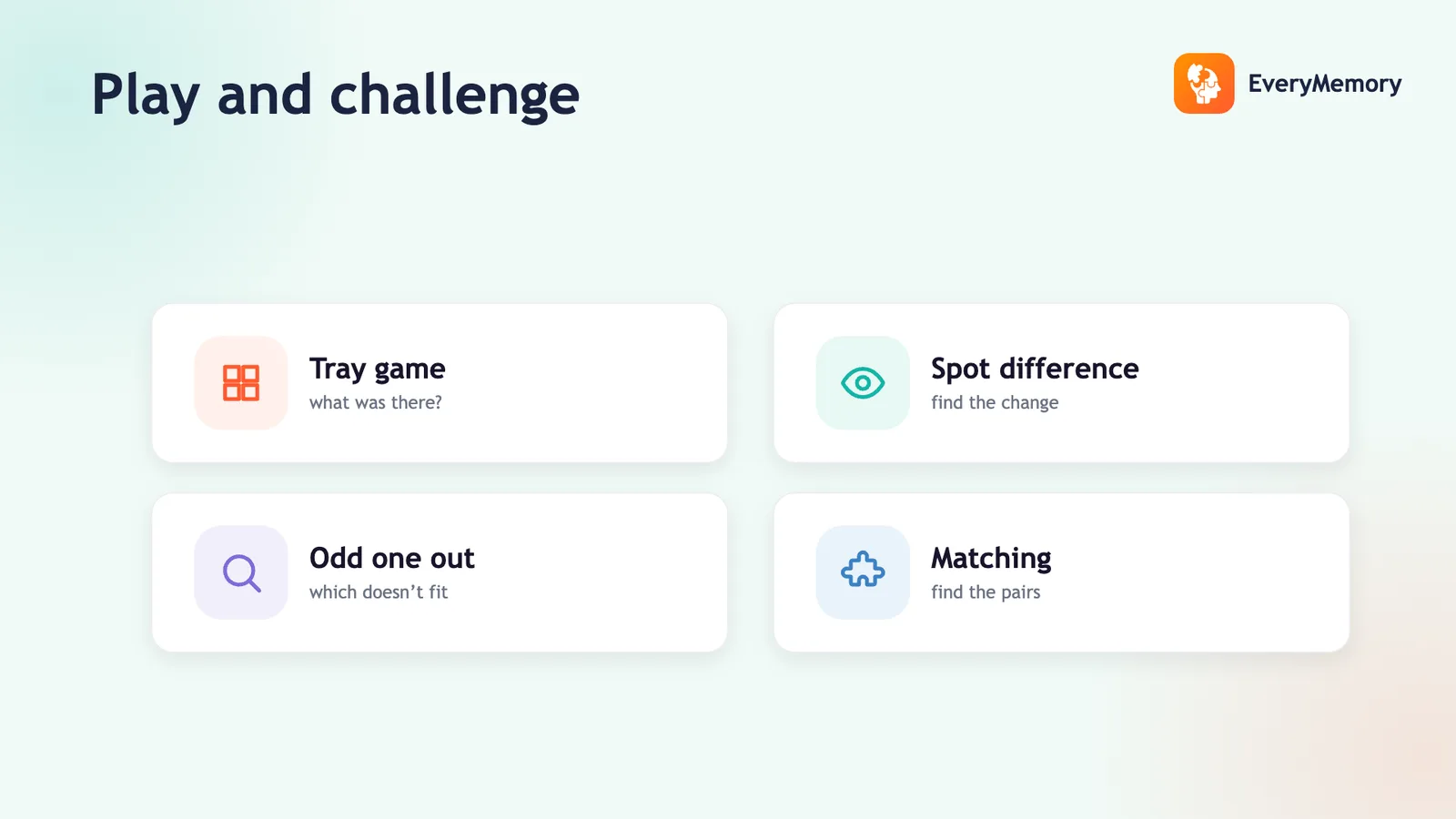
⚡ Quick answer
Fun brain quizzes are quick, playful challenges that exercise memory and attention - like the tray game, spot-the-change, digit span, and odd-one-out. They're for interest and enjoyment, not diagnosis. Played regularly under steady conditions, they double as a light self-check: track your own scores over time rather than comparing to anyone else.
Key takeaways
- Classic fun quizzes include the tray game, digit span, spot-the-change, and odd-one-out.
- Different quizzes train different skills, so mixing them gives a fuller workout.
- Keep conditions fixed if you want the score to mean something.
- A single quiz mainly improves you at that quiz; broad habits support memory long-term.
Not every memory check has to feel like an exam. Plenty of classic quizzes are genuinely fun - quick, playful, and surprisingly hard - while still nudging your recall and attention.
Here's a set you can play right now, what each one tests, and how to keep them honest if you want to track yourself.
Quizzes you can play right now
- The tray game (Kim's game) - study 10–15 small objects for 30 seconds, cover them, list what you recall. Tests visual recall.
- Digit span - have someone read random digits; repeat them back, adding one each round until you slip. Tests short-term memory.
- Spot the change - stare at a detailed photo, look away, then find what's different when it's altered. Tests attention to detail.
- Odd one out - scan a grid of similar shapes for the one that doesn't fit, against the clock. Tests attention and speed.
- Backward recall - repeat a short list in reverse order. Tests working memory.
What each one trains
The tray game and spot-the-change lean on visual memory and attention; digit span and backward recall lean on short-term and working memory; odd-one-out leans on attention and processing speed. Mixing them gives a fuller workout than hammering one - which is also why a brain quiz samples several at once. For more low-effort options, see daily brain exercises.
Keep them fun, but keep them fair
If you only want a laugh, play freely. If you want the score to mean something, fix the conditions: same time of day, quiet room, phone away, a practice round first. Then your improvement reflects your memory, not your growing familiarity with the trick.
Do quiz games actually help?
Playing a single quiz mostly makes you better at that quiz. The broader habit - regular, varied mental challenge plus sleep, movement, and social activity - is what supports memory over time. For the evidence on the bigger claims, see do brain games really work?.
✅ Try this today - a two-minute round
Right now, with anything on your desk:
- Pick 12 small objects and study them for 30 seconds.
- Cover them and write down every one you remember.
- Score yourself out of 12, jot the date, and beat it next week under the same conditions.


