 EveryMemory
Games to Improve Attention
Games to improve attention train you to lock onto a target and resist distraction. Here are the mechanics that work - spot-the-target, Stroop-like, and sustained vigilance - and honest expectations.
Part of the guide: Brain Exercises for Seniors: The Complete Guide →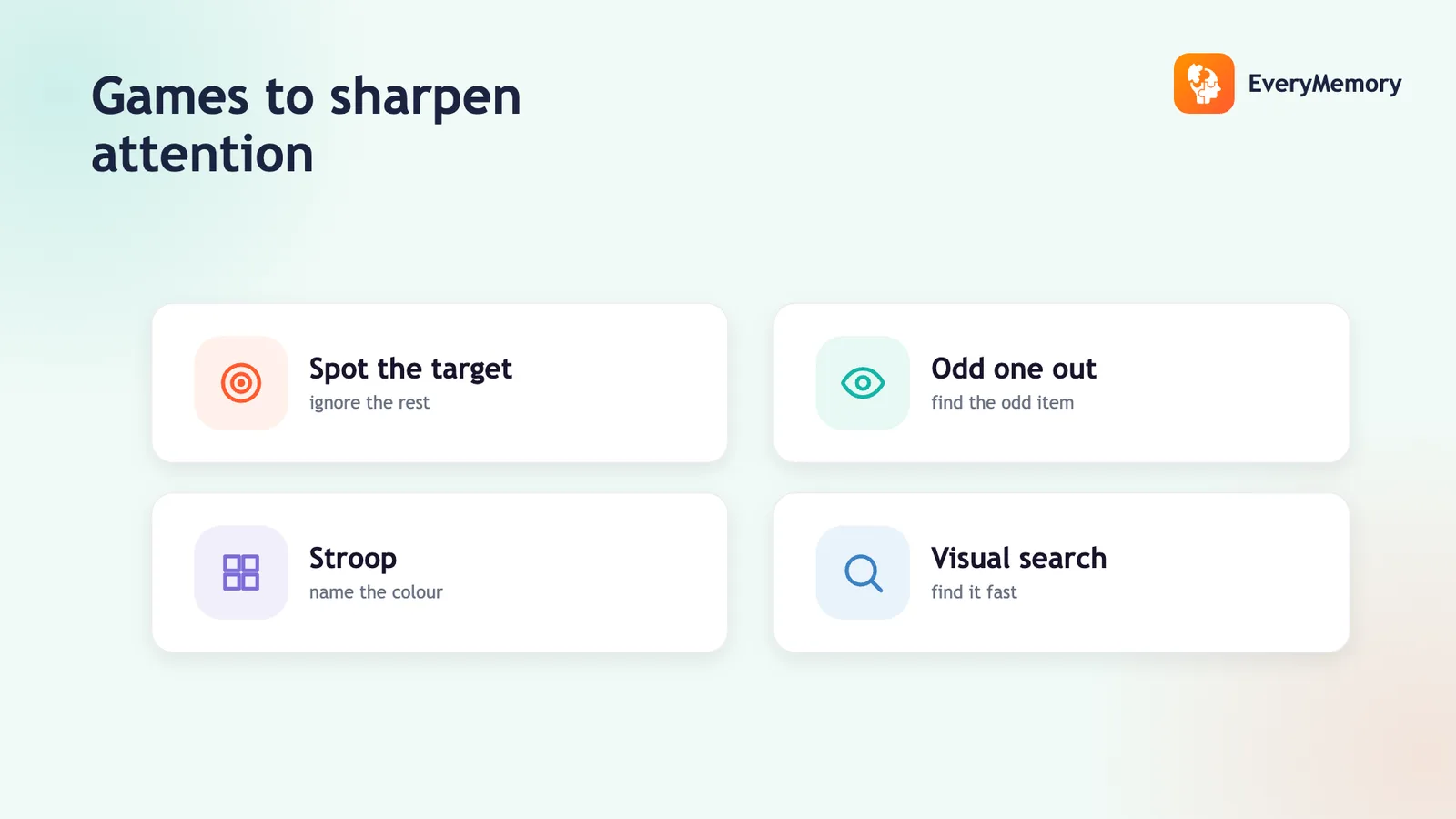
⚡ Quick answer
Games to improve attention train you to lock onto a target, hold focus, and ignore distraction. The mechanics that work are spot-the-target searches, Stroop-like response conflict, and sustained-vigilance tasks. You'll get noticeably better at those tasks and similar focus demands, but they won't broadly raise your intelligence.
Key takeaways
- Attention splits into selective, sustained, and inhibition
- Spot-the-target, Stroop-like, and vigilance tasks train it
- Gains are near-transfer; they won't cure all everyday distraction
- Non-medical practice - consistency matters more than intensity
Attention isn't one thing. There's selective attention - picking the one relevant thing out of clutter - and sustained attention, holding focus on something dull for longer than feels comfortable. Both fade when you're tired, and both can be practised. Games that target them are some of the most satisfying brain training because the demand is so obvious.
The catch is that plenty of "attention games" are really just busy and flashy. A game improves attention only when it makes you choose a target, hold focus, or suppress an automatic response. Knowing those mechanics lets you pick games that train the skill rather than ones that merely entertain.
The kinds of attention you can train
Selective attention is the spotlight - finding the one odd shape in a busy grid. Sustained attention is the marathon - staying alert through a long, monotonous stream waiting for a rare signal. A third flavour, response inhibition, is resisting the obvious wrong move when a quicker, automatic answer is tempting.
Good games target one of these clearly. A messy game that just throws lots at you trains frustration more than focus. If you want the practical, non-game side of this, how to improve focus and concentration covers the habits that pair well with the drills.
Mechanics that train attention
- Spot-the-target - scan a cluttered field and tap only the matching item, training selective attention and visual search.
- Stroop-like conflict - respond to one feature (the ink colour) while ignoring a stronger one (the word), training inhibition.
- Sustained vigilance - watch a slow stream and react only to a rare signal without drifting off.
- Flanker tasks - judge a central arrow while ignoring distracting ones pointing the other way.
Each of these forces a choice under mild pressure, which is what actually loads attention. A game with no distractor to resist isn't really training selectivity.
Game versus everyday benefit
| Game mechanic | Attention type | Everyday version |
|---|---|---|
| Spot-the-target | Selective | Finding your friend's face in a crowd |
| Stroop-like | Inhibition | Not blurting the obvious wrong answer in a meeting |
| Vigilance | Sustained | Catching the one typo on a long page |
| Flanker | Filtering | Reading on a busy train without losing your place |
These everyday payoffs are real but narrow. The honest framing is near-transfer: practice sharpens the trained skill and close cousins of it, not your intelligence at large. See do brain games really work for the evidence.
What to honestly expect
Attention games reward consistency. Short daily sessions beat one long weekly grind, because the skill you're building is partly the habit of catching your own drift and pulling back. You'll get faster and more accurate at the trained tasks, and you may notice closely related focus jobs feel a little easier.
What you shouldn't expect is a personality upgrade or a cure for everyday distraction - those depend far more on sleep, environment, and how many notifications are buzzing. Attention is also a non-medical topic here: games are practice and fun, not treatment. For a broader set of focus-friendly drills, browse daily brain exercises.
✅ Try this today - A 60-second spot-the-target drill
A page of text is all you need to load selective attention.
- Pick a common letter - say, the letter 'e' - and a paragraph of text.
- Scan line by line and count every instance as fast as you can.
- Time yourself, then check your count against a careful recount.
- Repeat with a different letter and try to beat your accuracy, not just speed.
- Notice when your mind drifts - catching that drift is the skill.


