 EveryMemory
Concentration Games
Concentration games train you to hold attention on one thing and resist the pull to switch. Here are the single-tasking mechanics that work, plus an honest take on transfer.
Part of the guide: Brain Exercises for Seniors: The Complete Guide →
⚡ Quick answer
Concentration games train you to hold attention on one task and resist the pull to switch. The mechanics that work are single-tasking drills, sustained-vigilance tasks, and games that penalise distraction. You'll get better at staying on similar tasks, but they're practice and fun - not a cure for everyday distraction.
Key takeaways
- Concentration is sustained, single-pointed attention through the boring middle
- Single-tasking and vigilance drills work, best paired with Pomodoro
- Environment beats any game - tidy your setup first
- Non-medical practice; it won't cure everyday distraction
Concentration is the ability to keep your attention on one thing and not flit away the moment it gets dull or hard. It's closely tied to sustained attention, and it's the skill that quietly decides whether a 20-minute task takes 20 minutes or 50 minutes of interrupted starts.
Concentration games build the habit of staying with one stream and catching yourself when you drift. The strongest ones reward single-tasking and punish the urge to switch - and they pair naturally with focus routines like the Pomodoro technique. Here's what works and what to honestly expect.
What concentration is
Concentration is sustained, single-pointed attention - staying on one task through the boring middle, not just at the exciting start. It's distinct from selective attention (picking a target) and from flexibility (switching on purpose). Here, switching is the enemy.
It's also heavily shaped by environment. Notifications, noise, and an open browser tab undo more concentration than any game can build, which is why drills work best alongside a tidied setup. The practical side is in how to improve focus and concentration.
Mechanics that train concentration
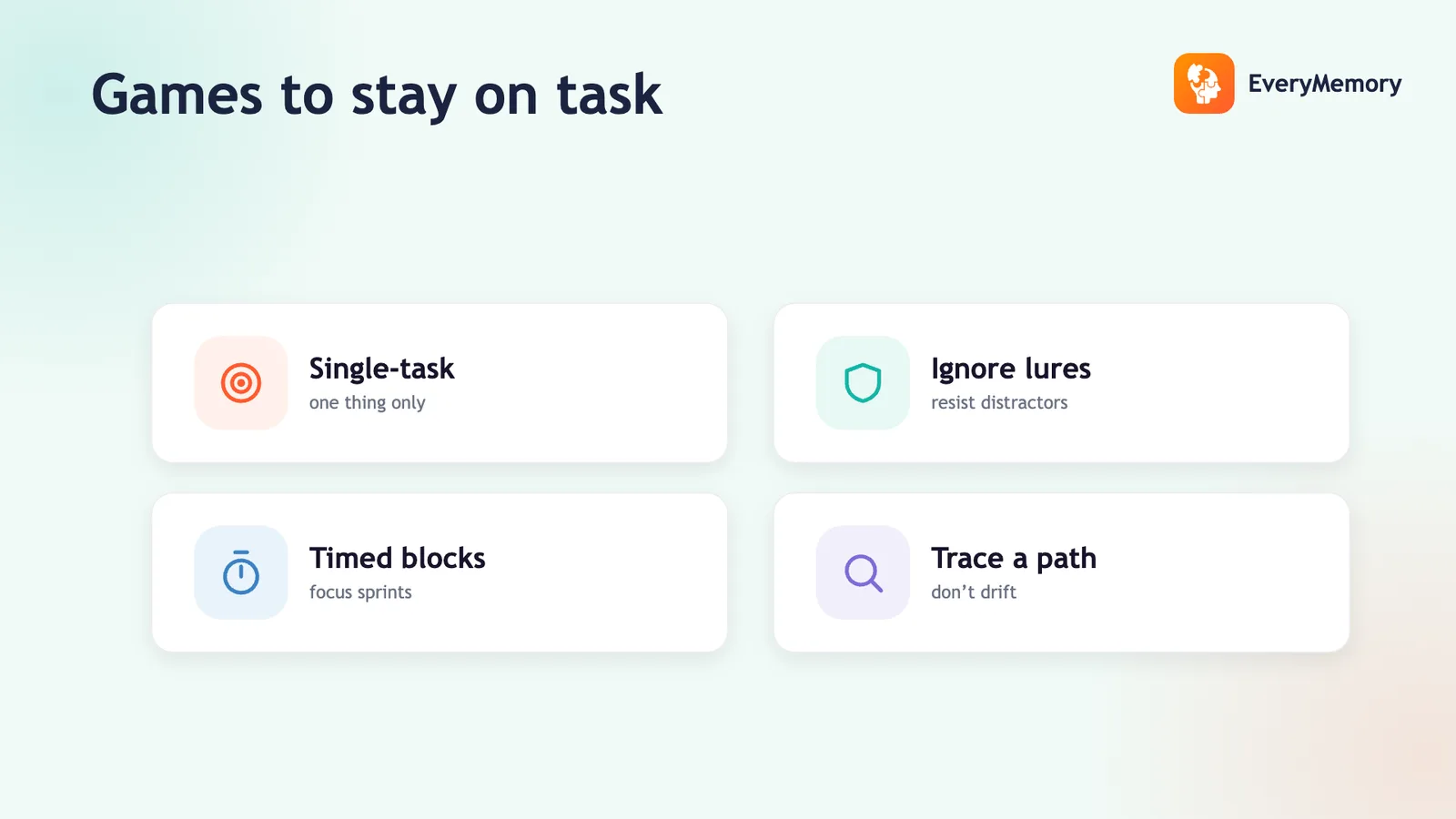
- Single-tasking drills - stay locked on one slow stream with no shortcuts, building tolerance for the boring middle.
- Sustained vigilance - watch for a rare signal over a long stretch without drifting off.
- Distraction-resistance - irrelevant cues try to pull you; staying on task is the win condition.
- Pomodoro-paired sessions - a focus game inside a timed work block, training the habit of one task at a time.
The shared feature is duration without switching. A fast, flashy game with constant novelty trains stimulation-seeking, not the patience concentration needs.
Concentration versus attention
| Skill | What it is | Game mechanic |
|---|---|---|
| Concentration | Holding one task over time | Single-tasking, vigilance |
| Selective attention | Finding a target in clutter | Spot-the-target |
| Flexibility | Switching on purpose | Task-switching |
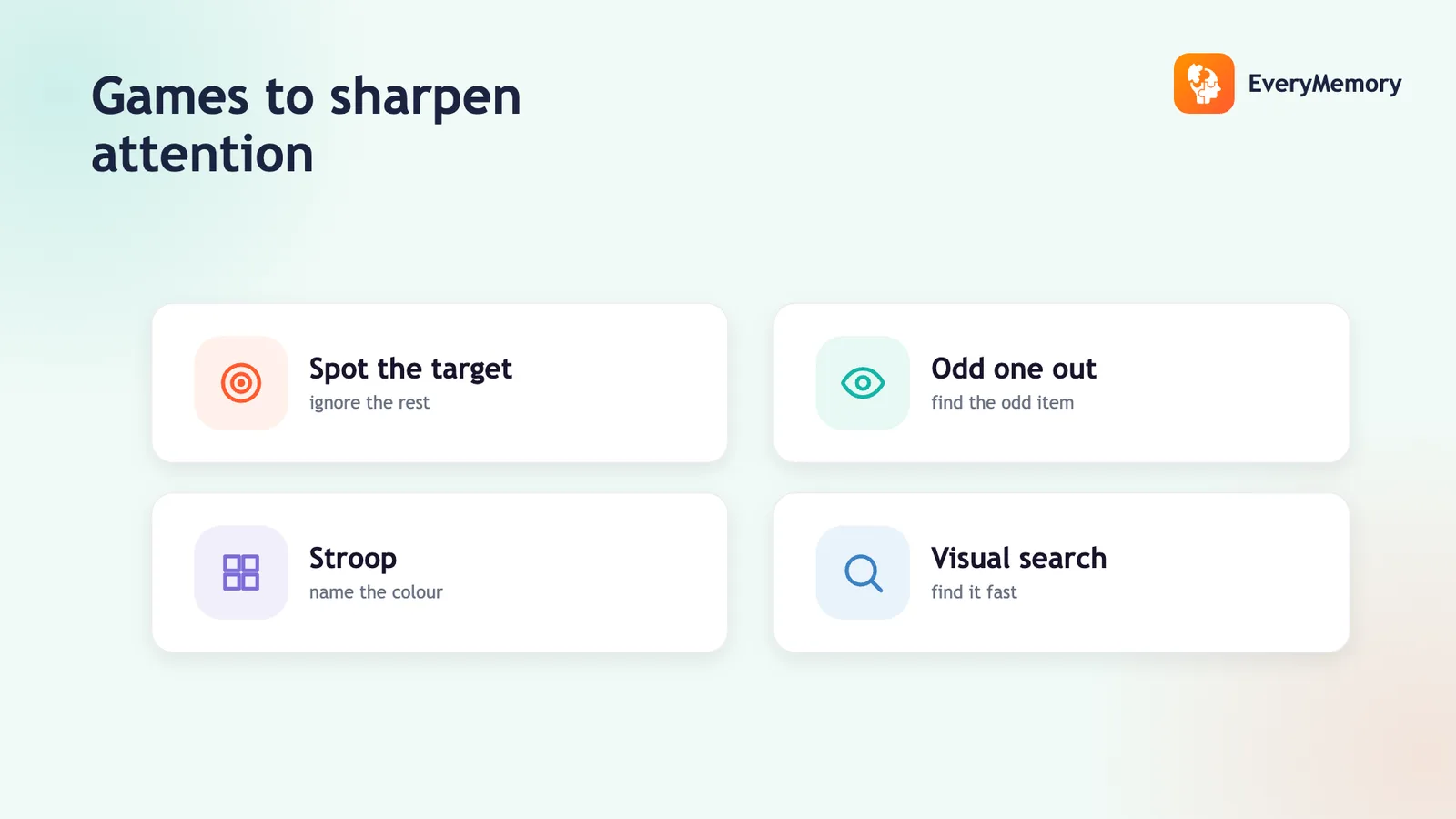
These overlap but aren't interchangeable. If your trouble is staying with a task, concentration drills fit; if it's finding the signal in noise, see games to improve attention.
What to honestly expect
With regular short practice, you'll hold focus longer on similar tasks and catch your drift sooner - a real, useful near-transfer, and one that's most powerful when paired with a Pomodoro-style work rhythm. What concentration games won't do is cure everyday distraction or raise your intelligence; environment, sleep, and motivation matter far more, and this is non-medical practice, not treatment.
Use the games to build the habit, then carry it into real work blocks. For more focus-building routines, see games to improve focus and the broader daily brain exercises.
✅ Try this today - A Pomodoro-paired focus block
Pair a single-tasking drill with a timer to build the habit.
- Pick one task and set a timer for 15 minutes.
- Work on only that task; if you drift, gently note it and return - no switching.
- Each time you catch a drift, make a tiny tally mark.
- When the timer ends, take a short break and check your tally.
- Repeat daily; aim to lower your drift count over the week.