 EveryMemory
Games to Improve Focus
Games to improve focus train you to direct and hold attention where you want it. Here are the mechanics that work, how to pair them with focus habits, and an honest take on transfer.
Part of the guide: Brain Exercises for Seniors: The Complete Guide →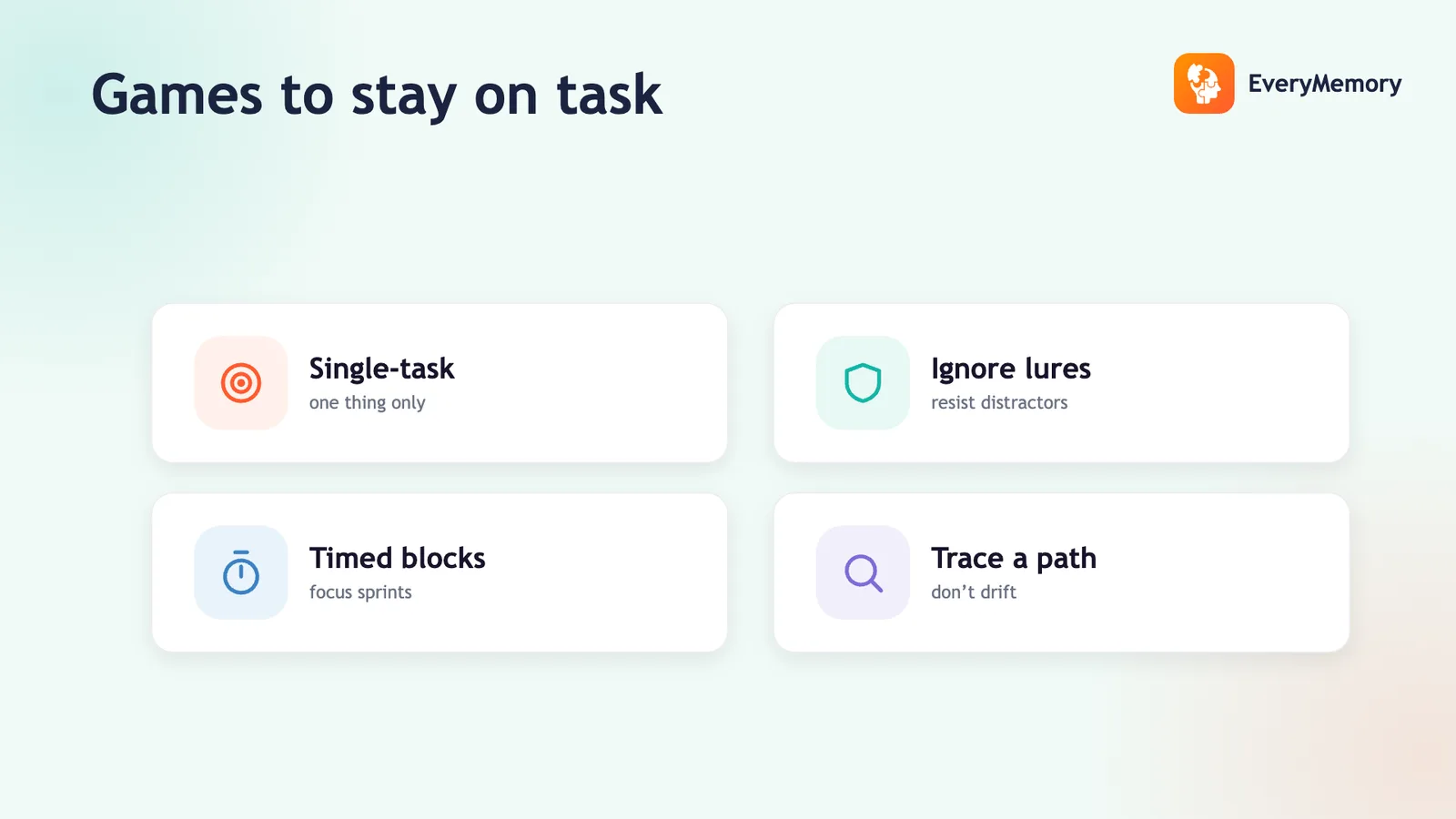
⚡ Quick answer
Games to improve focus train you to direct and hold attention on purpose. Effective mechanics combine selective attention (spot-the-target), sustained attention (single-tasking), and distraction-resistance. You'll get better at holding focus on similar tasks, especially paired with focus habits, but games alone won't fix everyday distraction or raise your IQ.
Key takeaways
- Focus bundles two jobs: directing attention and sustaining it
- Spot-the-target plus single-tasking and distraction-resistance train both
- Biggest payoff when paired with Pomodoro and a quiet setup
- Non-medical near-transfer - games alone won't cure distraction or raise IQ
Focus is the act of pointing your attention where you choose and keeping it there - both finding the right thing to attend to and holding it once you have. It draws on selective attention, sustained attention, and the discipline to ignore the pull of something more interesting.
Games to improve focus give you a clear target, a reason to stay, and distractions to resist. The strongest ones don't just keep you busy; they make you choose, hold, and suppress. And they work best stacked on top of focus habits rather than instead of them. Here's what actually trains focus and what to honestly expect.
What focus actually is
Focus isn't a single muscle - it bundles two jobs: choosing what to attend to and sustaining that choice against distraction. A good focus game loads both, which is why a pure spot-the-target drill or a pure single-tasking drill each trains only part of it.
It's also context-bound. The best game in the world loses to a phone buzzing every two minutes, so the games pay off most when stacked on a tidied environment. The habit side is covered in how to improve focus and concentration.
Mechanics that train focus
- Spot-the-target - choose the right item from clutter, training the 'point your attention' half of focus.
- Single-tasking - stay on one slow stream without switching, training the 'hold it' half.
- Distraction-resistance - irrelevant cues pull at you; ignoring them is the win condition.
- Timed focus blocks - a game inside a Pomodoro window, building the habit of sustained, single-pointed work.
Together these cover both halves of focus. A game that only entertains, with no target to choose and nothing to resist, trains engagement rather than the deliberate control focus needs.
Skill versus everyday benefit
| Focus skill | Game mechanic | Everyday version |
|---|---|---|
| Directing attention | Spot-the-target | Settling on the one task that matters |
| Holding attention | Single-tasking | Reading a long document without drifting |
| Resisting distraction | Distraction-resistance | Ignoring a buzzing phone mid-task |
| Sustaining over time | Timed focus blocks | Working through a 25-minute block |
These payoffs are real but close to the trained skill. Focus games help with similar focus demands, not with intelligence at large. The honest evidence is in do brain games really work.
What to honestly expect
With short, frequent practice you'll hold focus longer on similar tasks and catch drift sooner - and the gain is biggest when you pair the games with a Pomodoro rhythm and a quieter environment. That near-transfer is genuinely useful. What focus games won't do is cure distraction by themselves or raise your IQ, and this is non-medical practice, not treatment for any condition.
Treat the games as a way to build the habit, then carry it into real work. For the steadier, hold-one-task side, see concentration games, and for more routines, daily brain exercises.
✅ Try this today - A 10-minute focus block
Combine a single-tasking drill with a timer and a tidy desk.
- Clear your desk and silence notifications before you start.
- Set a 10-minute timer and pick exactly one task.
- Work only on that; when you drift, note it and return without switching.
- Tally each drift, then take a two-minute break when the timer ends.
- Repeat daily and aim to lower your drift count over the week.


