 EveryMemory
How to Improve Attention to Detail
Attention to detail is less about effort and more about systems - slowing down, checking deliberately, and removing the rush and distraction that cause most slips.
Part of the guide: Brain Exercises for Seniors: The Complete Guide →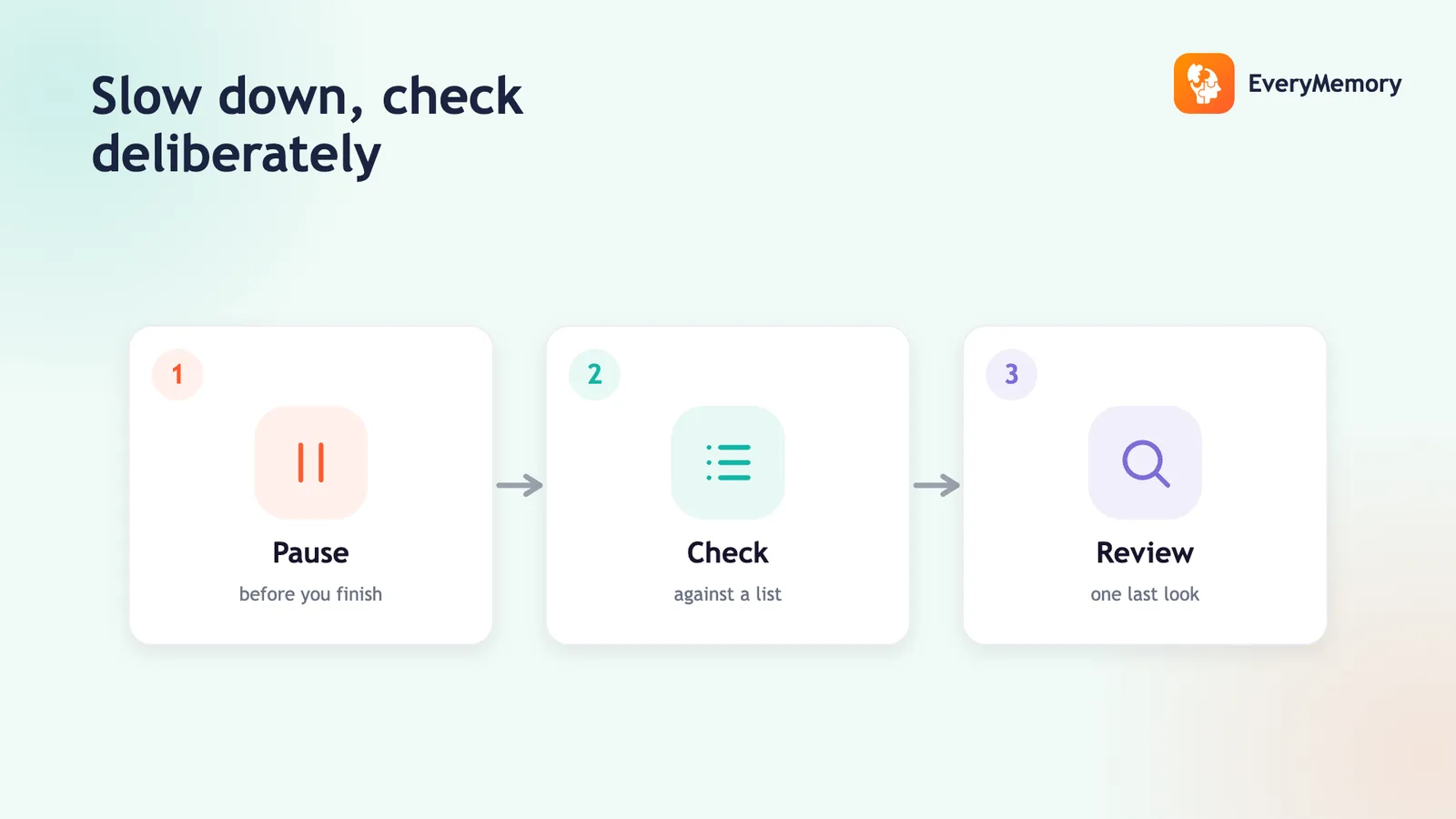
⚡ Quick answer
Improve attention to detail by changing conditions, not just trying harder. Slow down on detail-critical work and single-task so attention isn't split. Use checklists for repeatable tasks so memory isn't the safeguard. Review with fresh eyes after a break, and read carefully aloud or backwards to break the skimming your brain defaults to. Most errors come from rushing and distraction.
Key takeaways
- Most missed details come from rushing and distraction, not carelessness.
- Slow down on detail-critical steps and single-task while checking.
- Use checklists so memory isn't the safeguard under pressure.
- Review with fresh eyes: take a break, read aloud or backwards.
"Pay more attention" is useless advice, because nobody chooses to miss details. The misses come from predictable conditions - rushing, distraction, familiarity that makes your eyes skim - not from a flawed character. Fix the conditions and the details get caught.
Attention to detail is best treated as a system, not a virtue. The careful people you know mostly aren't trying harder; they've built habits and checks that catch errors automatically. Those habits are learnable, and they work better than willpower.
Slow down where it matters
Most missed details are caused by speed. The brain runs on shortcuts, filling in what it expects to see, and that prediction machine is exactly what skips the typo or the wrong figure. On work where details matter, deliberately drop your pace - the time you lose is far less than the time a missed error costs to fix.
Crucially, this is selective. You don't slow everything down; you identify the detail-critical steps - the number that goes in the contract, the dosage, the final figure - and slow down there specifically.
Single-task - divided attention misses things
Attention to detail and divided attention are opposites. When you're checking a document with a chat open, your attention is sampling both and fully present in neither, and that's precisely when details slip through. Detailed work needs your whole, undivided attention.
Close the other tabs, silence notifications, and give detail-critical work a clear run. This is the same single-tasking that underpins focus and concentration - attention to detail is really focus applied to checking.
Build systems so memory isn't the safeguard
Relying on yourself to remember every check is the weak link, because memory under pressure is unreliable. The fix is to externalise the checks so they don't depend on you remembering them:
| System | What it catches |
|---|---|
| Checklist for repeatable tasks | The step you'd skip when rushed or tired |
| Templates with required fields | Missing information before it ships |
| A second person's review | Errors invisible to the author |
| Automated checks (spellcheck, validation) | Mechanical mistakes, freeing you for judgment |
Review with fresh eyes
You can't proofread your own work well immediately, because your brain reads what it meant to write, not what's there. The fix is distance: step away, then review the work as if someone else made it. A few techniques force the fresh perspective:
- Take a break before reviewing - even ten minutes resets the over-familiarity.
- Read text aloud; your ear catches errors your eye glides over.
- Read backwards (last sentence first) to break the predictive skim for typos.
- Change the format - different font or printed page - so it looks unfamiliar.
✅ Try this today - Build a personal error checklist
Turn your own recurring mistakes into a system that catches them:
- For one week, note every detail error you catch or that gets caught - the type, not just the instance.
- Group them into patterns (wrong numbers, missing fields, name typos, broken links).
- Turn the top patterns into a short pre-send checklist for that kind of work.
- Run the checklist every time before you finish. You'll catch most of your usual slips before they ship.