 EveryMemory
How to Talk About Memory Without Scaring a Parent
Bringing up memory concerns with a parent is one of the hardest conversations in a family. Here's how to do it with honesty, warmth, and without causing fear.
Part of the guide: Helping a Parent With Memory Changes: The Complete Family Guide →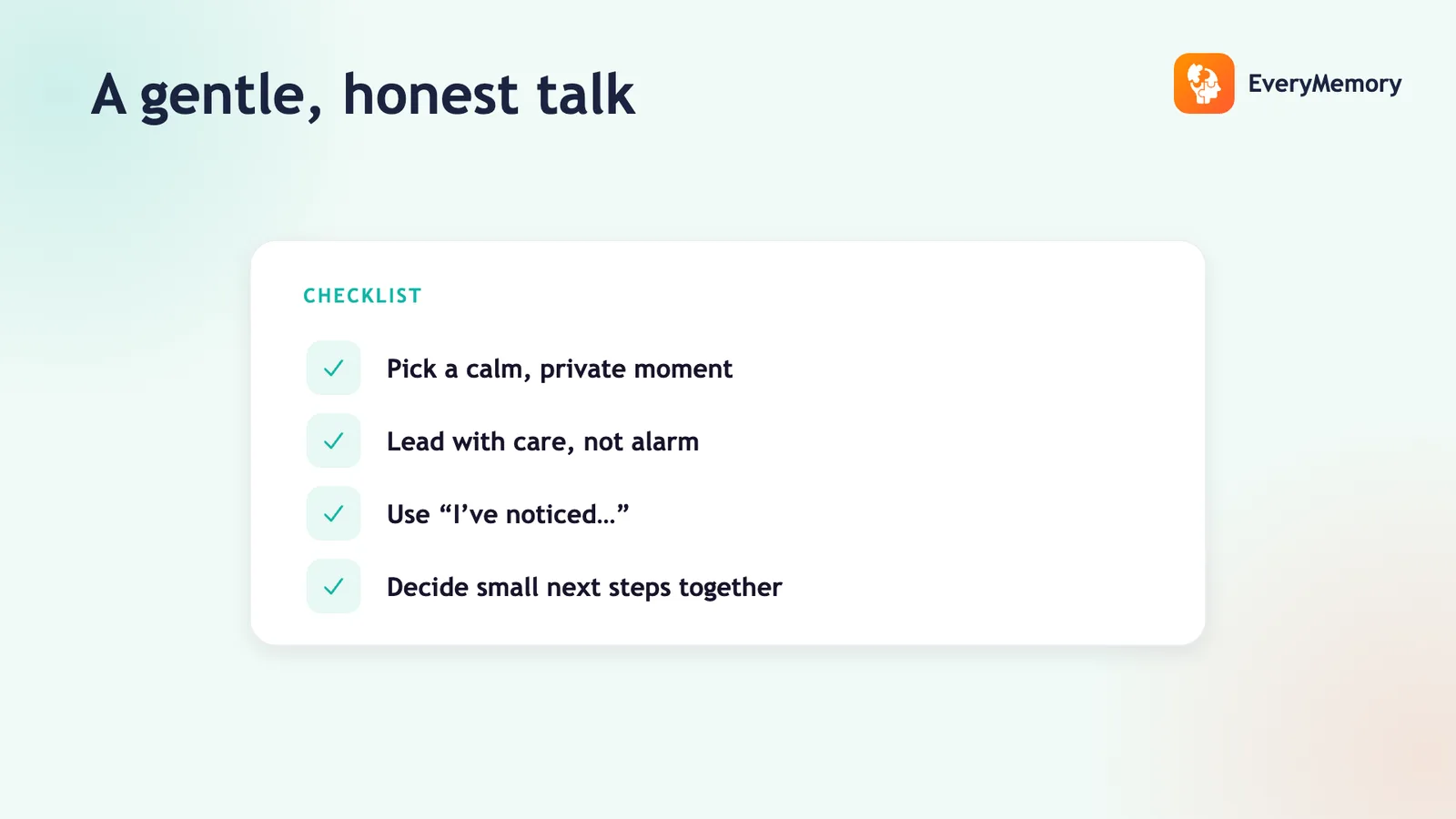
⚡ Quick answer
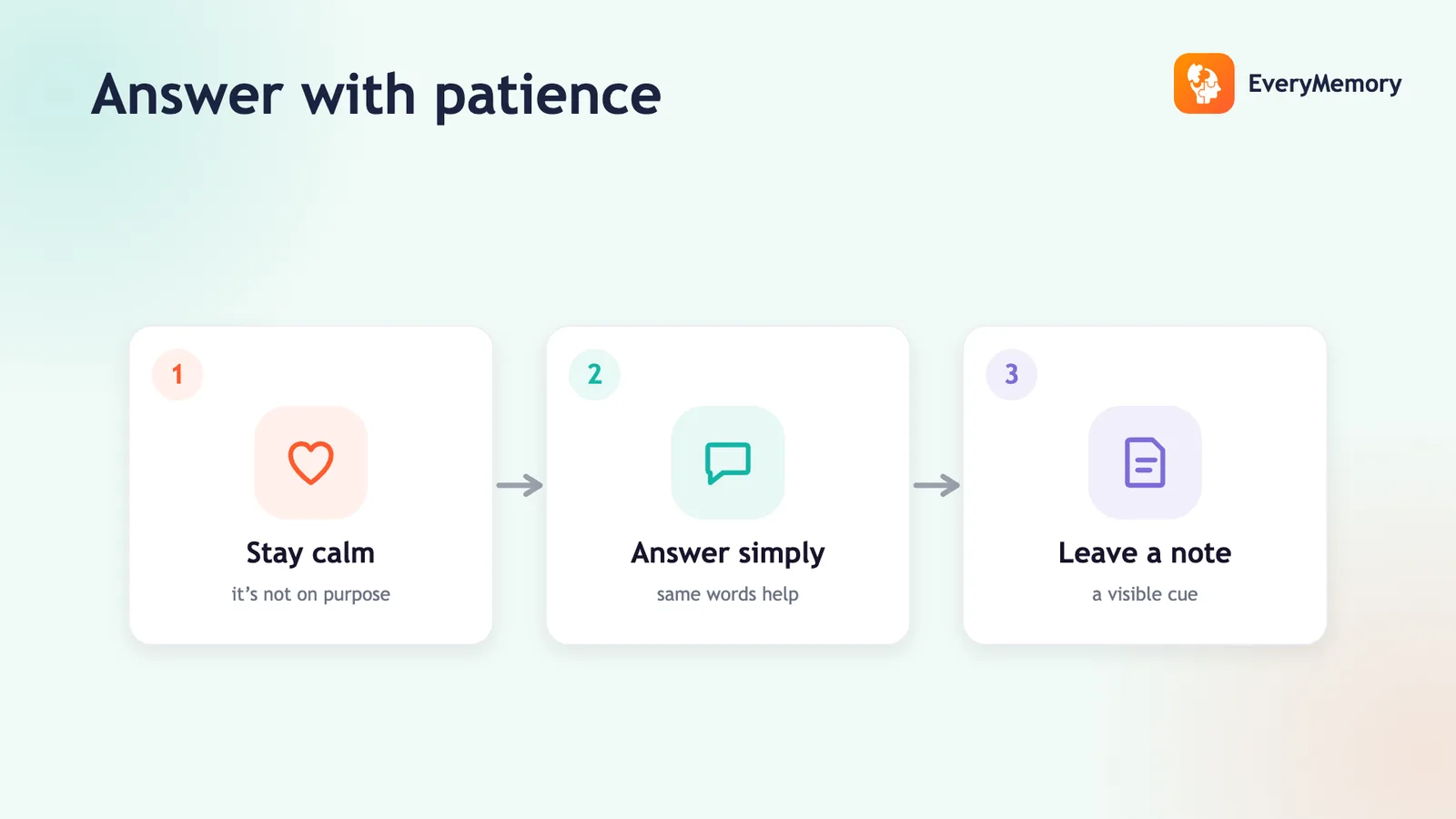
Choose a calm, private moment, lead with love rather than a list of problems, and frame the conversation around your concern for them - not as a verdict. Ask questions more than you make statements. Avoid the word 'memory' in the opening sentence if it feels too charged; talk about what you have noticed instead. And end with a concrete, non-threatening next step, not an open-ended worry.
Key takeaways
- Choose a calm, private moment and lead with your love and concern rather than opening with a list of incidents.
- Describing a specific observation - "you asked about the appointment three times on Tuesday" - is much easier to receive than a general verdict.
- Asking open questions and genuinely listening often reveals your parent has already noticed changes and is quietly frightened.
- Aim for one small, shared next step from the first conversation, not a full plan - a low-stakes action is far more likely to happen.
You have been quietly watching. A bill paid twice. The same story told three times in one visit. A moment of confusion about something your parent has known for years. You are worried - but every time you try to bring it up, you either pull back at the last second or end up in an argument.
Talking about memory concerns with an aging parent is genuinely hard. There is fear on both sides: yours, that something is seriously wrong; theirs, that you are about to take something away from them. But avoiding the conversation doesn't make the concern go away - and the longer it waits, the harder it gets. This guide gives you a clear path through it.
Why this conversation feels so hard
For your parent, memory is tied up with independence, identity, and self-worth. A comment about forgetfulness can land as "I think you are losing your mind" even when that is the last thing you mean. Fear of losing driving privileges, being moved out of their home, or becoming a burden can make even a gentle observation feel like the beginning of the end.
Knowing this helps you approach the conversation differently. You are not trying to convince your parent of something - you are trying to open a door together so that whatever is going on can be seen clearly and handled well.
Before you speak: the right moment matters
Timing is not everything, but it is close. Avoid raising the topic when your parent is tired, unwell, in a public place, or in the middle of an activity. The best moment is usually one-on-one, at a relaxed time of day, when neither of you is rushed.
- Choose a place that feels safe and familiar to them - their kitchen, their garden, a favourite chair.
- Don't ambush. A simple "There's something I've been wanting to talk to you about, and I'd like to find a good moment" gives them a little warning without alarm.
- Make sure you have enough time. A real conversation about this cannot be sandwiched between errands.
What to say - and what not to say
Start with love and concern, not with evidence. Opening with a list of incidents is likely to feel like an accusation. Instead, begin with your own feelings:
- "I love you, and I've been a bit worried about you lately. Can I tell you why?"
- "I've noticed a few things recently and I want to understand them better - not to alarm you, just because I care."
- "I know this might feel like a strange thing to bring up, but I'd rather talk about it than not."
Then describe what you have observed specifically and without exaggeration. "I noticed you asked me about the appointment three times in one afternoon" is much easier to hear than "You're always forgetting things." The first is an observation; the second is a verdict.
- Avoid: "You need to see a doctor." Try: "I'd feel better if we got a professional's opinion - just so we know what we're dealing with."
- Avoid: "You keep repeating yourself." Try: "A few times lately, it seems like the same thing has slipped your mind - is everything okay?"
- Avoid: "I'm really worried about you." (alone) Try: "I'm worried because I love you and I want to make sure you're well."
Listening is half the conversation
Many adult children go into this conversation with a plan to deliver information. But your parent also has things to tell you - they may have noticed the same changes and be frightened, or they may have an explanation you haven't considered (a new medication, a run of bad sleep, a stressful period).
Ask open questions and genuinely listen. "Have you noticed anything yourself?" or "How have you been feeling lately - not just physically, but in yourself?" often opens more than any prepared speech.
If your parent shuts the conversation down, don't force it. Say that you understand and that you'll leave it for now, but that you love them and the door is always open. A second attempt in a week or two is fine. Pushing hard in one sitting rarely helps.
Suggesting a next step without pressure
The goal of this first conversation is not to get a diagnosis - it is to take one small, shared step. Something low-stakes that feels manageable is far more likely to happen than a big, scary plan.
- "Would you be open to just mentioning it to your GP at your next regular checkup? Not as a crisis, just as something to be aware of."
- "I found this simple memory quiz online - it's not medical, just a fun way to see how different parts of memory are doing. Would you want to try it together?"
- "What if we just kept a little note for the next few weeks - so we have something concrete to show a doctor if we decide to go?" Our guide on what to track before talking to a doctor has a simple template.
Framing a non-medical memory check as something you do together can take the sting out of it entirely. It becomes a shared activity rather than a test your parent is being subjected to.
If your parent is in denial
Some older adults are genuinely not aware of the changes their family can see. Others are aware but frightened to acknowledge it. Denial is usually a form of self-protection, not stubbornness.
In this case, keep the door open without forcing it. Continue visiting, continue observing, and continue keeping your own notes. If safety becomes a concern - driving, medication, getting lost - that changes the equation. Safety issues are worth raising more directly and, if necessary, with the help of their doctor or another trusted person in their life. The article on helping an aging parent with memory concerns has more on navigating this.
✅ Try this today - The shared memory check
Take the EveryMemory quiz together as a gentle, low-stakes starting point:
- Frame it casually: "I've been trying this little memory quiz - want to do it together?" Take it alongside your parent rather than watching them.
- React to the results without alarm, whatever they show. The point is to establish a starting point, not to reach a verdict.
- Use it as a natural opening: "That was interesting - anything in there feel familiar to you?"
⚠ When to talk to a professional
If your parent shows sudden or rapid changes in memory, confusion about familiar people or places, difficulty with safety-critical tasks like driving or taking medication, or behaviour that puts them at risk, please speak with a qualified healthcare professional promptly. These situations go beyond a family conversation and deserve professional guidance.