 EveryMemory
How to Help an Aging Parent With Memory Concerns
A calm, practical guide to supporting a parent's memory with warmth and dignity - without taking over, causing alarm, or turning every interaction into a test.
Part of the guide: Helping a Parent With Memory Changes: The Complete Family Guide →
⚡ Quick answer
Help an aging parent by reducing the load on their memory (shared calendars, simple routines, consistent homes for important items), keeping conversations warm and non-clinical, and quietly noting patterns over time rather than correcting every slip. Offer help as partnership, not rescue - preserve their independence - and gently encourage a professional conversation if changes are sudden, worsening, or affecting daily safety.
Key takeaways
- Framing help as partnership rather than rescue preserves your parent's confidence, which directly supports how memory works.
- Practical scaffolding - a shared calendar, a weekly whiteboard, consistent homes for keys and glasses - reduces daily memory load without any confrontation.
- Keeping quiet, dated notes on patterns you observe gives a professional far more to work with than a general impression.
- Gently encourage a professional conversation if changes are sudden, worsening, or starting to affect everyday safety.
Noticing that a parent has become more forgetful is a quietly destabilising experience. The person who once kept the whole family organised now repeats a question, or misses an appointment, or searches for a familiar word - and you feel a mix of worry, sadness, and a strong urge to do something, fix something, right now.
That urge comes from love, but acting on it too forcefully can backfire. The most helpful approach is almost always the opposite of dramatic: calm, gradual, and built entirely around your parent's dignity and independence. Support that feels like partnership is welcomed; support that feels like being managed is resisted.
This guide walks through how to help in a way that actually lands - reducing the pressure on their memory, keeping conversations warm rather than clinical, quietly noticing patterns, and knowing when it's time to involve a professional.
Lead with respect, not rescue
The instinct to swoop in and take over is natural, but it often triggers exactly the defensiveness you're trying to avoid. Your parent has spent a lifetime being competent and independent; feeling that slip away is frightening, and being corrected or managed makes it worse.
So frame everything as partnership. "Want to put that on the shared calendar so we're both covered?" lands far better than "You forgot again." Offer choices rather than instructions. Let them keep doing everything they can still do well, and offer support only where it's genuinely needed. Preserving independence isn't just kinder - it protects confidence and mood, both of which directly affect how well memory works.
Reduce the memory load
The most powerful help you can give removes the need to remember in the first place. Practical scaffolding takes the daily pressure off without anyone having to rely on willpower:
- One shared calendar you can both see, so appointments don't depend on memory alone.
- A whiteboard for the week in a central spot - the day, plans, who's visiting, and any reminders.
- Consistent homes for keys, glasses, and medication, which removes the daily search (the same idea behind why we misplace things).
- A simple, repeatable daily rhythm, which is calming and reduces decision-making. Our morning brain routine for seniors is a gentle place to start.
Set these up with your parent, not for them, so the systems feel like theirs.
Handle repeated questions with patience
One of the most wearing parts of early memory change is the repeated question - the same thing asked five times in an hour. It helps enormously to know that the repetition is often driven by anxiety, not just forgetting: "When is the doctor?" frequently means "I'm worried I'll miss it."
Answer calmly and consistently, and let writing do some of the reassuring for you - a visible note or whiteboard lets your parent check the answer themselves, which eases the worry behind the asking. A steady, kind tone each time keeps the moment from becoming stressful for either of you.
Support memory gently, without making it a test
Many families want to "keep Mom's mind active," which is a lovely instinct - as long as it never feels like an exam. The trick is to fold engagement into things that are genuinely enjoyable and shared.
Looking through old photos and naming people exercises long-term memory and sparks wonderful conversation. Card games, simple word games, and cooking a familiar recipe from memory all gently work recall while feeling like fun. Doing a short, friendly daily exercise together - rather than handing it over as homework - adds connection and quiet accountability. The point is to support memory while protecting enjoyment and dignity; the moment it feels like pressure, ease off.
Notice patterns quietly
Resist the urge to test or interrogate. Instead, keep gentle private notes about what you observe and when - specific moments, with dates. Patterns across weeks are far more meaningful than any single slip, and they're exactly what a professional will find useful later.
A light, non-judgemental tool can help here. A printable memory tracker kept casually, or an occasional non-medical memory check, gives you a record without turning daily life into surveillance.
When to involve a professional - and how to broach it
Gently encourage a professional conversation if changes are sudden, clearly worsening, or starting to affect safety and daily life - for example, getting lost on familiar routes, trouble managing medication, or concerns about driving. There's no downside to asking; at worst it brings reassurance.
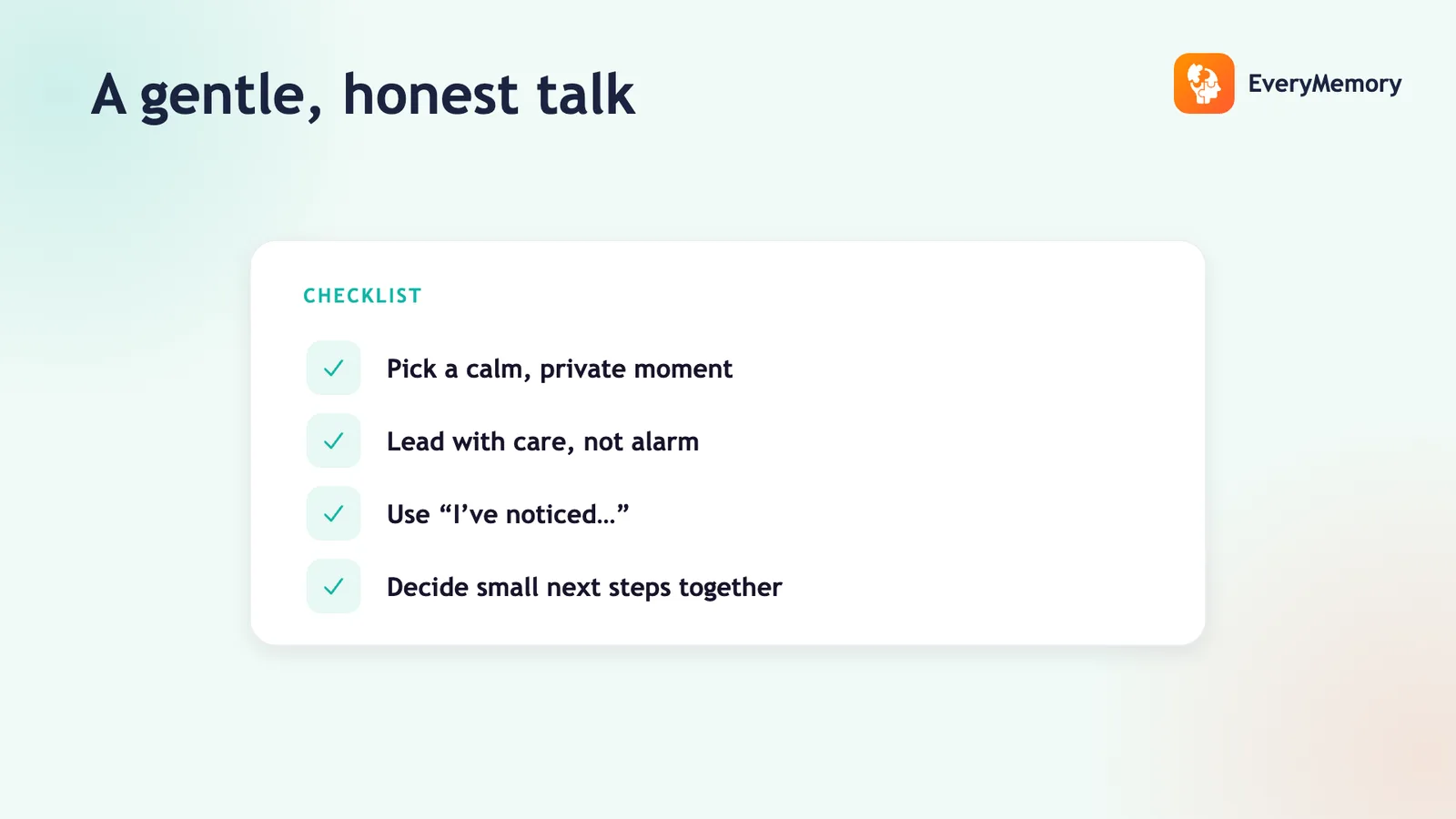
Raising it is delicate, so lead with care, not fear. Choose a calm, private moment, mention a specific situation rather than a verdict, and frame it around making life easier: "I'd feel better if we just checked in with someone - want me to come with you?" Our guides on talking about memory without scaring a parent and what to track before the appointment walk through both the conversation and the preparation.
Don't forget to support yourself
Helping a parent through memory changes is emotionally heavy, and it's easy to pour everything into them while quietly running on empty. Share the load with siblings where you can, agree on a united and calm approach, and give yourself permission to find it hard. You'll be far more present and patient when you're not depleted.
✅ Try this today - Three low-pressure first steps
You don't need to overhaul everything. Start with three small, dignity-preserving moves:
- Set up one shared calendar you can both see, and add the next few appointments together.
- Agree on fixed, obvious homes for keys, glasses, and medication.
- Start a private log of patterns you notice, with dates - not to test, just to observe.
⚠ When to talk to a professional
This is general, non-medical guidance, not medical advice. If you notice sudden changes, confusion, disorientation, or any risk to your parent's safety, encourage a conversation with a qualified healthcare professional. EveryMemory does not diagnose or treat any condition.