 EveryMemory
How Trivia Helps Memory
Does trivia help your memory? Honestly - yes and no. It strengthens recall of what you practise and keeps you engaged, but it won't expand your memory capacity. Here's the real mechanism.
Part of the guide: Understanding Memory Loss and Forgetfulness: A Calm, Reassuring Guide →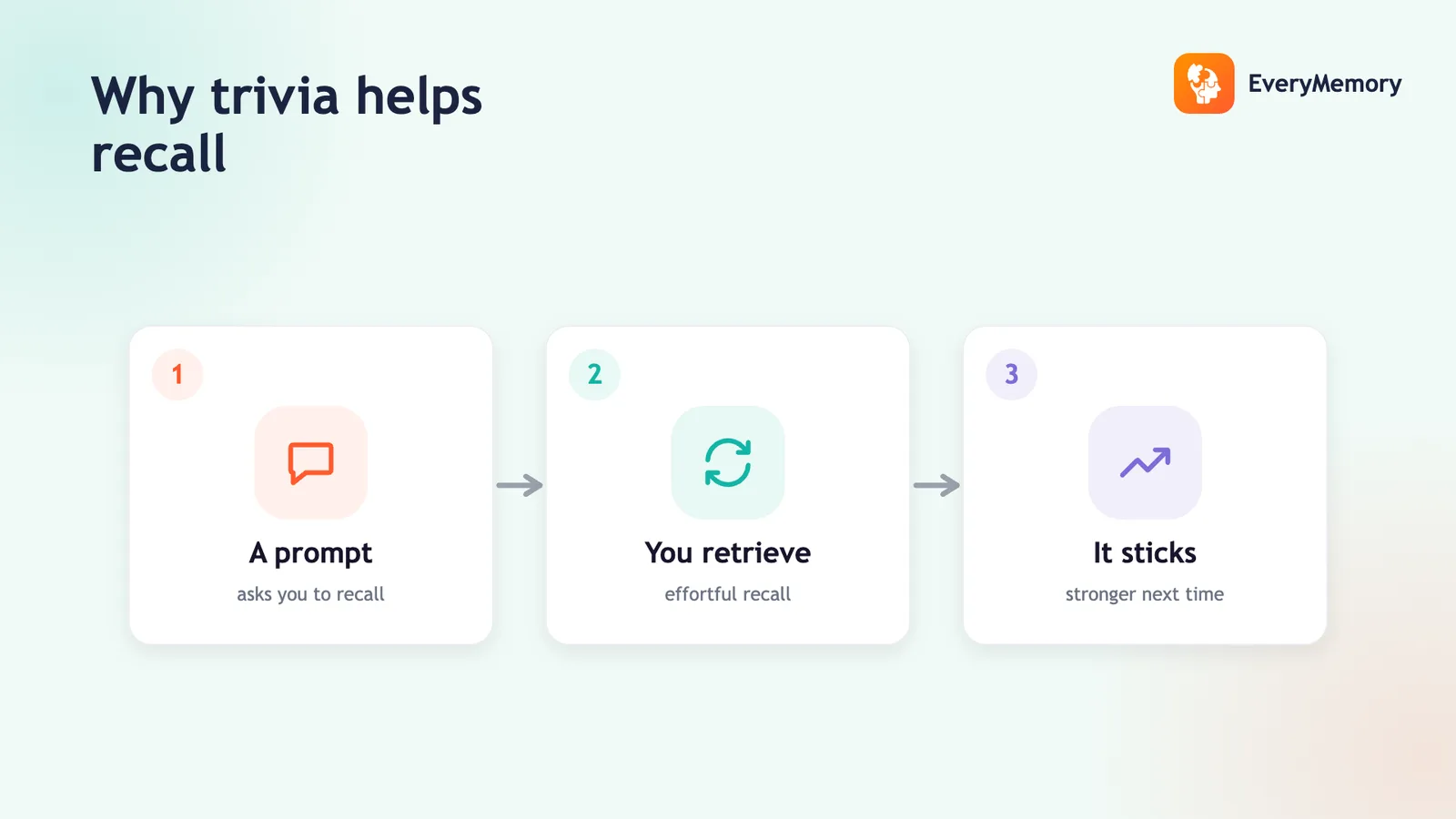
⚡ Quick answer
Trivia helps memory through retrieval practice: every time you pull up an answer, you strengthen the path back to that fact, so it sticks better. It also keeps you mentally engaged and socially connected. What it doesn't do is expand your overall memory capacity, raise IQ, or transfer to unrelated everyday recall.
Key takeaways
- The mechanism is retrieval practice - recalling strengthens that fact
- Gains are specific; they don't transfer to everyday recall or IQ
- Engagement and social fun are real, non-capacity benefits
- Answer before peeking and space sessions to get the genuine payoff
"Does trivia help your memory?" is one of those questions with an honest answer of "yes, but not in the way you might hope." Trivia genuinely strengthens your recall - of the specific facts you keep retrieving. It keeps you engaged and gives you a social, enjoyable reason to keep your mind active. What it doesn't do is expand some general memory capacity or make you better at remembering unrelated things.
Understanding the actual mechanism is useful, because it tells you how to get the real benefit and stops you expecting a benefit that isn't there. The good news: the honest version is still worth your time. The realistic version is just better than the hype.
The real mechanism: retrieval practice
The honest engine behind 'trivia helps memory' is the testing effect, or retrieval practice. When you actively pull a fact out of memory - rather than just re-reading it - you strengthen the neural path back to it, making it easier to find next time. This is one of the most robust findings in learning science.
So a quiz that makes you reach for an answer is doing real work - but only on the facts you're reaching for. Quiz yourself on capital cities and your recall of capital cities improves. It won't improve your recall of where you parked. For why that boundary exists, see do memory quizzes work.
Engagement and social fun count too
Beyond retrieval, trivia offers two things worth naming. First, engagement: it's active mental time, and staying mentally engaged is associated with healthy ageing (though association isn't the same as a guarantee). Second, social connection: quiz nights bring people together, and connection genuinely matters for wellbeing.
These aren't 'memory boosts' in the brain-capacity sense - they're reasons trivia is a good thing to keep in your life. For the wider context, see keep your brain active.
What it honestly doesn't do
Here's the part the quiz-book covers leave out. Getting good at trivia does not:
| Hoped-for benefit | Reality |
|---|---|
| Expand overall memory capacity | No - gains are specific to what you practise |
| Transfer to everyday recall (names, keys) | No - different memory systems |
| Raise your IQ | No - it reflects knowledge, not reasoning |
| Prevent memory decline | No - it's not a treatment |
| Strengthen recall of facts you quiz on | Yes - this part is real |
Only the last row delivers - and that's enough reason to enjoy it, as long as you're honest about the rest.
How to get the genuine benefit
If you want the real retrieval-practice payoff, play trivia like a learner. Always try to answer before checking - the effort is the active ingredient. Space your sessions across days rather than cramming. And quiz on things you actually want to know, because interest is what makes facts stick.
- Answer before you peek - guessing first beats re-reading.
- Space it out - revisit facts days apart, not all at once.
- Re-test the misses, not the hits - that's where the learning is.
- Pick topics you care about - interest cements recall.
- Keep it social - the fun is what keeps you coming back.
For a structured, self-relative alternative, see brain quiz.


