 EveryMemory
Paid vs Free Brain Training Apps
Paid vs free brain training apps: free covers the core training for most people, while paid mainly adds variety, tracking, and convenience - here's how to decide.
Part of the guide: How to Keep Your Brain Healthy: A Complete Lifestyle Guide →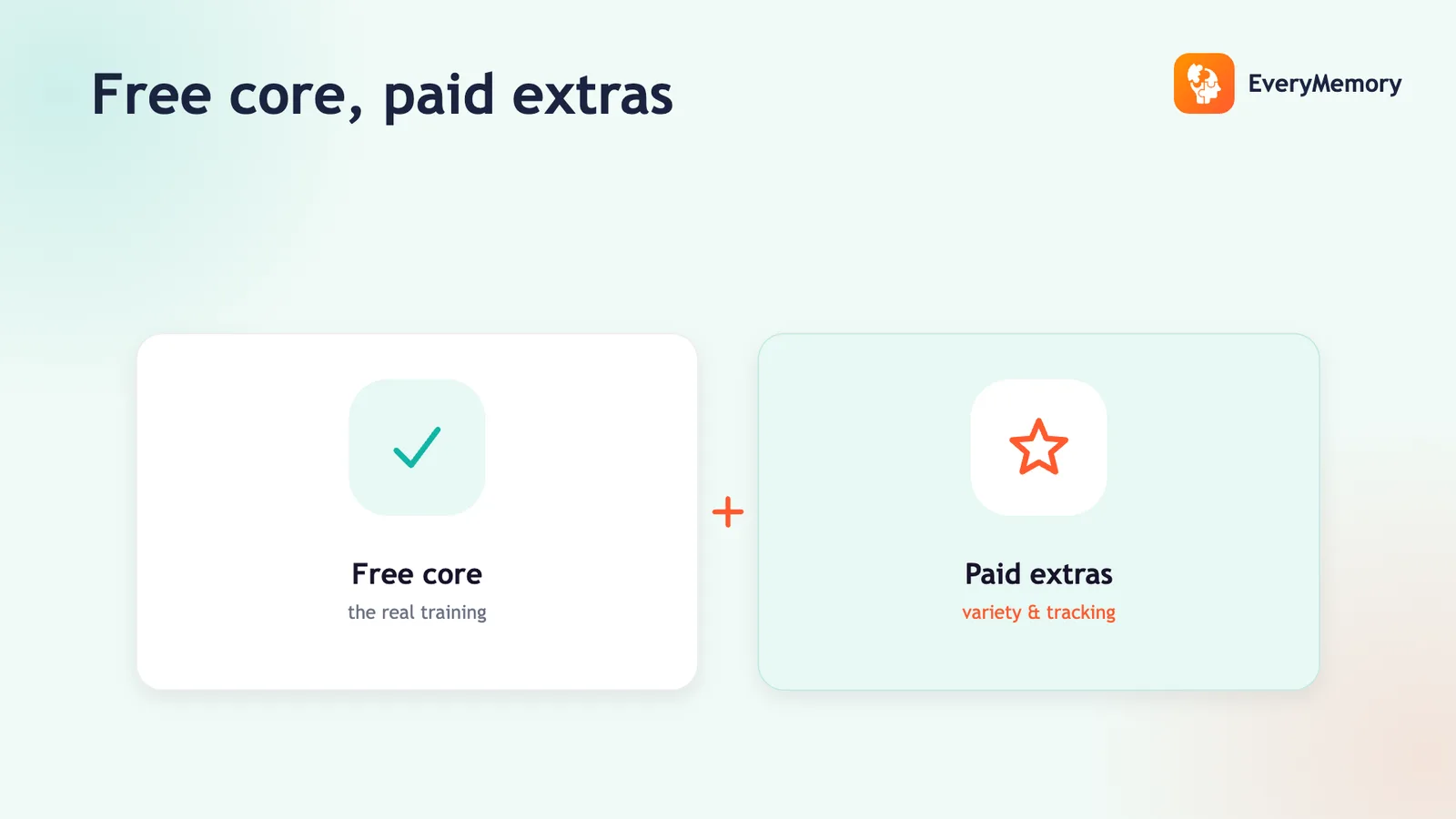
⚡ Quick answer
For most people, free brain training apps cover the essentials: adaptive games, a baseline, and consistent practice of a skill. Paid tiers mainly add more game variety, detailed progress tracking, and convenience features - not fundamentally better training. Start free, train consistently, and only pay if you hit a real limit like wanting more variety. Never pay for fake percentiles.
Key takeaways
- Free covers the core driver: adaptive practice done consistently.
- Paid mainly adds variety, deeper tracking, and convenience.
- Free is the only honest way to test before committing.
- Never pay for fake percentiles, "brain age," or medical promises.
The paid-versus-free question has a clearer answer than the marketing suggests. The core thing that drives improvement - adaptive practice of a skill, consistently - is available free. What you pay for is usually variety, deeper tracking, and convenience, not better core training.
Here's an honest breakdown of what each side actually gives you, when free is enough, and when paying is worth it - without quoting any specific prices, which change and vary by app anyway.
What each side gives you
Strip away the marketing and the difference is narrower than it looks. The core training value lives on the free side; the paid side is mostly extras.
| Free | Paid | |
|---|---|---|
| Adaptive games | Usually yes | Yes |
| Your-own-baseline tracking | Often yes | Yes, more detailed |
| Game variety | Limited selection | Larger library |
| Detailed stats / history | Basic | Deeper |
| Ads / interruptions | Sometimes | Usually removed |
When free is genuinely enough
If your goal is to take a baseline and train one or two skills consistently, free is plenty. The mechanism that produces improvement - adaptive difficulty plus regular practice - doesn't require a subscription. Many people get the full practical benefit without ever paying. See free brain training apps for what to expect.
Free is also the only honest way to test an app before committing. If you can't try it without a card, that's a reason for suspicion, not a reason to pay.
When paying is worth it
Paying makes sense once you've used a free app consistently and bumped into a real limit: you want more game variety to stay engaged, you want richer progress history, or you simply value an ad-free, frictionless experience. Those are legitimate reasons - convenience and variety have value once the habit is established.
What's never worth paying for is a fake percentile, a "brain age" number, or any medical-sounding promise. Those are marketing, and they don't get more real behind a paywall. The honest scope of benefit is in do brain games really work.
A sensible path
Start free. Train consistently for two to four weeks and watch your own baseline. If the habit sticks and you want more - more games, deeper stats, no ads - then upgrade with eyes open. If a free app already does the job, keep your money.
EveryMemory is free to start by design, so you can build the habit and judge it before any decision to pay. To choose well in the first place, run through how to choose a brain training app.