 EveryMemory
Printable Trivia Questions
Printable trivia questions with answers: ready-to-use rounds, what trivia actually exercises, how to build a themed quiz sheet, and printing tips for group play.
Part of the guide: Brain Exercises for Seniors: The Complete Guide →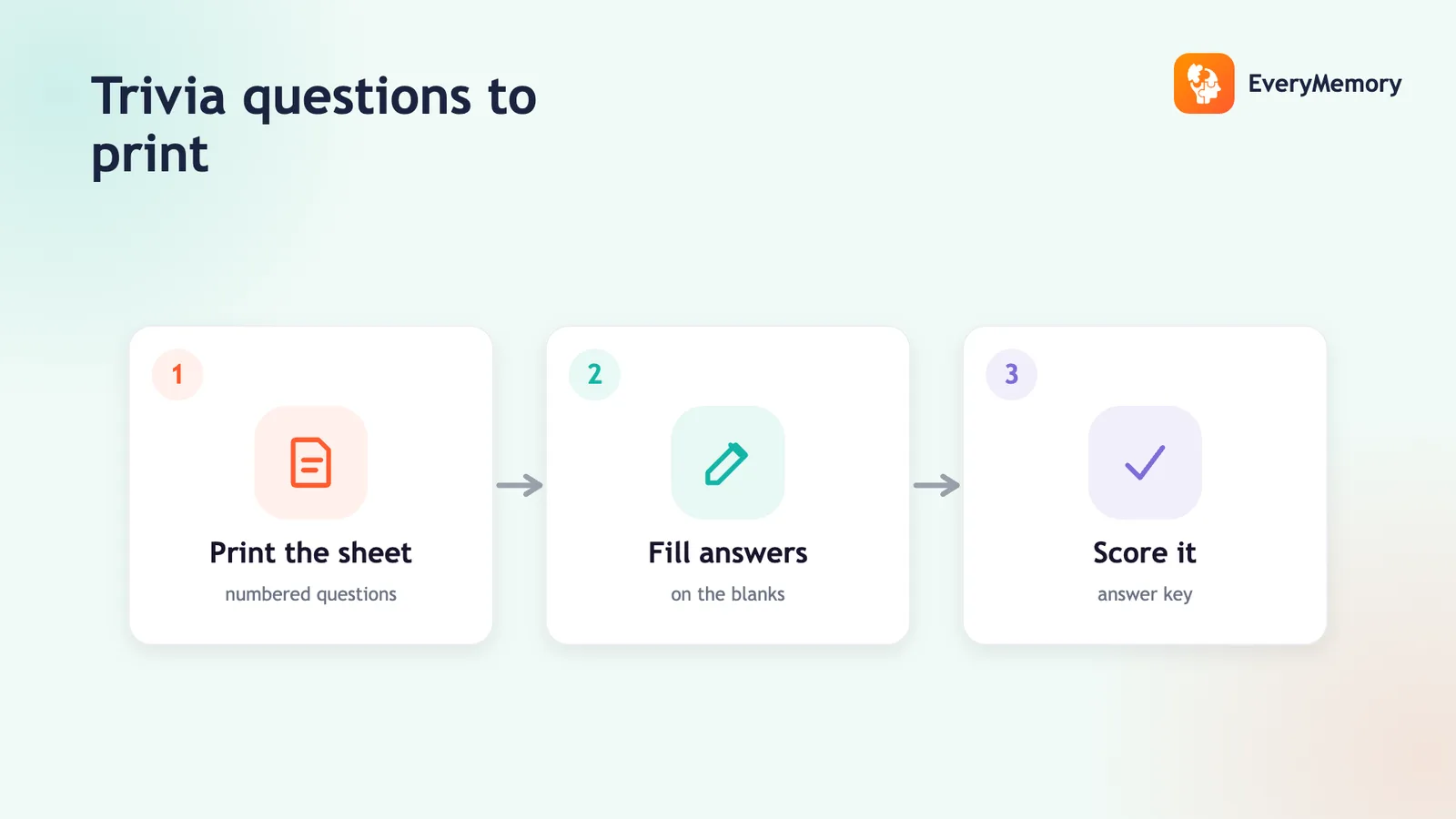
⚡ Quick answer
Printable trivia questions are quiz questions you print and answer, ideally grouped into themed rounds with an answer key. They mainly exercise general knowledge and word retrieval - recalling facts you already hold - rather than new memory encoding. They're a great sociable activity, and you can use the ready-made rounds below or build your own.
Key takeaways
- Three ready-to-use rounds with answers are on the page
- Trivia exercises stored knowledge and retrieval, not new memory
- Its real value is social - themed rounds boost engagement
- Print 16pt+, numbered, with a host-only answer sheet
Trivia is the most sociable puzzle there is. A printed quiz sheet turns a coffee morning, a family dinner, or a care-home afternoon into a shared game - and the chatter it sparks is half the fun. The trick is having good questions ready, sorted by difficulty, with answers on hand.
This page hands you exactly that: ready-to-use trivia rounds with answers, an honest note on what trivia trains, a quick way to build your own themed sheet, and printing tips for group play. The questions here work as a standalone quiz before you print a thing.
Three ready-to-use rounds (answers below)
Here are three short rounds across different topics. Read them aloud for a group, or hand them out as a sheet.
- General: What is the largest planet in our solar system?
- General: How many sides does a hexagon have?
- Geography: What is the capital of Australia?
- Geography: Which river runs through London?
- History: In which year did the Second World War end?
- History: Who was the first person to walk on the Moon?
- Nature: What is the fastest land animal?
- Nature: How many legs does a spider have?
Give everyone a moment per question, and let the discussion run - the best trivia nights are as much about the chat as the score.
The answers
- Jupiter.
- Six.
- Canberra (not Sydney - a classic catch).
- The River Thames.
- 1945.
- Neil Armstrong.
- The cheetah.
- Eight.
Notice what trivia draws on: stored general knowledge and the ability to retrieve it on demand. That's word and fact retrieval - enjoyable and engaging - rather than encoding something new. For more recall-style play, see memory games.
What trivia actually exercises
Be honest about the skill. Trivia tests knowledge you already hold and your ability to fish it back out - that tip-of-the-tongue retrieval. It's great for confidence and connection, and the social setting adds real value. But it isn't training new memory, and like any puzzle it won't prevent age-related change.
That said, the sociability matters. Doing a quiz together - laughing at near-misses, sharing what you each knew - is exactly the kind of engaged, connected activity that's worth building into a week. For the bigger picture, see keep your brain active.
Build a themed quiz sheet
A themed quiz beats a random one for engagement, especially with older players who light up at topics from their era.
- Pick a theme - 1960s music, classic films, gardening, local history.
- Write 10 questions, mixing easy and harder ones.
- Add a clear answer for each on a separate page.
- Group questions into rounds of five with a title.
- Print one quiz sheet per player and one answer sheet for the host.
Tailoring the theme to the room - a parent's youth, a hometown, a shared hobby - turns a generic quiz into something personal and memorable.
Printing for group play
For a group, legibility and layout matter. Print one quiz per player in large, clear type with space to write each answer, and keep the host's answer sheet separate. Number the questions clearly and leave a scoring column down the side.
| Element | Recommendation |
|---|---|
| Font size | 16pt or larger for easy reading |
| Layout | Numbered questions, answer line under each |
| Answer key | Separate host-only page |
| Rounds | Five questions each, with a title |
Keep it warm and low-stakes - trivia is a game, not an exam. The point is the shared half-hour, not the final tally.
✅ Try this today - Run a five-question round tonight
Turn the questions on this page into a quick group game.
- Pick five questions and read them aloud to the room.
- Give everyone a moment to call out or jot an answer.
- Reveal each answer and let the discussion run.
- Keep a light tally - first to five wins the round.
- Swap in a themed round next time to keep it fresh.


