 EveryMemory
Trivia and Brain Health
Is trivia good for your brain? An honest, non-medical answer: it's engaging, social, and great retrieval practice - but it isn't a shield against decline. Here's the real picture.
Part of the guide: Understanding Memory Loss and Forgetfulness: A Calm, Reassuring Guide →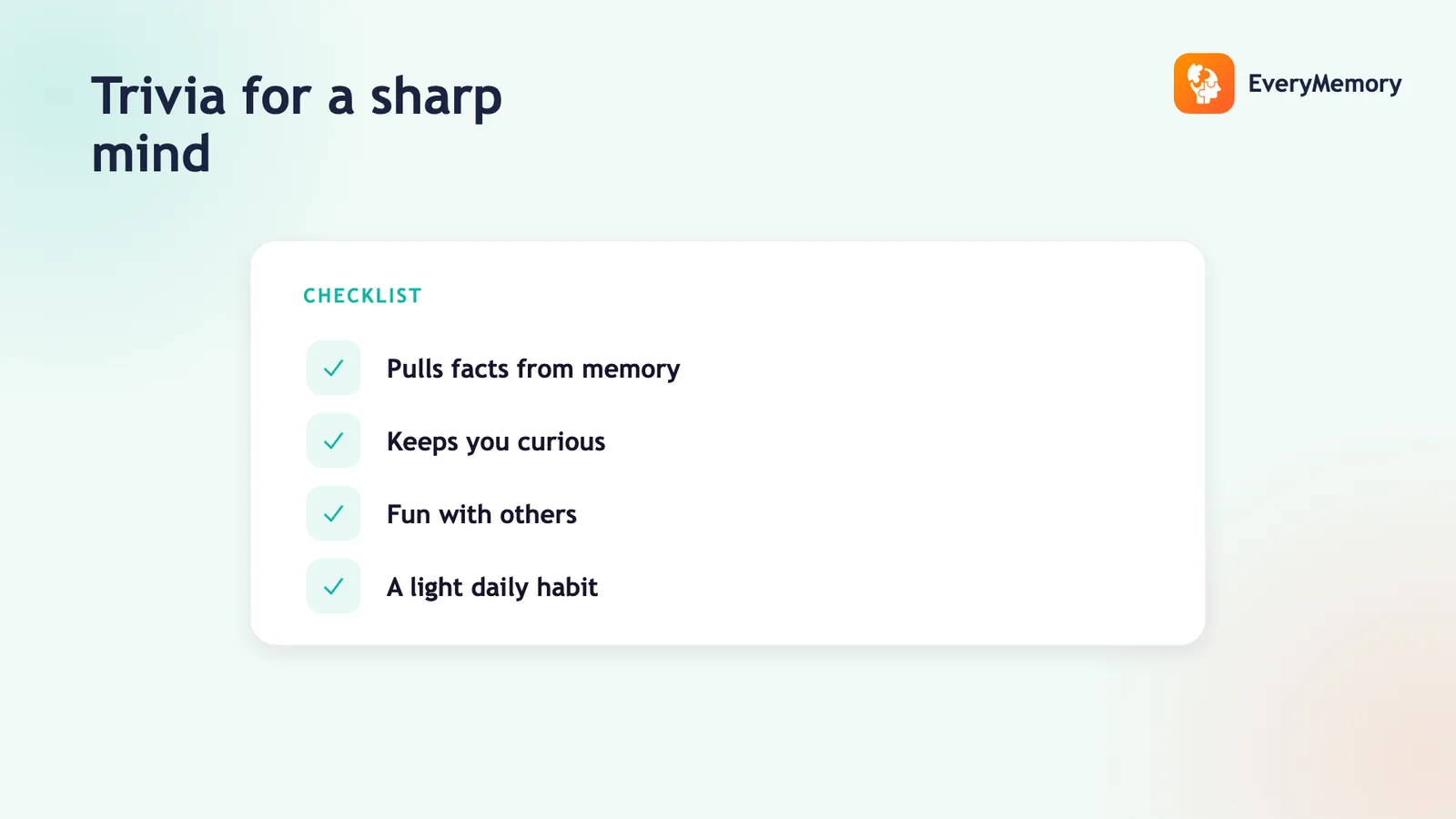
⚡ Quick answer
Trivia is good for staying mentally active and socially engaged, and quizzing yourself strengthens recall of the facts you practise. But it doesn't prevent cognitive decline, treat any condition, or boost overall memory capacity. Its honest value is engagement, retrieval practice, and fun - keep it in your week for those reasons, not as medicine.
Key takeaways
- Honest benefits: engagement, retrieval practice, social connection
- Trivia does not prevent decline, treat conditions, or raise IQ
- Engagement is the active ingredient, not the quiz format itself
- Best as one fun thread in a varied week, not a brain-health plan
"Trivia keeps your brain young" is the kind of headline that sells quiz books. The truth is gentler and more honest: trivia is a genuinely good way to stay mentally engaged and socially connected, and engagement matters - but it is not a treatment, it won't prevent decline, and no quiz will make you smarter overnight.
Let's separate the real, modest benefits from the overclaims. Done right, trivia is exactly the kind of pleasant, low-cost mental activity worth keeping in your week. Done as a panic-driven 'brain training' chore, it loses most of what makes it worthwhile.
The honest benefits
Trivia earns its place for a few clear, non-medical reasons. None of them are dramatic, and that's fine - pleasant, regular mental activity doesn't need to be dramatic to be worth doing.
- Engagement - it's mentally active time, which most people value over passive scrolling.
- Retrieval practice - pulling up answers strengthens recall of those facts.
- Social connection - quiz nights bring people together, and connection matters for wellbeing.
- Curiosity - a good question sends you off to learn something new.
- Low friction - it's cheap, portable, and genuinely fun, so you actually keep doing it.
For the wider context of staying engaged, see keep your brain active.
What trivia can't do
Here's where honesty matters. Quizzing does not prevent dementia, reverse age-related changes, or raise your IQ. Improving at trivia mostly means improving at trivia - the skills are narrow and don't transfer to unrelated everyday memory. Anyone selling quizzes as protection against decline is overstating the evidence.
This isn't a reason to stop quizzing; it's a reason to enjoy it for what it is. For the honest verdict on quiz-style brain training generally, see do memory quizzes work.
Engagement vs. the hard claims
The strongest case for trivia is engagement - and engagement is something researchers genuinely associate with staying mentally sharp, alongside sleep, movement, and social ties. But engagement is the active ingredient, not the quiz format itself. A lively book club or learning an instrument offers the same engagement with a different flavour.
| Claim | Honest verdict |
|---|---|
| "Trivia keeps your mind active" | True - it's engaging mental activity |
| "Trivia is fun and social" | True - a big part of its value |
| "Trivia builds your memory" | Overclaim - it practises recall of those facts only |
| "Trivia prevents memory loss" | No - don't believe this |
| "Trivia raises your IQ" | No - it reflects knowledge, not reasoning speed |
Trivia as part of a fuller week
Treat trivia as one enjoyable thread in a varied week rather than your whole brain-health plan. The things with the strongest evidence behind them - regular movement, decent sleep, social contact, and managing stress - do the heavy lifting; trivia adds engagement and fun on top. That's a perfectly good role for it.
If you'd rather a structured daily option, a few minutes of varied puzzles works too - see brain games online for the honest pros and cons.


