 EveryMemory
Types of Intelligence
Are there really nine types of intelligence? The popular 'multiple intelligences' framework is appealing but debated. Here's an honest tour of how psychologists actually carve up the mind.
Part of the guide: How to Keep Your Brain Healthy: A Complete Lifestyle Guide →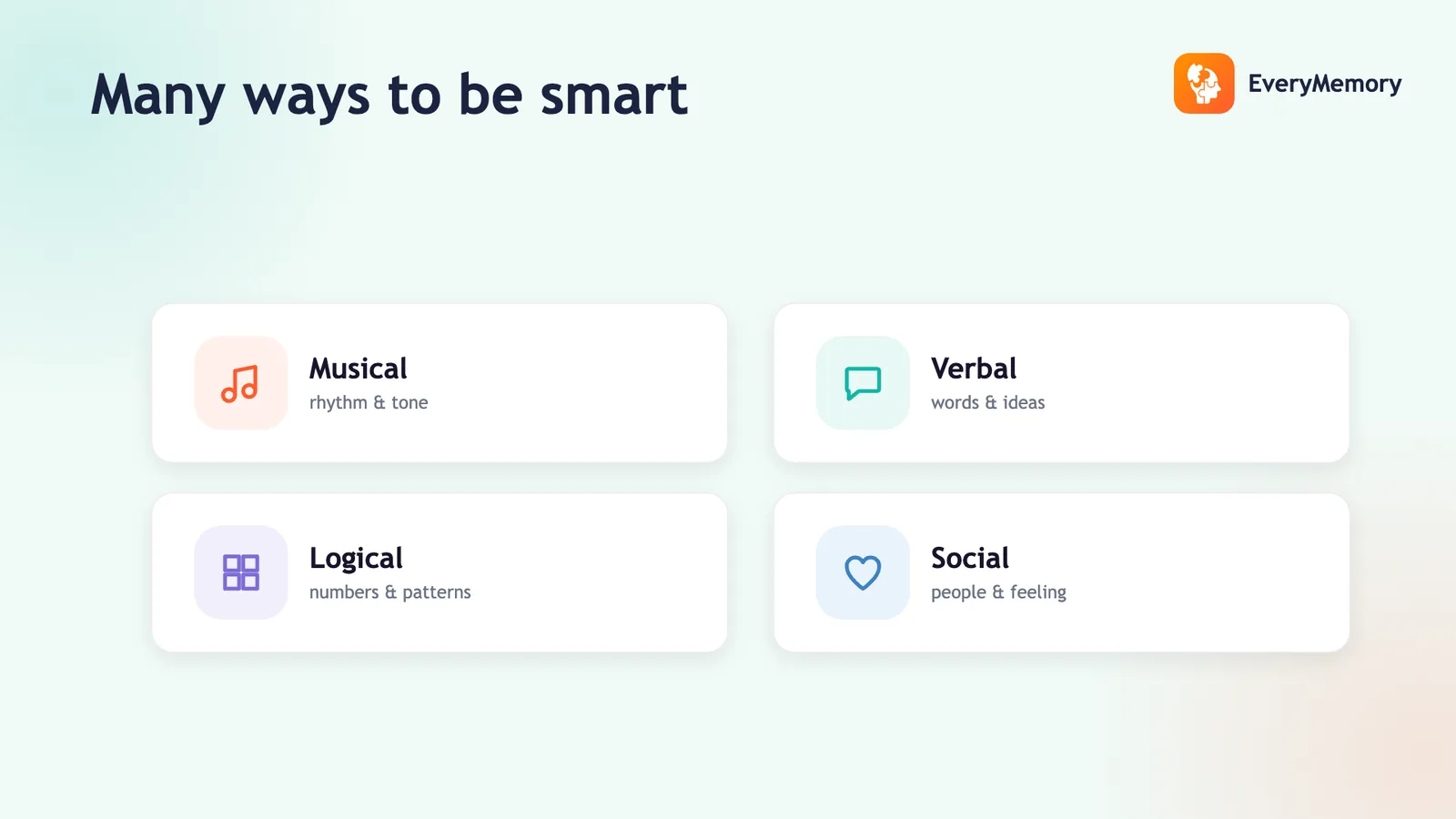
⚡ Quick answer
There's no single agreed list of intelligence types. The popular "multiple intelligences" framework proposes distinct abilities like linguistic, logical, musical, and interpersonal - but it's debated and not strongly evidence-backed. Better-supported distinctions include fluid vs crystallized intelligence and the broad general-reasoning factor IQ tests measure.
Key takeaways
- There's no single agreed list of intelligence types.
- Gardner's multiple intelligences is a popular framework, debated and not strongly evidenced.
- Better-supported distinctions: fluid vs crystallized, plus a general reasoning factor.
- Learning styles is a related, popular claim that the evidence doesn't support.
"There are nine types of intelligence" is one of the internet's favourite facts. It's reassuring - it suggests everyone is gifted in some way - and it's everywhere in education and self-help. The honest position is more careful: this is a popular framework, not settled science, and it sits alongside other, better-evidenced ways of dividing up the mind.
So this guide does two things. It explains the famous "multiple intelligences" idea fairly, and it places it next to the distinctions that have held up better in research. The goal isn't to debunk anything for sport - it's to let you use these ideas without overselling them.
The popular framework: multiple intelligences
In the 1980s psychologist Howard Gardner proposed that intelligence isn't one ability but several relatively independent ones. The idea struck a chord, especially in education, because it reframed "smart" as something everyone has a version of.
- Linguistic - facility with words and language.
- Logical-mathematical - reasoning, numbers, and patterns.
- Spatial - visualizing and manipulating objects in the mind.
- Musical - sensitivity to rhythm, pitch, and tone.
- Bodily-kinesthetic - physical coordination and control.
- Interpersonal - understanding and working with others.
- Intrapersonal - self-awareness and reflection.
- Naturalistic - recognizing patterns in the natural world.
It's an attractive, generous picture. The catch is the evidence.
Why it's debated, not settled
The trouble is that Gardner's "intelligences" don't behave like fully independent systems. When researchers measure these abilities, they tend to correlate - people good at one are, on average, somewhat good at others - which is exactly what the older idea of a general reasoning factor predicts. Critics argue several of Gardner's categories look more like talents or interests than separate intelligences.
There's also the closely related "learning styles" claim (that you're a visual or auditory learner) - popular, intuitive, and not supported by evidence that matching teaching to a style improves results. Treat multiple intelligences as a useful way to value diverse strengths, not as a proven map of the brain.
Distinctions that hold up better
Some divisions of intelligence rest on firmer ground. The clearest is fluid versus crystallized intelligence - reasoning with new problems versus accumulated knowledge - which is well established and ages in measurable ways. We cover it in fluid vs crystallized intelligence.
There's also the broad general-reasoning factor that IQ tests are built to capture, which is why subtests tend to correlate. None of this denies that people have wildly different strengths - it just locates those strengths more accurately. For the underlying score, see what is IQ.
How to use this honestly
The practical takeaway isn't "pick your intelligence type." It's that intelligence is multi-faceted, much of it is built through learning and practice, and labelling yourself as one fixed type can quietly limit you.
If you want to grow, target real, trainable abilities rather than a category. Sharpening reasoning, memory, and knowledge pays off regardless of which framework you prefer - see how to be smarter for the practical version.
⚠ When to talk to a professional
This is general educational information, not medical or psychological advice. Frameworks like multiple intelligences are models, not diagnoses, and shouldn't be used to label anyone's ability or limits.


