 EveryMemory
What Makes Someone Intelligent?
Intelligence is more than a test score. It's a blend of reasoning, knowledge, judgement, creativity, emotional skill, and drive - much of it built rather than born. Here's the honest, fuller picture.
Part of the guide: How to Keep Your Brain Healthy: A Complete Lifestyle Guide →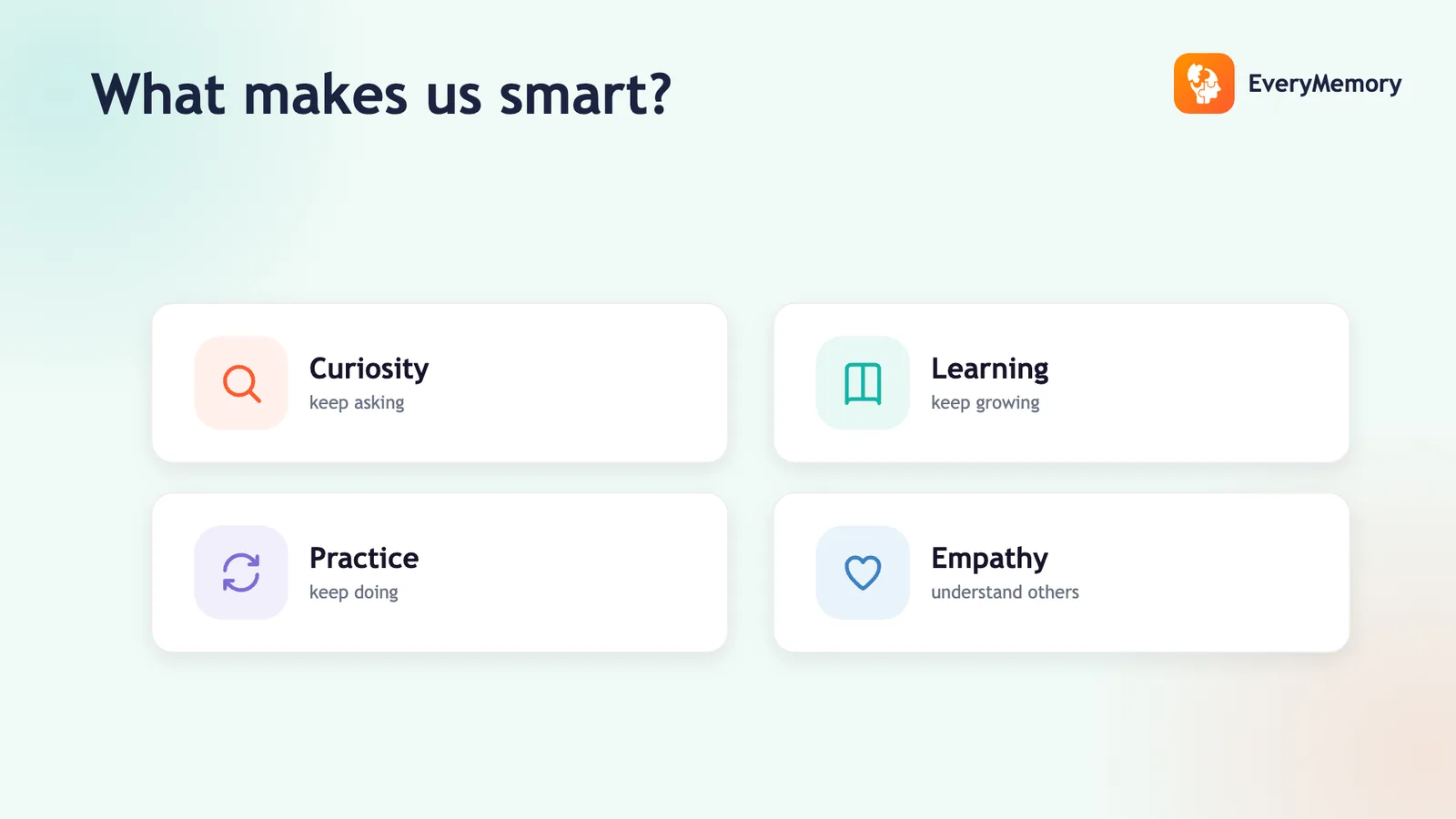
⚡ Quick answer
Intelligence is a blend, not a single number. It combines reasoning ability (what IQ captures), accumulated knowledge, practical judgement, creativity, emotional skill, and the drive to apply all of it. Much of it is built through learning and practice rather than fixed at birth - which is why no one trait defines a smart person.
Key takeaways
- Intelligence is a blend: reasoning, knowledge, judgement, creativity, emotional skill, drive.
- IQ measures the reasoning slice well and the rest barely at all.
- Judgement and knowledge often matter more than raw reasoning speed.
- Much of it is built through learning and practice, not fixed at birth.
Ask what makes someone intelligent and most people reach first for IQ. But anyone who's met a high scorer with terrible judgement, or a modest scorer with extraordinary wisdom, knows the number can't be the whole story. Intelligence in the real world is broader, messier, and more interesting than a single test captures.
This guide assembles the fuller picture. It treats reasoning ability as one ingredient among several, takes seriously the parts IQ ignores, and resists the tidy myth that intelligence is a fixed gift you either have or don't. Much of what makes someone effective is built, not bestowed.
The ingredients, not the number
It helps to see intelligence as a set of contributing ingredients rather than one quantity. Each does something different, and a person can be strong in some and ordinary in others.
| Ingredient | What it does |
|---|---|
| Reasoning ability | Solving novel problems - the slice IQ measures |
| Knowledge | Crystallized expertise that makes reasoning useful |
| Judgement | Knowing what matters and deciding well |
| Creativity | Generating new, useful ideas |
| Emotional skill | Reading and working with people |
| Drive | The motivation to actually apply the rest |
IQ measures the first row well and the rest barely at all - which is why it captures only a slice. We make that limit explicit in do IQ tests measure intelligence.
Why judgement and knowledge matter so much
Raw reasoning power is close to useless without knowledge to apply it to and judgement to aim it. This is why a brilliant reasoner can still make poor decisions, and why deep expertise - crystallized intelligence - does so much of the real work. It keeps growing for decades, as we cover in fluid vs crystallized intelligence.
Judgement is the most underrated ingredient. Knowing which problems are worth solving, when to act, and when you're out of your depth often matters more than how fast you can solve an abstract puzzle. It's intelligence in action rather than intelligence on paper.
The role of drive
No combination of ability does anything on its own. Drive - motivation, persistence, the willingness to keep going at something hard - is what converts potential into results. Plenty of high-ability people accomplish little, and plenty of moderate-ability people achieve a great deal, and the gap is usually effort and persistence.
This is encouraging, because drive is something you direct rather than something fixed at birth. It's also why "how smart you are" predicts far less about your life than how consistently you apply what you've got.
Built, not just born
The most important and most hopeful point: a large share of what makes someone intelligent is built. Knowledge accumulates through learning, judgement sharpens with experience, emotional skill grows with practice, and even reasoning gets honed through harder thinking. The fixed-gift framing quietly discourages exactly the effort that helps most.
Reasoning ability does have real limits to how far you can move it durably, but everything around it is highly trainable. For the practical playbook, start with how to be smarter - it focuses on the parts you can genuinely build.
⚠ When to talk to a professional
This is general educational information, not medical or psychological advice, and no article can measure anyone's intelligence or potential. For any genuine concern about your thinking, please consult a qualified professional.


