 EveryMemory
Are Crosswords Good for Your Brain?
Crosswords are a rich workout for vocabulary and verbal recall, and they're genuinely absorbing. But like all puzzles, the benefit is mostly crossword-specific - here's the honest read.
Part of the guide: How to Keep Your Brain Healthy: A Complete Lifestyle Guide →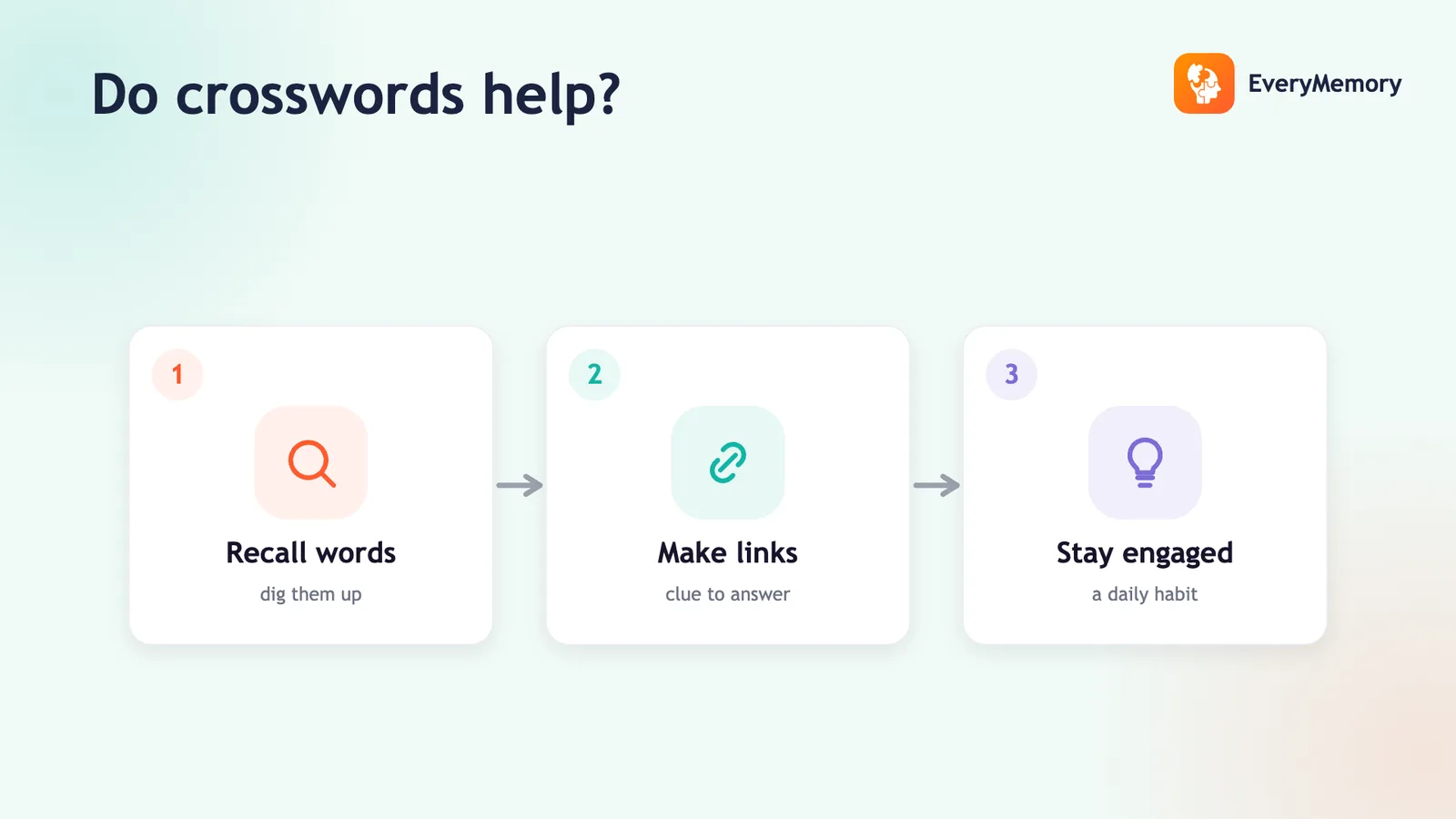
⚡ Quick answer
Crosswords are good mental exercise: they exercise vocabulary, verbal recall, and the ability to dig a word out of memory from oblique clues. They're absorbing and worthwhile. But the benefit is largely crossword-specific - they won't broadly raise intelligence or prevent decline. Enjoy them as engaging practice, not protection.
Key takeaways
- Exercises vocabulary and verbal recall via clue retrieval
- Much of the 'younger brain' research is selection effects
- Gains are largely verbal and crossword-specific
- Pair with non-verbal puzzles for variety
Few puzzles have a better reputation than the crossword. It's the one your grandparents swore by, the one studies keep poking at, the one people credit for keeping a mind "young." And it deserves real credit: a good crossword is a genuine retrieval workout that can keep you stuck and satisfied for an hour.
But "good for your brain" hides two very different claims. One is that crosswords are demanding, enjoyable mental work - clearly true. The other is that they protect or upgrade your brain in some lasting way - and that's where the honest answer gets more careful.
What a crossword actually trains
A crossword is a retrieval engine. A clue dangles a definition, a pun, or a wordplay trap, and your job is to pull the matching word out of long-term memory with only a letter or two as scaffolding. That act - searching memory for a word that fits both meaning and shape - is the core skill, and cryptic crosswords add a layer of lateral, rule-based decoding on top.
- Verbal recall - retrieving a known word from a partial cue.
- Vocabulary and general knowledge - the wider your store, the more you solve.
- Pattern fitting - matching answers to crossing letters and lengths.
- Lateral thinking - especially in cryptics, where the surface lies to you.
If you want to understand the recall side more deeply, mental stimulation and memory covers how retrieval practice works.
The honest limit: you mostly get better at crosswords
The famous studies are real but easy to over-read. People who do crosswords regularly tend to score well on verbal tests - but a lot of that is selection: people with strong vocabularies enjoy crosswords in the first place. When you actually train people, they get faster and better at crosswords, while broad, untrained abilities barely shift.
So the careful claim is: crosswords sharpen and exercise the verbal knowledge you already have and keep your retrieval limber, which is worthwhile. What they don't do is reliably make you better at unrelated cognitive tasks or prevent decline. That's not a knock - it's just the truth that makes the habit honest.
Crossword versus sudoku versus word search
| Puzzle | Mainly exercises | Honest limit |
|---|---|---|
| Crossword | Vocabulary, verbal recall, lateral thinking | Benefit is largely verbal and crossword-specific |
| Sudoku | Logic, working memory | Sharpens logic inside the grid, narrow transfer |
| Word search | Visual scanning, attention | Light on memory; mostly a search task |
The takeaway isn't to crown one. It's that variety beats repetition - different puzzles touch different abilities. Compare the scanning-heavy cousin in word search and memory.
Getting more from the habit
To keep a crossword challenging rather than rote, climb in difficulty, mix in cryptics, and don't reach for the reveal button at the first stuck moment - the struggle to retrieve is where the work happens. And pair it with non-verbal challenges so you're not exercising one slice of cognition forever.
That deliberate variety is the point of structured training. A daily crossword is great engagement; a balanced routine spreads the load. See keep your brain active for how to build one around the puzzles you love.
⚠ When to talk to a professional
This is general educational information, not medical advice, and crosswords are not a treatment for or protection against any condition. If you have a genuine or persistent concern about your memory or thinking, please speak with a doctor or qualified professional.


