EveryMemory
Word Search and Memory
Word search is relaxing and great for visual scanning - but it's much lighter on memory than people assume. Here's the honest read on what it actually trains.
Part of the guide: How to Keep Your Brain Healthy: A Complete Lifestyle Guide →
⚡ Quick answer
Word search is mostly a visual-scanning and attention task, not a memory workout. You hunt a visible grid for visible words - there's almost nothing to recall. It's relaxing, absorbing engagement that exercises focus and search, but if your goal is memory, word search is the wrong tool. Enjoy it as calm attention practice.
Key takeaways
- Mostly visual scanning and attention, not memory
- Answers are on the page - almost nothing to recall
- Relaxing, absorbing calm-attention practice
- For memory, choose recall-based activities instead
Word searches feel like brain food. They're often grouped with crosswords and sudoku as "memory puzzles," handed out as gentle cognitive exercise, and quietly trusted to keep the mind ticking. They are relaxing and absorbing - but the memory label is the part that needs an honest correction.
Because when you look at what a word search actually asks of you, very little of it is memory. The real work is somewhere else entirely, and naming it correctly tells you what the puzzle is good for.
What a word search actually exercises
Strip a word search to its mechanics: you have a list of words and a grid, both fully visible, and you scan the grid in every direction until you find each word. There's no recall - the answers are printed right there. What the task demands is disciplined visual search, attention to letter patterns, and the focus to keep hunting without skipping.
- Visual scanning - sweeping the grid in multiple directions.
- Pattern recognition - spotting a word's shape among noise.
- Sustained attention - staying with the search to the last word.
- Letter-level perception - distinguishing near-miss sequences.
That's an attention profile, not a memory one. For what real memory work looks like, see working memory vs short-term memory.
Be honest: word search is light on memory
Here's the correction. A word search barely touches memory because nothing is hidden in your head - everything you need is on the page. You might briefly hold a target word in mind while you scan for it, which is a sliver of working memory, but that's the whole memory content. Calling it a memory exercise oversells it considerably.
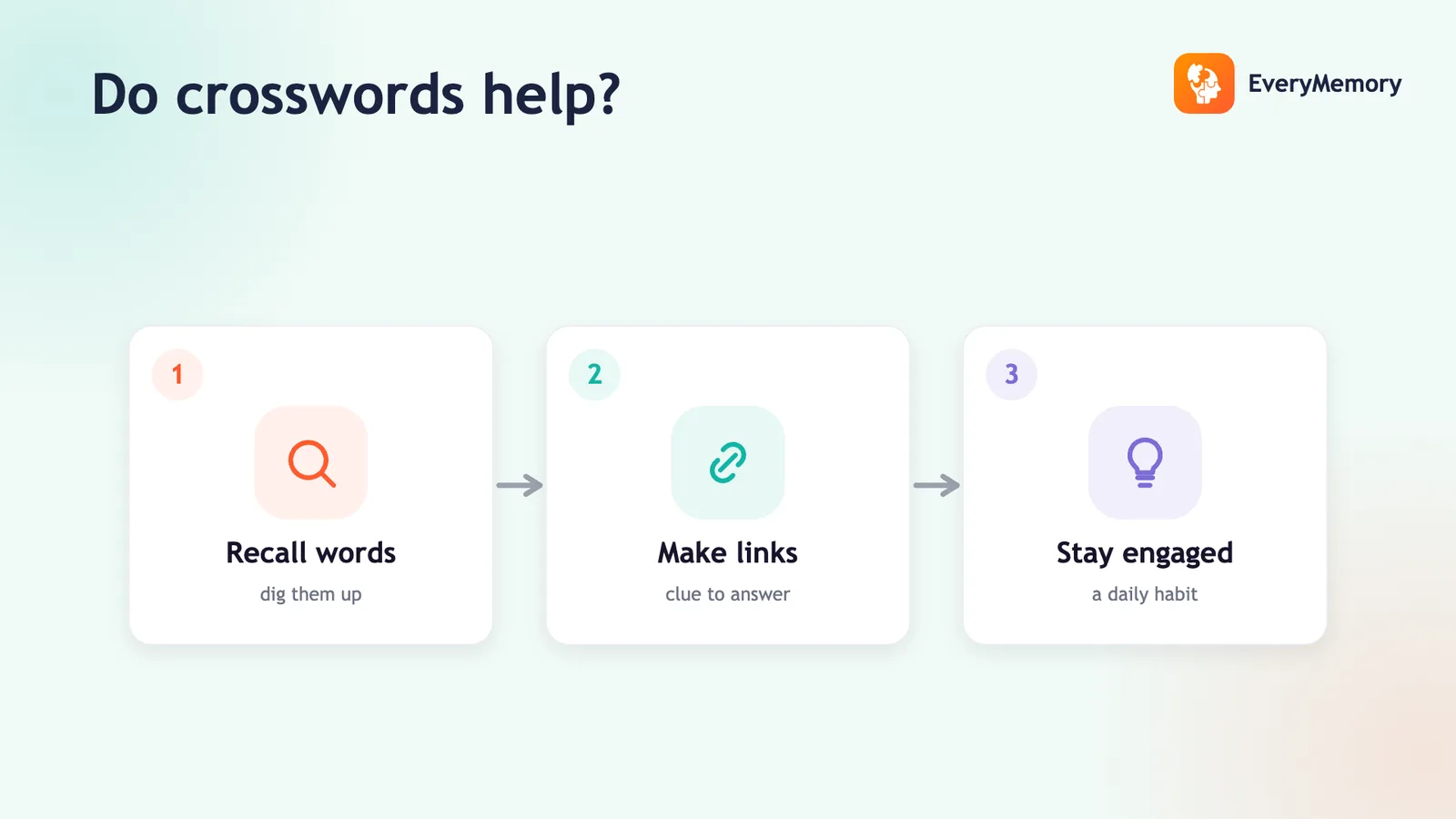
Compare it with a crossword, where you genuinely retrieve a word from long-term memory using only a clue. That's a real recall demand. A word search is closer to spot-the-difference: a search-and-attention task wearing a vocabulary costume.
Word search versus its lookalikes
| Puzzle | Mainly exercises | Memory demand |
|---|---|---|
| Word search | Visual scanning, attention | Very light |
| Crossword | Verbal recall, vocabulary | Genuine recall |
| Spot the difference | Visual search, comparison | Very light |
| Sudoku | Logic, working memory | Moderate working memory |
If you came for memory, the crossword is the better-aimed cousin - see are crosswords good for your brain.
The genuine value, honestly framed
None of this means skip word searches. They're calming, low-pressure, and a pleasant way to practise sustained visual attention - and for many people that relaxed focus is exactly the appeal. Just match the puzzle to the goal: word search for calm attention, recall-based activities for memory.
If memory is what you're after, choose tools built for retrieval rather than search - see mental stimulation and memory.
⚠ When to talk to a professional
This is general educational information, not medical advice, and word searches are not a treatment for or protection against any condition. If you have a genuine or persistent concern about your memory or thinking, please speak with a doctor or qualified professional.