 EveryMemory
What Makes a Good Brain Training App
A good brain training app adapts difficulty to you, tracks your own baseline, makes honest non-medical claims, and is free to try - here's the full standard.
Part of the guide: How to Keep Your Brain Healthy: A Complete Lifestyle Guide →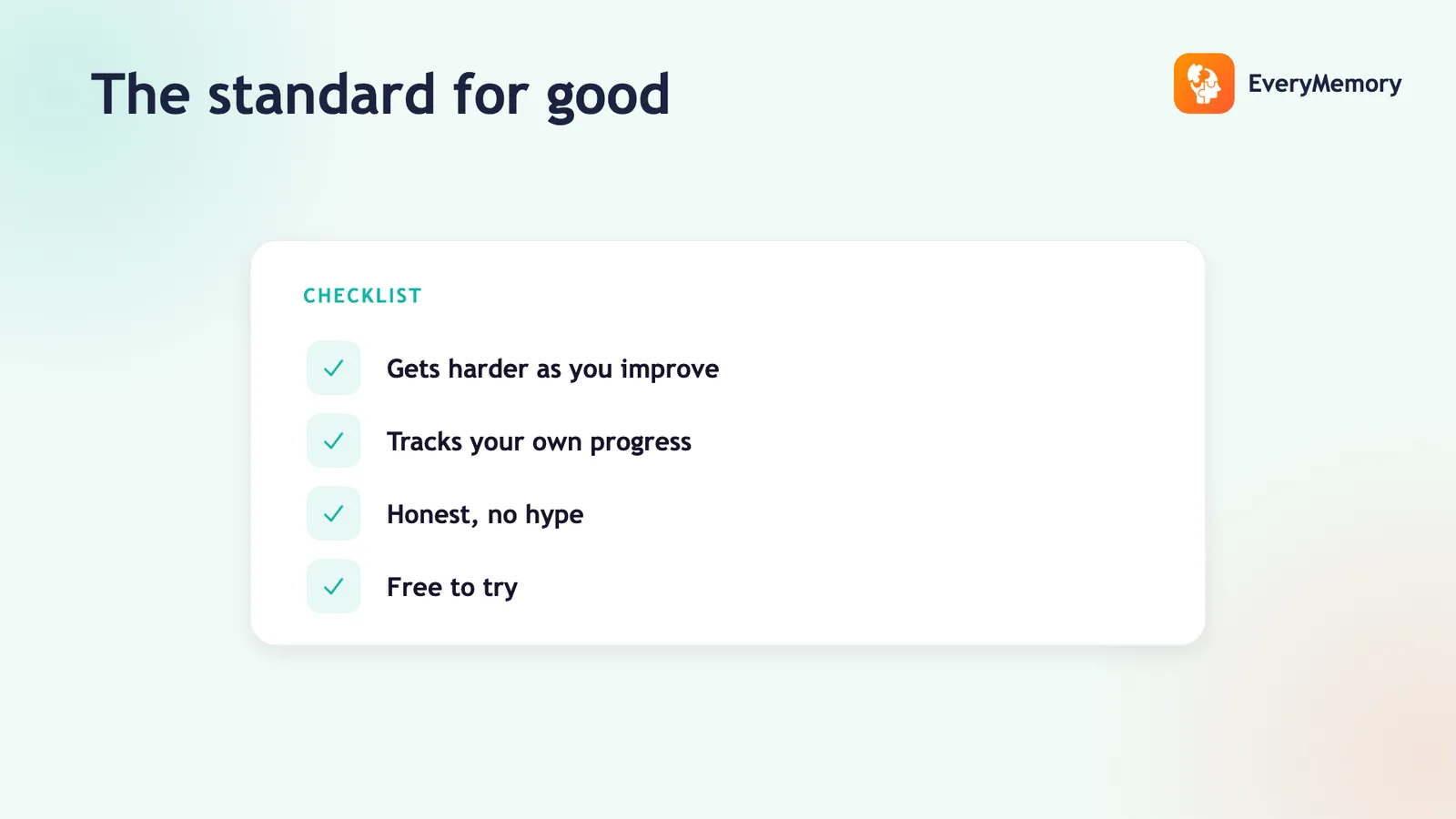
⚡ Quick answer
A good brain training app does five things: adapts difficulty to your level so you stay challenged, tracks your own baseline instead of fake percentiles, makes honest claims (trained skills improve; broad transfer is limited), avoids any medical or fear-based marketing, and lets you try it free before paying. Polish and game count are secondary - those five are the substance.
Key takeaways
- Adaptive difficulty is the non-negotiable defining feature.
- Good tracking compares you to yourself, never to strangers.
- Claims stay evidence-honest and strictly non-medical.
- Game count is secondary to criteria; calm tone beats fear marketing.
Strip away the graphics and the marketing, and a good brain training app comes down to a handful of things done right. Most apps nail the polish and miss the substance. This is the substance - the standard worth holding every app to, including the one you currently use.
None of these criteria are about looks or game count. They're about whether the app is built to improve you honestly or built to keep you subscribed. Here's the full standard, and why each part matters.
It adapts to you
The defining feature of real training is adaptive difficulty: the app keeps you in the zone just past your current ability, ramping up as you improve and easing when you struggle. Fixed levels can't do that - too easy for some, too hard for others, and stale once you've cracked the pattern. If an app doesn't respond to your performance, it isn't training you.
Test it directly: play one round well, one badly, and watch whether the difficulty moves. That two-minute check is the most informative thing you can do.
It tracks your own baseline
Good progress tracking compares you to yourself over time - your score this week versus last, on the same task. That's actionable. What's not good is a percentile against unverified strangers or a single "brain age" number; those feel motivating and measure nothing. A good app shows you your own trend and resists the temptation to sell you a flattering rank.
This is also an app-store-safety marker. Honest apps avoid fake benchmarks because they don't stand up - and that honesty is a feature, not a limitation.
Its claims are evidence-honest
A good app tells you the truth about what it does: you improve at the skills you practise, that transfers modestly to closely related tasks, and broad gains in general intelligence are not on offer. It makes no medical claims - no diagnosing, treating, or preventing anything. The balanced evidence is here.
Honest claims are a sign of a serious product. Overselling - IQ promises, decline prevention, fear-based hooks - is a sign the marketing is doing work the product can't.
The full standard, at a glance
Here's the complete checklist in one place. Score any app against it.
| Criterion | Good | Bad |
|---|---|---|
| Difficulty | Adapts to your level | Fixed for everyone |
| Tracking | Your own baseline | Fake percentiles / brain age |
| Claims | Trained skills improve | Smarter brain / IQ gains |
| Marketing | Calm, practice-based | Fear of decline |
| Access | Free to try first | Paywall before play |
EveryMemory is built to this standard - adaptive, self-relative, evidence-honest, non-medical, free to start. To put the checklist to work, see how to choose a brain training app.