 EveryMemory
Do Learning Styles Exist?
The idea that you're a "visual" or "auditory" learner is popular but unsupported - matching teaching to a style doesn't improve learning. Here's what actually works.
Part of the guide: How to Keep Your Brain Healthy: A Complete Lifestyle Guide →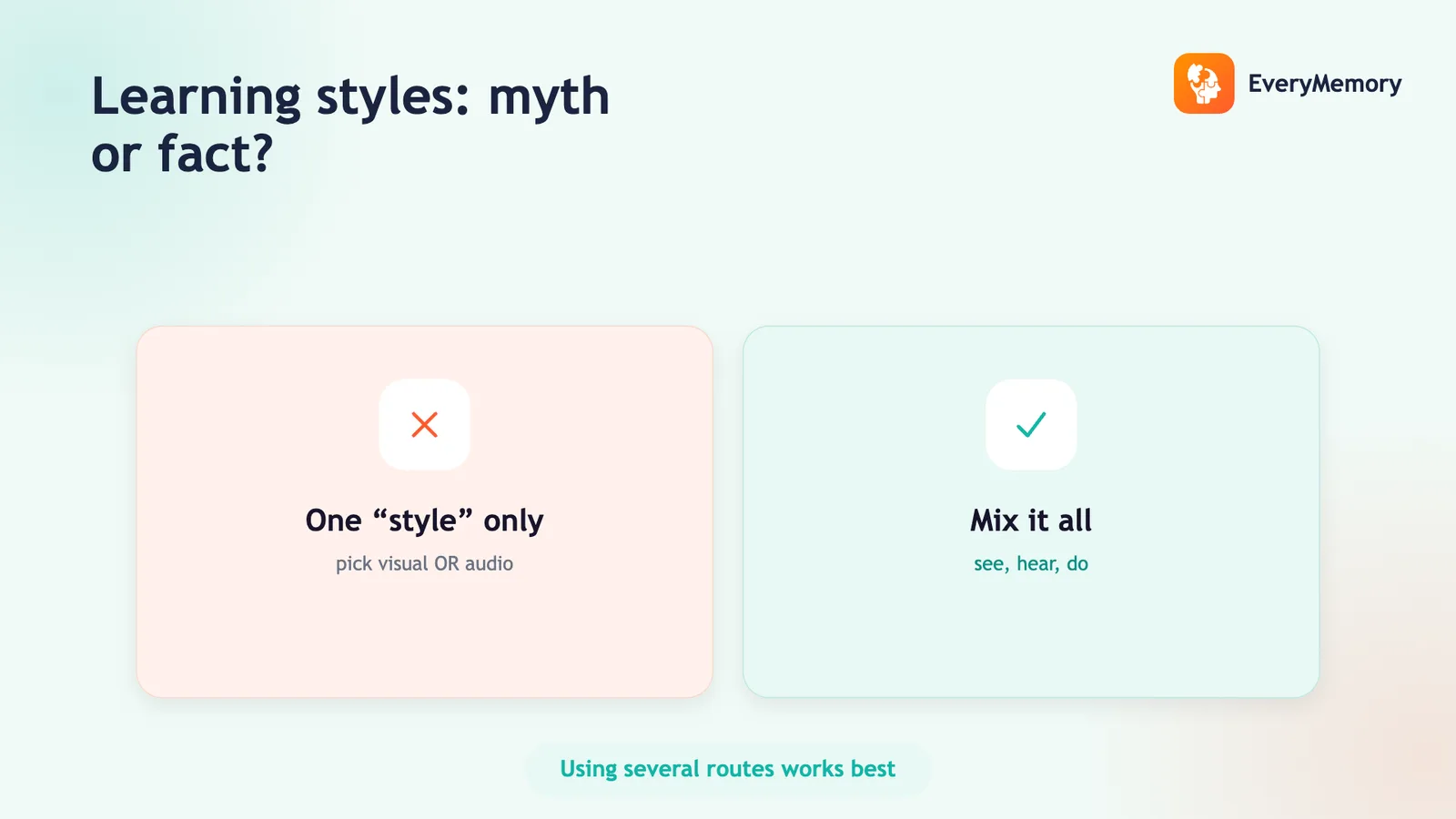
⚡ Quick answer
Fixed learning styles like "visual" or "auditory" learners aren't supported by evidence. People do have format preferences, but studies show that matching instruction to a supposed style doesn't improve how much you learn. What works is matching the format to the material and using proven strategies like active recall and spacing.
Key takeaways
- Fixed VAK learning styles aren't supported by evidence.
- Matching teaching to a "style" doesn't improve retention in tests.
- Preferences are real, but they don't predict how well you learn.
- Active recall, spacing, and format-to-material actually work.
Most of us have been told we're a particular kind of learner - visual, auditory, or hands-on - and that we'll learn best if material is delivered in our style. It's intuitive, widely taught, and printed in countless training materials. It also doesn't hold up. When researchers actually test the claim, matching the teaching method to a person's supposed style doesn't produce better learning.
This matters because the myth wastes effort. People relabel themselves, avoid useful formats, and chase a personalised method that the evidence says won't help. The honest picture is more useful - it points you at strategies that genuinely work for nearly everyone.
The claim and the test
The popular model - often called VAK, for visual, auditory, kinesthetic - says each person has a dominant channel and learns best through it. The crucial, testable prediction is that visual learners taught visually should outperform visual learners taught some other way.
When this "matching" prediction is tested directly, it fails. People learn about as well regardless of whether the format matches their claimed style. Preferring a format isn't the same as learning better from it - and it's the learning, not the preference, that counts.
Why it feels so true anyway
The myth survives because it's flattering and tidy, and because preferences are real even when their power isn't. You might genuinely enjoy diagrams more than lectures. But enjoying a format and retaining more from it are different things, and the comfort of "that's just not my style" can quietly excuse avoiding hard but useful methods.
There's also a kernel of truth that gets overstated: the best format usually depends on the material, not the person. Geography wants maps; music wants sound. Match the format to the subject, not to a personality label.
Myth versus fact
| Learning-styles claim | What the evidence shows |
|---|---|
| You have one fixed learning style. | You have preferences; they don't reliably predict how well you learn. |
| Teach to the style for better results. | Matching to a style doesn't improve retention in controlled tests. |
| Visual learners should avoid text. | Everyone benefits from varied formats matched to the material. |
| Knowing your style boosts grades. | Strategies like recall and spacing boost learning; style labels don't. |
What actually improves learning
Drop the labels and use methods that work for nearly everyone: test yourself instead of rereading, space study out over days, mix related topics, and explain ideas in your own words. These are dull to market but reliable in practice.
- Use active recall - try to retrieve before you check the answer.
- Space your sessions across days rather than cramming.
- Match the format to the material, not to a self-label.
- Explain the idea aloud, as if teaching someone.
These strategies double as memory practice. For the related debunk on brain-type quizzes, see the left-brain vs right-brain myth, and for keeping your mind engaged generally, see keep your brain active.
⚠ When to talk to a professional
This is general educational information, not medical advice, and nothing here diagnoses or assesses any condition. If you have concerns about learning or memory, please speak with a qualified professional.


