 EveryMemory
Hearing, Vision and Memory: Why They Matter
Uncorrected hearing or vision problems can look a lot like forgetfulness - and addressing them is one of the most straightforward ways to support sharper recall after 60.
Part of the guide: How to Keep Your Brain Healthy: A Complete Lifestyle Guide →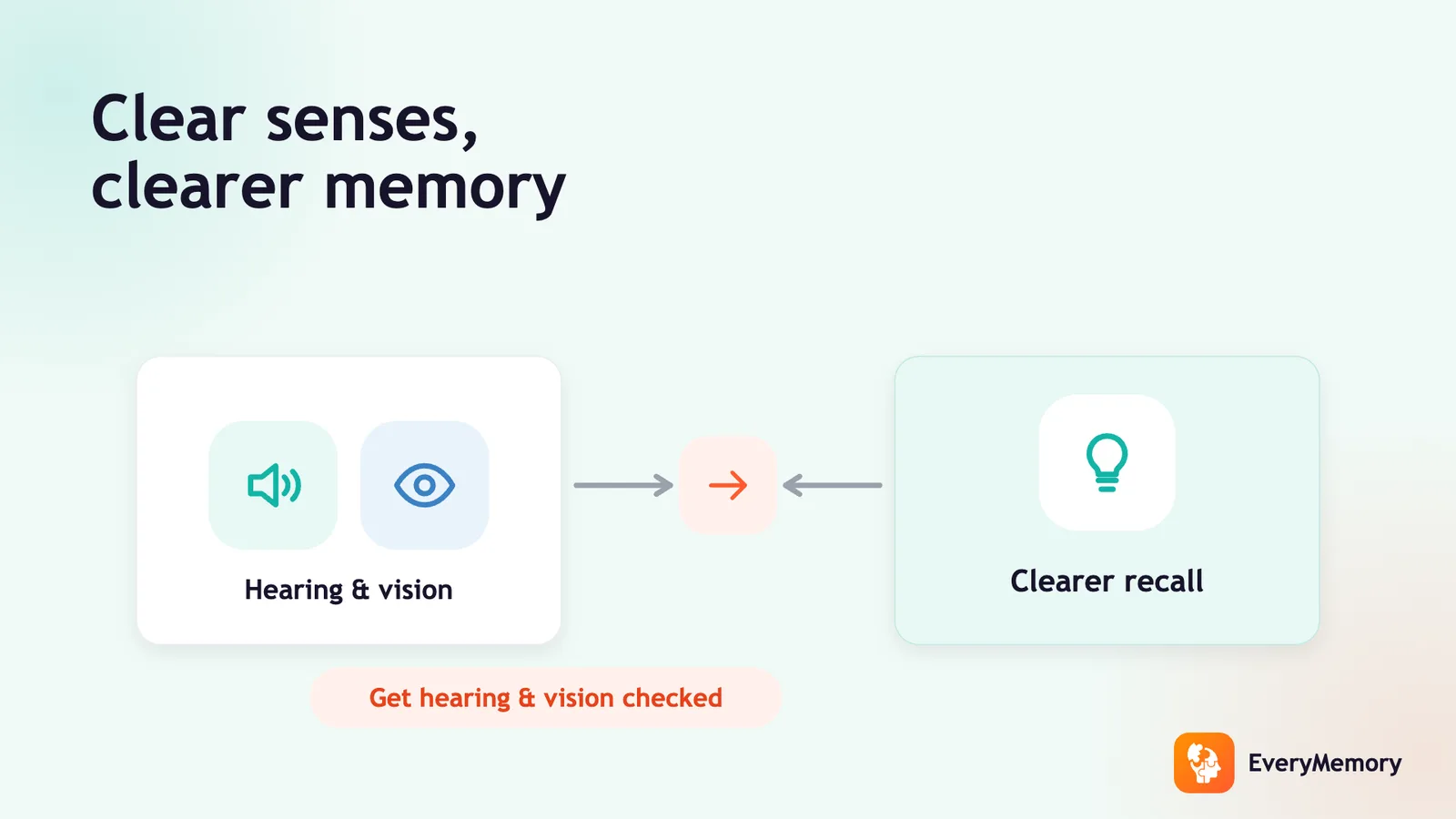
⚡ Quick answer
Hearing and vision difficulties make it harder to encode information clearly in the first place, which can look and feel like a memory problem. You can't remember what you didn't fully hear or see. Keeping both senses well-supported - through regular professional checks and appropriate correction - is one of the most direct things you can do to protect sharp everyday recall.
Key takeaways
- Uncorrected hearing loss can mimic a memory problem because the brain never received the information clearly enough to encode it in the first place.
- The extra mental effort of straining to hear or see uses cognitive resources that would otherwise be available for memory and attention.
- Adults over 60 are generally advised to have a hearing check every two to three years and a vision check every one to two years, or sooner if any change is noticed.
- Getting hearing aids or an updated glasses prescription often noticeably improves the ability to follow conversations and stay socially engaged, which has its own downstream benefit for memory.
When people notice their memory feeling less sharp, hearing and vision are rarely the first things they think to check. But the connection between sensory health and cognitive clarity is stronger than most people realise - and it's one of the most practical places to look when forgetfulness starts to feel like a pattern.
This article explains how hearing and vision affect memory and attention, why uncorrected sensory problems can be easily mistaken for cognitive decline, and why regular professional checks matter more as you get older.
How hearing loss mimics memory problems
Memory begins with input. Before the brain can store something, it needs to receive and process it clearly. When hearing is reduced - even mildly - the brain receives incomplete or effortful input. Names get missed. Conversation fragments. Instructions arrive blurred by noise.
The result can feel exactly like forgetfulness: you ask someone to repeat themselves, you miss the name of a new person you were just introduced to, you can't follow the thread of a conversation in a busy room. In many cases, this isn't a memory problem at all. It's a hearing problem that's been mistaken for one.
There is also a second mechanism: the extra mental effort required to follow conversations when hearing is impaired leaves less cognitive bandwidth for actually processing and storing what's being said. The brain is working so hard to decode the sound that it can't simultaneously encode the meaning effectively.
How vision affects memory and attention
Vision plays a parallel role to hearing in how information gets into memory. Reading, recognising faces, navigating environments, following visual cues - all of these depend on clear vision, and all of them contribute to how well the brain encodes and retrieves everyday information.
Uncorrected vision changes - whether near-sightedness, far-sightedness, or the contrast sensitivity changes common in older adults - create similar cognitive friction to hearing loss. More mental effort goes into basic perception, less is available for memory and focus. Eye strain and headaches from struggling to see clearly are also associated with fatigue that further undermines concentration.
Like hearing, vision changes in older adults are often gradual enough that people adapt without fully noticing - until they wear a new, correctly-fitted prescription and are struck by how much easier thinking feels. Our article on memory loss vs normal aging can help put these kinds of changes in broader context.
The case for regular professional checks
Both hearing and vision change gradually enough that many people don't seek a check until a problem is quite pronounced. This is understandable but worth reconsidering. Early, moderate hearing or vision changes - the kind that don't feel dramatic - can quietly increase cognitive load for months or years before anyone notices the cause.
For adults over 60, regular checks with a qualified professional are a practical investment in cognitive clarity, not just sensory health. The general guidance is:
- Vision: a check with an optometrist every one to two years, or sooner if you notice any change in reading comfort, night vision, or eye strain.
- Hearing: a check with an audiologist every two to three years, or sooner if you find yourself regularly asking people to repeat themselves, turning up the television, or struggling to follow conversations in background noise.
- If a parent or family member seems more forgetful than usual, a hearing or vision check is a sensible early step - before assuming the cause is cognitive.
When corrective aids make a real difference
Hearing aids and updated glasses prescriptions don't just help you hear and see better - they reduce the cognitive load that sensory strain was creating. Many people report that getting properly fitted hearing aids, or updating a long-overdue glasses prescription, noticeably improves their ability to follow conversations, stay engaged socially, and feel mentally sharper overall.
This matters for memory in a concrete way. Social engagement is one of the most reliably supported factors in healthy cognitive aging - see our article on social activity and memory. Hearing or vision difficulties that make conversation exhausting or social situations uncomfortable can quietly undermine social engagement, which has its own downstream effect on memory and focus.
If cost is a barrier to hearing aids, it's worth asking an audiologist about NHS provision (in the UK), Medicare or Medicaid coverage (in the US), or local charitable schemes - access is better than many people realise.
What to notice and when to act
Gradual sensory changes are easy to normalise. Here are the patterns worth acting on rather than waiting out:
- Regularly asking people to repeat themselves, or saying "what?" more than a few times in a typical conversation.
- Turning up the television volume higher than others in the household find comfortable.
- Struggling to follow conversations when there is background noise, such as in a restaurant or at a family gathering.
- Noticing words or faces look blurred at your usual reading or conversation distance.
- Getting headaches or eye strain after reading, screen use, or detailed visual tasks.
- A family member or friend commenting that you seem to mishear things often.
Any of these is a reasonable prompt for a professional check. None of them require waiting for a problem to become severe. For practical guidance on tracking changes over time, our guide on what to track before talking to a doctor gives you a simple framework.
Sensory health as part of a broader picture
Hearing and vision are two pieces of the larger picture of what supports clear thinking as you age. Alongside consistent movement, good sleep, social engagement, and direct memory practice, keeping your senses well-supported means your brain gets the clearest possible input to work with.
If you've been noticing forgetfulness and haven't had a hearing or vision check recently, that's a natural first step. Pair it with a simple daily memory routine and you're addressing both the input side and the practice side of cognitive sharpness.
✅ Try this today - The sensory self-check
Take five minutes to answer these questions honestly:
- When was your last vision check? If it's been more than two years, schedule one. If you wear glasses or contacts, do they feel like the right prescription for how you're using your eyes now?
- Do you regularly ask people to repeat themselves, or find group conversations in noisy environments difficult? If yes, a hearing check is overdue.
- Over the next week, notice once each day whether any moment of "forgetfulness" might actually have been a moment of not fully hearing or seeing something clearly.
⚠ When to talk to a professional
This article contains general, non-medical information. Hearing and vision changes are common with age and very often correctable. If you notice sudden changes to your hearing or vision, or new symptoms like sudden confusion or dizziness, seek prompt advice from a qualified healthcare professional.


