 EveryMemory
A Simple Daily Memory Routine You Can Repeat
A practical daily memory routine - under 15 minutes - that fits any schedule and helps you build sharper recall through consistent, repeatable practice.
Part of the guide: How to Improve Your Memory: The Complete Beginner's Guide →
⚡ Quick answer
A daily memory routine works best when it is short, repeatable, and attached to something you already do. Aim for 10 to 15 minutes: a brief recall warm-up, one focused memory exercise, and a one-minute review at the end of the day. Doing this consistently matters far more than doing it perfectly.
Key takeaways
- A 15-minute daily routine - warm-up, one main exercise, and a brief evening review - outperforms occasional long sessions.
- Attaching practice to an existing anchor, like morning coffee, removes the daily decision of whether to start.
- The 2-minute end-of-day review is the most skipped and most valuable step, since sleep consolidates what you rehearse.
- A reduced 5-minute version on busy days is far better than skipping and keeps the habit intact.
Most people imagine memory training as something that requires a big block of free time - a class, a workbook, a dedicated session at a desk. The reality is that the most effective support for recall comes from short, consistent practice that you repeat every day without having to think hard about whether to do it.
This guide outlines a simple daily memory routine that takes roughly 15 minutes. Every part has a clear purpose, nothing requires special equipment, and the structure is easy enough to run on autopilot after a week. If you have been looking for a place to start, this is it.
Why a daily routine beats occasional long sessions
Memory is a skill, and skills improve through repeated practice spaced out over time - not through cramming. A 12-minute routine done six days a week does more to support recall than a 90-minute session done once a week. The brain consolidates what it practices, and it consolidates it best when that practice is regular.
Routine also removes decision fatigue. When you have a fixed slot - morning coffee, after breakfast, before the evening news - you no longer spend energy deciding whether or when to do it. You simply start. That friction reduction is one of the biggest reasons structured routines outperform open-ended intentions.
For a deeper look at why structure specifically supports focus and recall, see why routine matters for focus.
The three-part structure
This routine has three segments. Together they take about 15 minutes. You can compress each when time is short - a 7-minute version still beats skipping entirely.
- Warm-up (2 minutes). Start with a quick retrieval exercise. Write down five things you did yesterday, in order. Or name the last five people you spoke with. This is not a test - it is a gentle way to shift your brain into active-recall mode before the main exercise.
- Main exercise (10 minutes). Choose one focused activity from the options below. Rotate through them across the week so different types of memory get attention.
- End-of-day review (2 minutes). Just before bed, close your eyes and run through three things that happened today you want to remember. No writing needed - just a quiet mental replay.
The end-of-day review is the part most people skip, and it is quietly the most valuable. Sleep consolidates memory; rehearsing events just before sleep gives the consolidation process something concrete to work with.
What to do during the main 10-minute slot
Vary your main exercise across the week. Here is a simple rotation:
- Monday and Thursday - word recall. Read a list of 10 words slowly, close the list, and write as many as you can. Check and note which ones slipped. Our word recall daily exercise has ready-made lists you can use.
- Tuesday and Friday - names and faces. Use a magazine, family photos, or the names and faces exercise to practise linking names to faces with a short visual story.
- Wednesday - pattern or spatial recall. Draw a simple grid from memory, recall the layout of a room you visited recently, or use a visual pattern exercise. See visual memory training for older adults for guided options.
- Saturday - attention and focus. A focused attention task such as the ones in focus and attention brain workout keeps the concentration side of memory sharp.
- Sunday - free or rest. Skip the formal exercise, or do something enjoyable that uses recall naturally: cook a recipe from memory, retell a story to someone, or write a short journal entry.
Attaching the routine to an anchor
The single most reliable way to make a new habit stick is to attach it to something you already do reliably. This is called habit stacking. A few pairings that work well:
- After morning coffee - do the warm-up while the cup is still warm.
- After breakfast but before checking your phone - run the 10-minute main exercise.
- After turning off the bedroom light - do the 2-minute end-of-day review.
The exact anchor does not matter as much as the consistency. Pick one that already feels automatic and attach the routine to it for two weeks. By day fourteen, the routine is likely to feel as automatic as the anchor itself.
Keeping it small when life gets in the way
There will be mornings when you have five minutes, not fifteen. That is fine. A five-minute version - just the warm-up and a single round of word recall - still counts. The goal is to avoid breaking the streak entirely, not to perform perfectly every day.
Research on habit formation consistently shows that a reduced version of a routine done on a hard day does more to preserve the habit than skipping and promising to double up tomorrow. Give yourself permission to do less on busy days. The routine will still be there the next morning.
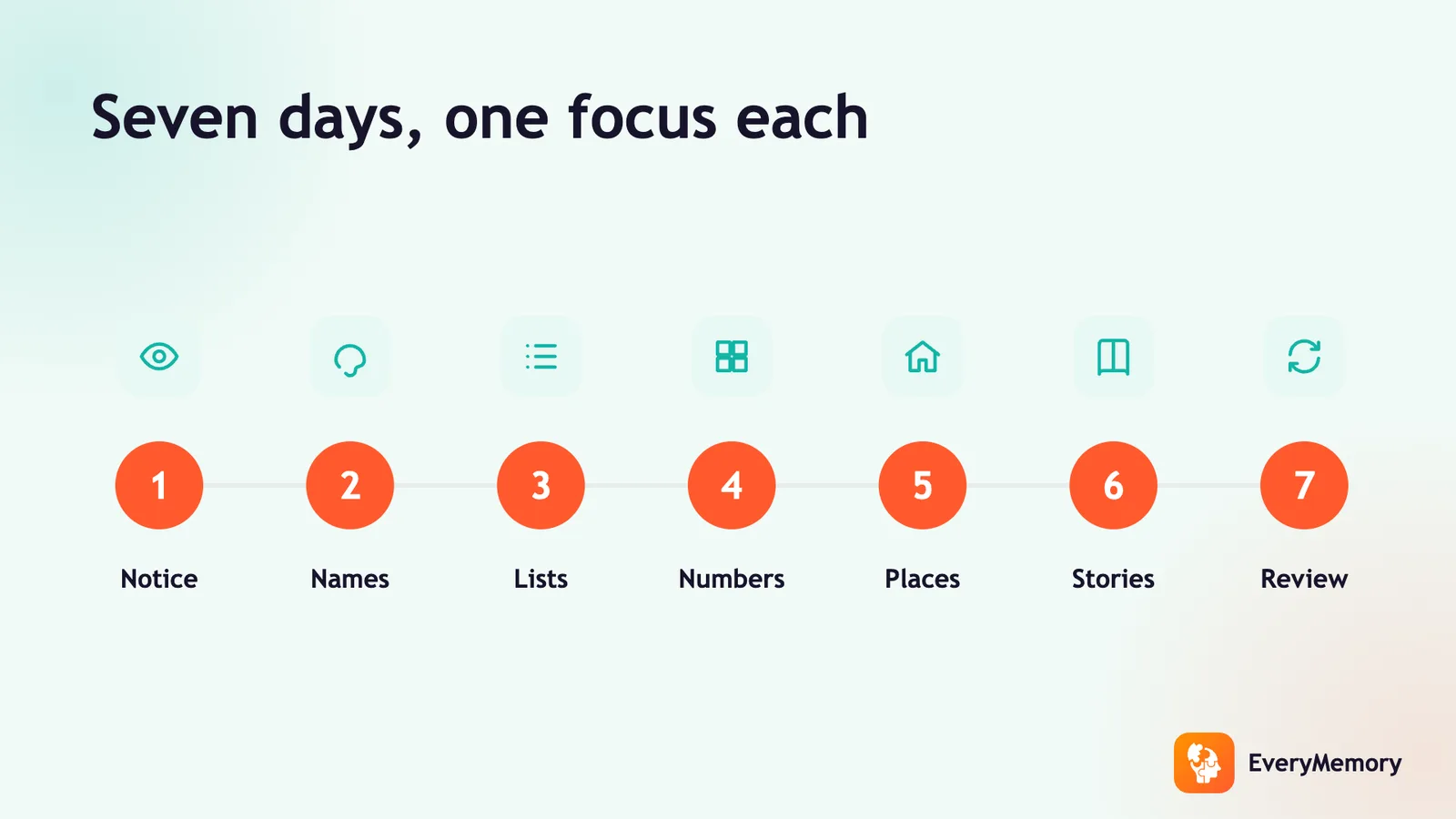
If you want a structured seven-day jumpstart, the 7-day memory training plan for beginners gives you one exercise per day with clear instructions.
Tracking your progress
Progress in memory training is not always immediately visible, which is why a simple tracking habit helps. After each session, note just two things: what exercise you did and whether it felt easier, harder, or the same compared to last time. That is it - two facts, ten seconds.
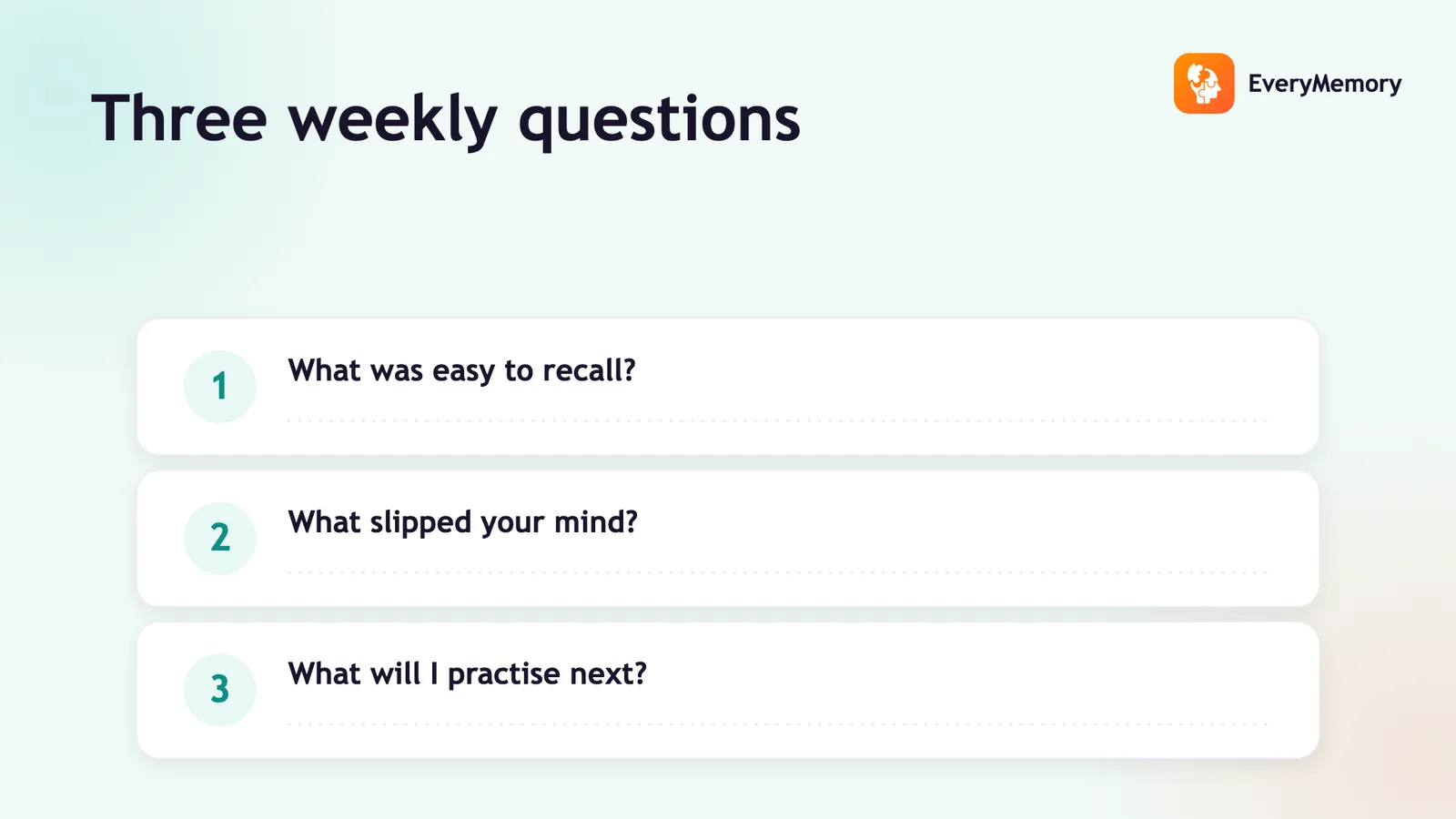
After four weeks you will have a genuine pattern to look back on. Most people find that exercises that felt hard in week one feel noticeably easier by week three. That shift is real progress. For a more structured way to track recall over time, the weekly memory check-in template gives you a simple format to follow.
✅ Try this today - Your first week at a glance
To start without overthinking, follow this stripped-down version for the first seven days:
- Every morning after your first drink: write five things you did yesterday, in order (2 minutes).
- Then spend 8 minutes on one memory task - alternate word recall and names/faces on alternate days.
- Every night before sleep: replay three moments from today in your mind, slowly and clearly.