 EveryMemory
Social Activity and Memory
Staying socially connected is one of the most consistently cited factors in healthy cognitive aging - here's what that means in practice for adults 55 and older.
Part of the guide: How to Keep Your Brain Healthy: A Complete Lifestyle Guide →
⚡ Quick answer
Regular social engagement - conversations, shared activities, feeling connected to others - is consistently linked with better memory, sharper attention, and more resilient focus in older adults. It doesn't require a busy social calendar: even moderate, regular contact with others appears to support brain health meaningfully.
Key takeaways
- Conversation exercises memory, attention, and processing speed simultaneously, making regular meaningful interaction one of the most cognitively demanding and beneficial daily activities.
- Active engagement - back-and-forth conversation, shared activities - is what supports the brain; passive time around others, such as watching TV together, does not offer the same benefit.
- Prolonged isolation is linked with worse performance on memory and attention tasks, likely through a combined effect of lower stimulation, higher stress, and disrupted sleep.
- Quality and regularity of connection matter more than volume - even a few meaningful interactions each week appears to be sufficient for cognitive benefit.
Of all the lifestyle habits linked with healthy cognitive aging, social engagement is one of the most consistently supported - and, for many people, the most neglected. Life after retirement can quietly become much more solitary than the years before it, and that shift is worth paying attention to.
This article looks at why social connection and memory are so intertwined, what kinds of interaction seem to matter most, and how to stay meaningfully connected even when circumstances make it harder.
Why social connection affects the brain
Conversation is cognitively demanding in the best possible way. Following what someone says, formulating a response, tracking context, remembering what was said three sentences ago - all of this exercises memory, attention, and processing speed simultaneously. Meaningful conversation is, in effect, a workout for the skills you most want to preserve.
But the benefit goes beyond the mental exercise of talking. Feeling connected to others also supports mood, and mood has a direct effect on memory. Loneliness and low mood make it harder to encode new information and easier to ruminate, which leaves less mental bandwidth for everyday recall. The brain works better when it feels safe and engaged.
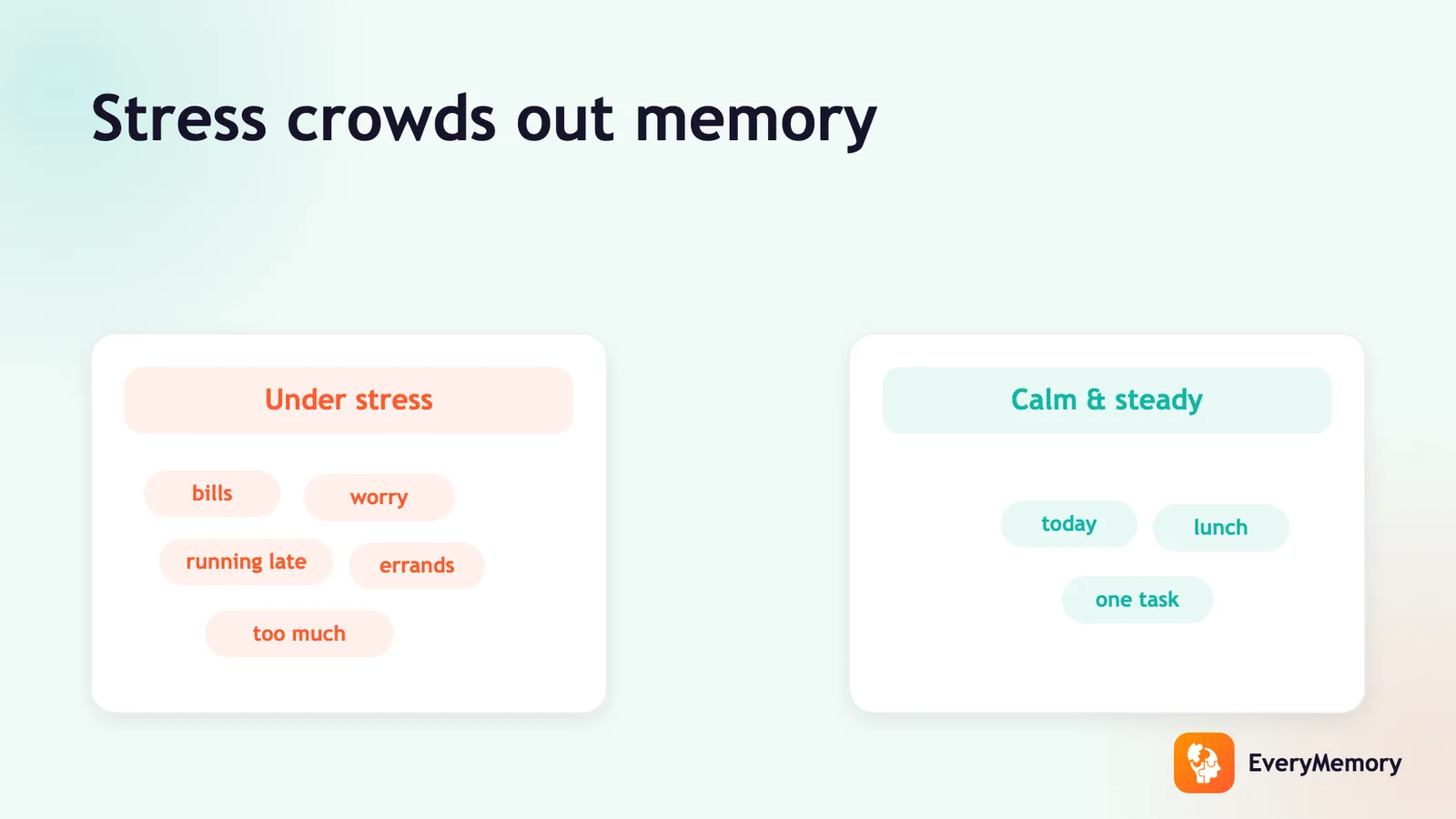
There is also evidence that strong social ties are linked with lower chronic stress levels - and chronic stress is one of the clearest environmental factors that undermines memory and focus over time. Our article on stress and forgetfulness explores this in more detail.
What counts as meaningful social activity
You don't need a packed social diary to get the benefit. The research on social activity and brain health tends to highlight quality and regularity over volume. A handful of meaningful interactions each week appears to provide most of the benefit.
- Regular one-to-one conversations: phone calls, video calls, or in-person visits with family or friends.
- Group activities with a shared focus: a book club, a walking group, a regular card game, a class.
- Volunteering or mentoring, which provides structured, purposeful contact with others.
- Casual but consistent contact: a neighbour you chat with regularly, a weekly coffee with a friend.
Passive activities - watching television with others in the room, scrolling social media - don't appear to offer the same benefit. Active engagement, where you're listening, responding, and being heard, is what matters.
Loneliness, isolation, and the memory connection
Prolonged social isolation isn't just unpleasant - it has measurable effects on how the brain functions. Studies consistently find that adults who report feeling lonely perform worse on memory and attention tasks, even after controlling for depression and physical health.
The mechanism isn't fully understood, but it likely involves the combined effect of lower mental stimulation, higher stress, disrupted sleep, and reduced motivation to stay active. These factors reinforce each other, which is why isolation can become a self-reinforcing cycle fairly quickly.
If you or someone you care for has become significantly more isolated - after a move, a bereavement, or loss of driving independence - it's worth taking that seriously as a factor in overall cognitive health, not just wellbeing. Our guide on helping an aging parent with memory concerns addresses this directly for family members who are worried.
Social activity and cognitive reserve
Researchers use the term "cognitive reserve" to describe the brain's resilience - its capacity to keep functioning well even as some natural change occurs with age. Higher cognitive reserve is associated with more education, more mentally stimulating work, and more socially active lives.
This means that the social activities you engage in now are likely contributing to a kind of long-term resilience. You can't build cognitive reserve in a week, but years of consistent engagement - reading, conversation, learning, staying connected - appear to matter. Pairing social activity with a daily brain training routine builds on both fronts at once.
When staying social feels difficult
Many people know that social connection is good for them and still find it genuinely hard to maintain, especially after retirement, illness, or loss of mobility. Knowing and doing are different things, and the barriers are real.
A few practical approaches that tend to lower the barrier:
- Schedule calls as fixed appointments. A Tuesday morning call with a friend or sibling is more likely to happen than a vague intention to "catch up soon."
- Join something structured. A class, club, or volunteer role provides ready-made social contact with a shared purpose - you don't have to generate the interaction from scratch.
- Use technology deliberately. Video calls, group chats, and even voice messages are genuinely useful substitutes when in-person contact isn't possible.
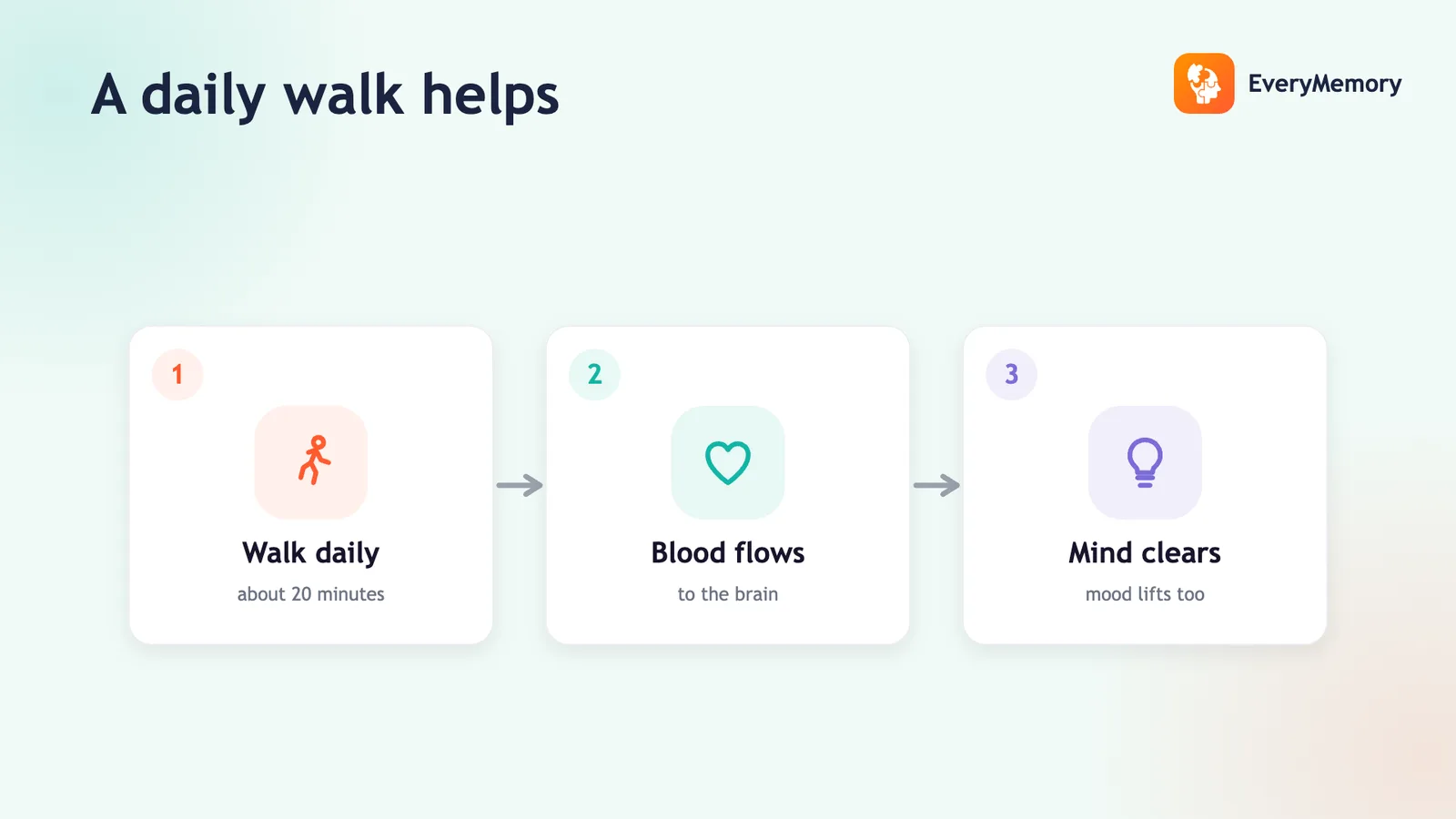
- Make social activity part of other healthy habits. Walking with someone, for example, combines physical and social benefit in the same time slot - a natural pairing with the brain benefits of walking.
Tracking your social engagement alongside memory
One simple approach to understanding your own patterns is to notice, informally, how your mental sharpness and mood vary in periods of more versus less social contact. Many people find the correlation is stronger than they expected.
If you want a more structured way to track cognitive patterns over time - including the factors that seem to affect them - our article on tracking memory changes month by month offers a practical, non-medical framework.
✅ Try this today - The weekly connection audit
At the end of this week, take five minutes to answer three questions:
- How many real conversations did you have this week - not errands or logistics, but actual exchanges where you listened and shared?
- Is there one person you've been meaning to contact but haven't? Schedule that call or visit now, before closing this page.
- Is there one regular activity - a class, a group, a volunteer role - that would give you reliable social contact each week? Identify one option and find out how to join.