 EveryMemory
How to Help a Child With Memory and Recall
Children remember better with the right strategies - chunking, repetition, linking new facts to what they know, and plenty of playful recall practice.
Part of the guide: Brain Exercises for Seniors: The Complete Guide →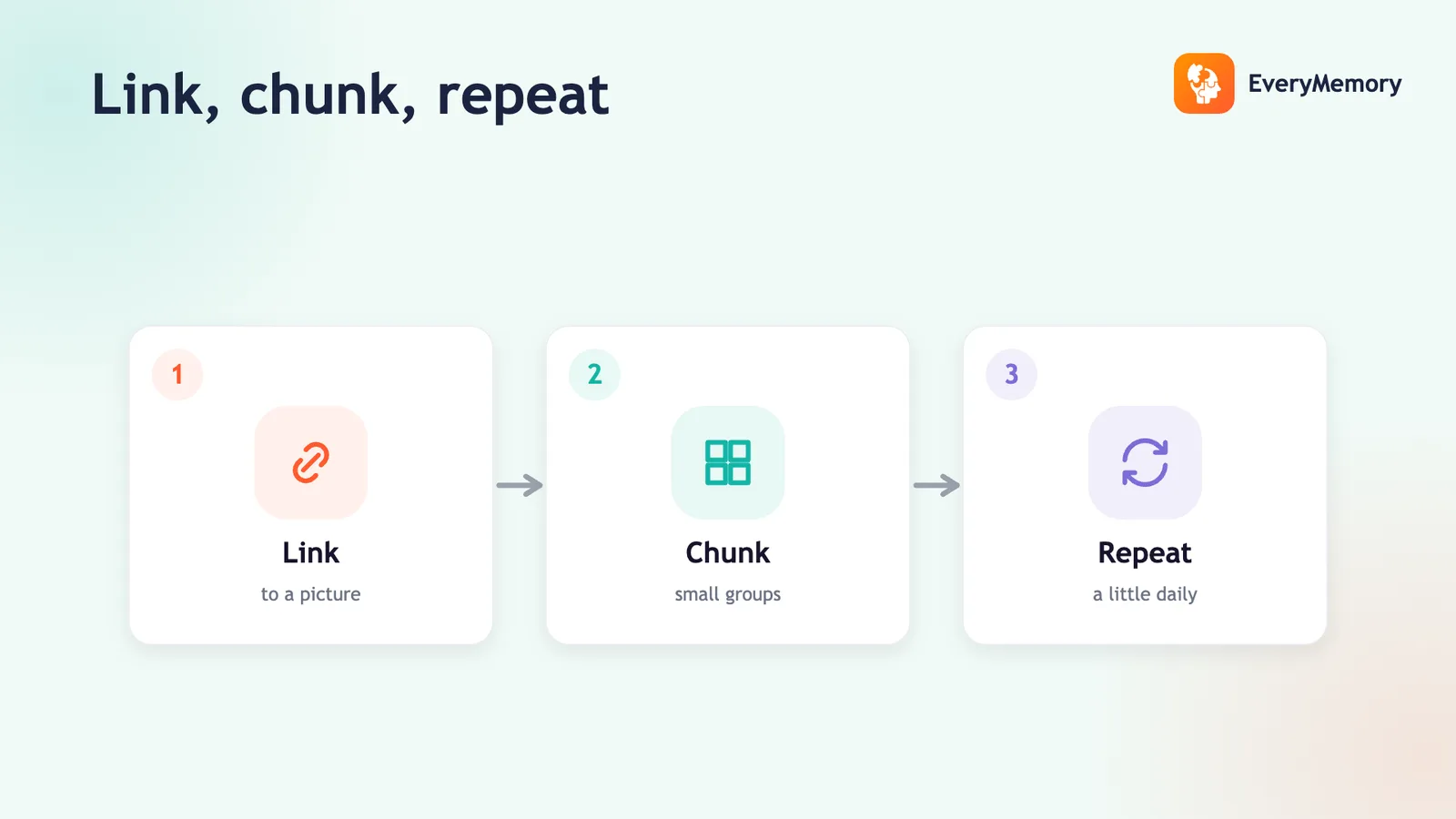
⚡ Quick answer
Help a child with memory by breaking information into small chunks, repeating it with gaps over days rather than all at once, and linking new facts to things they already know. Add plenty of playful recall - games where they retrieve answers - and keep a steady routine so remembering becomes a habit. Praise the effort of trying to recall, not just getting it right.
Key takeaways
- Chunk information, repeat with gaps, and link new facts to what they already know.
- Make recall a game - quizzes and matching games are retrieval practice in disguise.
- Spaced repetition over days beats ten repeats in one sitting.
- Routine and sleep take load off memory and help yesterday's learning stick.
Children aren't born knowing how to remember things - recall is a skill they pick up with the right strategies. A child who "can't remember" their spellings often just hasn't been shown how to practise them in a way that sticks.
The good news is that the same handful of techniques help across the board: breaking things into smaller pieces, repeating with gaps, linking new facts to things they already know, and lots of playful retrieval. Taught early and kept light, these turn remembering from a frustration into something a child can actually get good at.
Strategies that make remembering easier
These work because they match how memory actually forms - through repetition, meaning, and retrieval rather than sheer effort.
| Strategy | What it means | Example |
|---|---|---|
| Chunking | Break info into small groups | A phone number in 3s, spellings in syllables |
| Spaced repetition | Repeat with gaps, not all at once | Revisit spellings over four short days |
| Linking | Connect new to known | Tie a new word to one they already use |
| Retrieval | Ask them to recall, not re-read | Cover the word, have them write it |
| Multi-sensory | Use sight, sound and movement | Say it, write it, trace it in the air |
Make recall a game, not a drill
The single most powerful thing you can do is ask a child to remember, rather than letting them re-read. But framed as a drill, that's a chore. Framed as a game, it's fun - and the practice is identical.
Turn spellings into a quiz, facts into a "beat your last score" challenge, or the day's events into a bedtime retell. Matching-pairs and Kim's game are pure recall practice in disguise. See memory games for kids for a set you can rotate through.
Use repetition the smart way
Repeating something ten times in one sitting helps far less than repeating it twice a day across five days. The gaps are what build a lasting memory, because each return makes the brain work to retrieve it.
- Introduce the new information in a short, focused burst.
- Quiz it again a few hours later - quickly, playfully.
- Revisit the next day, then skip a day and revisit again.
- Stretch the gaps as it gets easier - every few days is plenty.
- Mix old and new together so earlier learning stays fresh.
Support memory with routine and sleep
A predictable routine takes load off a child's memory - when the steps of the morning or homework are the same each day, there's less to remember and more room for the things that matter. Checklists and a consistent spot for school things help too.
Sleep does the quiet work of fixing memories in place, so a well-rested child remembers more of yesterday's learning. None of this is about a child trying harder - it's about giving their memory the conditions to do its job. For the habit side, see daily brain exercises.
✅ Try this today - Spelling-in-disguise game
Turn this week's spellings into recall practice they'll enjoy.
- Read a word together, then cover it and have your child write it from memory.
- Check it together - a near-miss is a teaching moment, not a fail.
- Group tricky words by sound or pattern so they chunk naturally.
- Quiz the same words again tomorrow, then skip a day and quiz again.
- Keep a "beat your score" tally to make returning to them fun.
⚠ When to talk to a professional
These are general learning strategies, not advice for any specific difficulty. If you're concerned a child's memory struggles are persistent and affecting learning at school, talk with their teacher and a qualified professional.