EveryMemory
Brain Games for Kids
Puzzles, card games, riddles and movement games give kids real thinking practice through play - here are the best brain games to rotate through, sorted by skill and age.
Part of the guide: Brain Exercises for Seniors: The Complete Guide →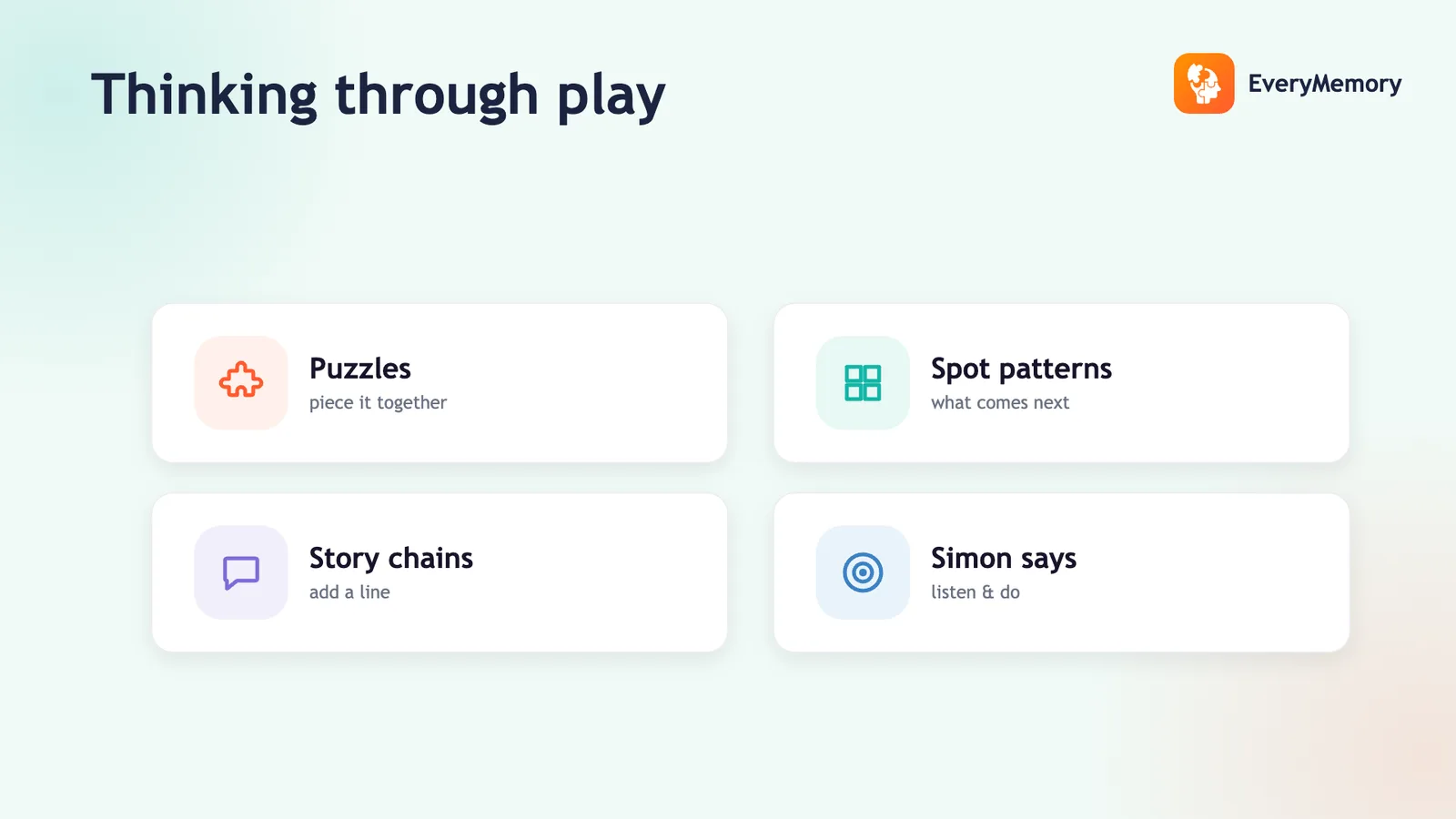
⚡ Quick answer
Good brain games for kids include jigsaw and logic puzzles (pattern-spotting), card games like Uno and Go Fish (memory and attention), riddles and word games (flexible thinking), and movement games like Simon Says (listening and self-control). Rotate a few so different thinking skills get practised, and match the difficulty to your child so they win often and stay keen.
Key takeaways
- Puzzles, card games, riddles and movement games each stretch a different thinking skill.
- Rotate a few games rather than drilling one to cover more ground and stay fresh.
- Ordinary family games like Uno and Connect 4 hide real thinking inside the fun.
- Pitch difficulty so kids win often but still have to try, and let them choose.
"Brain games" sounds like flashcards, but the best ones are the games kids already love - a tricky puzzle, a round of Uno, a riddle that makes them groan. Each one quietly asks a child to hold information, spot patterns, or plan ahead, which is exactly the thinking practice that helps at school.
The trick is variety. Different games stretch different skills, so rotating through a few keeps things fresh and covers more ground than drilling one. Below are reliable favourites grouped by what they build, plus how to pitch each to your child's age.
Brain games by skill
Pick from across the list rather than sticking to one type - that variety is what makes the practice broad.
| Skill | Games to try | Good for ages |
|---|---|---|
| Memory | Matching pairs, Go Fish, Kim's game | 4+ |
| Logic & patterns | Jigsaw puzzles, dominoes, Set | 5+ |
| Flexible thinking | Riddles, 20 questions, word chains | 6+ |
| Planning ahead | Checkers, Connect 4, simple chess | 7+ |
| Listening & control | Simon Says, freeze dance, red light/green light | 3+ |
Card and board games that do double duty
Ordinary family games are some of the best brain games going, because the thinking is hidden inside the fun.
- Uno - colour and number matching plus a bit of strategy.
- Go Fish - remembering who asked for what trains memory.
- Connect 4 - planning a move ahead while blocking yours.
- Dobble / Spot It - fast visual matching and attention.
- Dominoes - number matching and a little forward planning.
No-equipment brain teasers
For the car or the queue, a riddle or a word game does the job with nothing to carry.
Try "20 questions," where your child narrows down what you're thinking of with yes/no questions, or word chains where each word starts with the last letter of the one before. Riddles are great too - they reward looking at a problem sideways. For games aimed squarely at attention, see concentration exercises for kids.
How to keep brain games working
The difficulty has to fit. Too easy and a child is bored; too hard and they quit. Aim for games where they win often enough to stay keen but lose enough to be stretched - and nudge the level up only when a game starts feeling easy.
Keep sessions short and let kids choose. A child who picks the game plays longer and tries harder than one handed a "brain exercise." Fold a couple of minutes into the day rather than scheduling a session, and see daily brain exercises for building the habit gradually.
✅ Try this today - Rotate-three challenge
Keep three different brain games on the go this week.
- Pick one memory game, one logic game, and one word or riddle game.
- Play a different one each day - five to ten minutes is plenty.
- Let your child choose which of the three to play that day.
- When one starts feeling easy, swap in a slightly harder version.
- At the end of the week, ask which was their favourite and keep it.