EveryMemory
Memory Games for Kids
Simple memory games like matching pairs, Kim's game and sequence-clapping give kids real recall practice without screens, worksheets, or any sense that they're being tested.
Part of the guide: Brain Exercises for Seniors: The Complete Guide →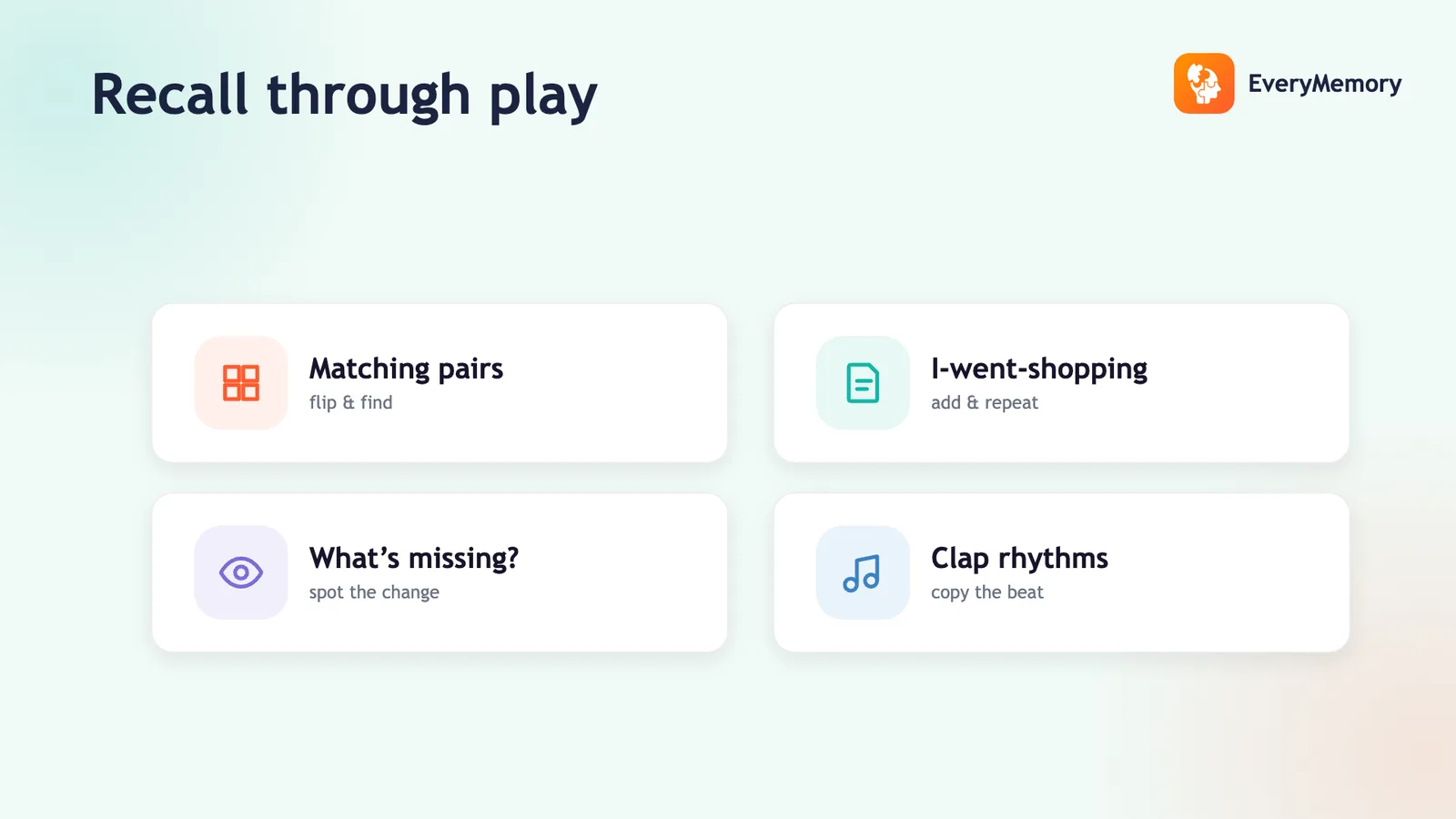
⚡ Quick answer
The best memory games for kids are matching pairs (Concentration), Kim's game (memorise a tray of objects, then spot what's removed), Simon-style clapping or tapping sequences, and "I packed my bag" where each player adds an item to a growing list. They train visual recall, working memory and sequencing through play, and most need only cards or household objects.
Key takeaways
- Matching pairs, Kim's game, Simon-style sequences and "I packed my bag" all train recall through play.
- Most need only cards or household objects - no app or worksheet required.
- Match the number of items to the child's age so they win often and stay keen.
- Keep rounds to five to ten minutes and never keep score of misses.
Kids remember best when they're playing, not studying. A round of matching pairs or a quick game of "what's missing" gives a child the same recall practice as a worksheet, except they'll ask to do it again. The win is built into the game, so the practice happens by itself.
None of the games here need an app or a printout. Most run on a deck of cards, a tray of small objects, or nothing at all. The goal isn't to make a child memorise faster - it's to make remembering feel like fun, so the habit sticks long after the game ends.
Classic memory games that still work
These games have lasted because they're simple, repeatable, and genuinely fun. Each one targets a slightly different kind of remembering.
| Game | What it trains | Good for ages |
|---|---|---|
| Matching pairs (Concentration) | Visual memory, where-was-it recall | 3+ |
| Kim's game (what's missing) | Visual memory, attention to detail | 5+ |
| Simon / clap-this-back | Sequence memory, listening | 4+ |
| I packed my bag | Growing-list memory, order | 6+ |
| Snap & Go Fish | Quick recognition, attention | 4+ |
How to play matching pairs
Matching pairs is the easiest to set up and the easiest to scale. Use a normal deck or a printed picture set, and adjust the number of cards to your child's age.
- Lay cards face down in a grid - start with 8 cards (4 pairs) for little ones, more as they improve.
- Players take turns flipping two cards, trying to find a matching pair.
- If the two cards match, the player keeps them and goes again; if not, they're turned back face down.
- Whoever has the most pairs when the grid is empty wins.
- To make it harder, add cards. To make it easier, narrow the grid or use fewer pairs.
No-equipment memory games
Some of the best games need nothing at all, which makes them perfect for car journeys and waiting rooms.
- I packed my bag - each player repeats the list so far and adds one item: "...a toothbrush, an apple, and a kite."
- Clap-this-back - clap a short rhythm and have your child copy it, getting one beat longer each round.
- Story chain - build a story one sentence at a time, repeating the whole story before adding to it.
- Number string - say a short string of numbers and have them repeat it back, adding a digit each time.
These are easy to fold into a daily routine. For a steady habit you build over time, see daily brain exercises, and for keeping focus during the game itself, concentration exercises for kids.
Keeping it fun, not pressured
The fastest way to ruin a memory game is to make it feel like a test. Don't keep score of misses, don't correct every slip, and let a child win sometimes. Praise the effort and the trying-again, not just the right answer.
Short and frequent beats long and rare. Five minutes most days does far more than a half-hour once a week, and it keeps the game on the "yes please" side of your child's list. When they get bored of one game, swap it - variety keeps the same skill fresh.
✅ Try this today - Five-minute Kim's game
All you need is a tray and a handful of small objects.
- Put 6–10 small objects on a tray - a coin, a spoon, a toy, a button.
- Let your child study them for 30 seconds, then cover the tray with a cloth.
- Secretly remove one object, then uncover the tray and ask what's missing.
- Make it harder by adding objects or removing two at once.
- Swap roles - let your child set the tray and test you.