 EveryMemory
How to Learn Faster
Learning faster isn't about reading more or harder - it's about using methods that make information stick the first time, so you stop re-learning what you forgot.
Part of the guide: Brain Exercises for Seniors: The Complete Guide →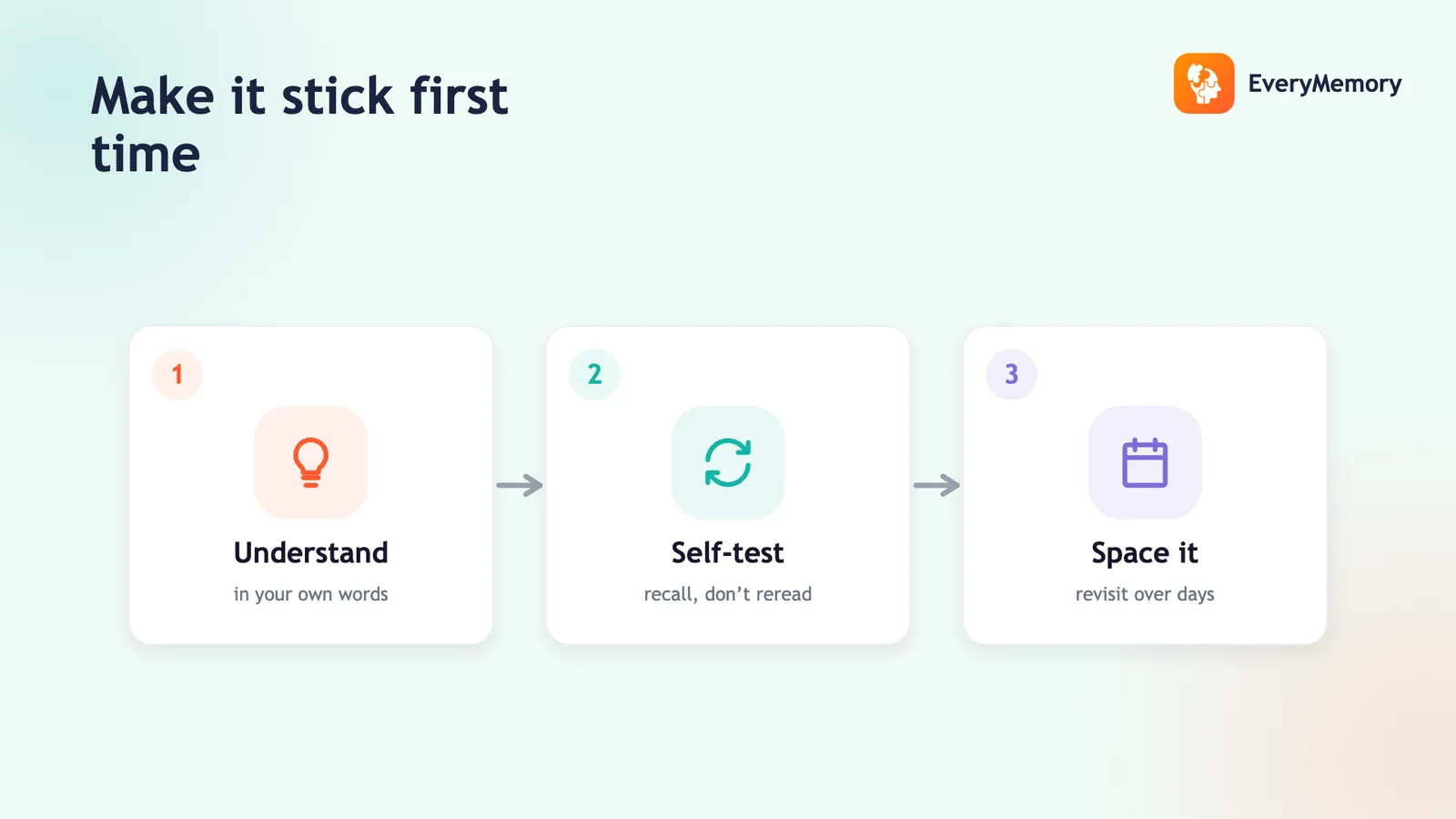
⚡ Quick answer
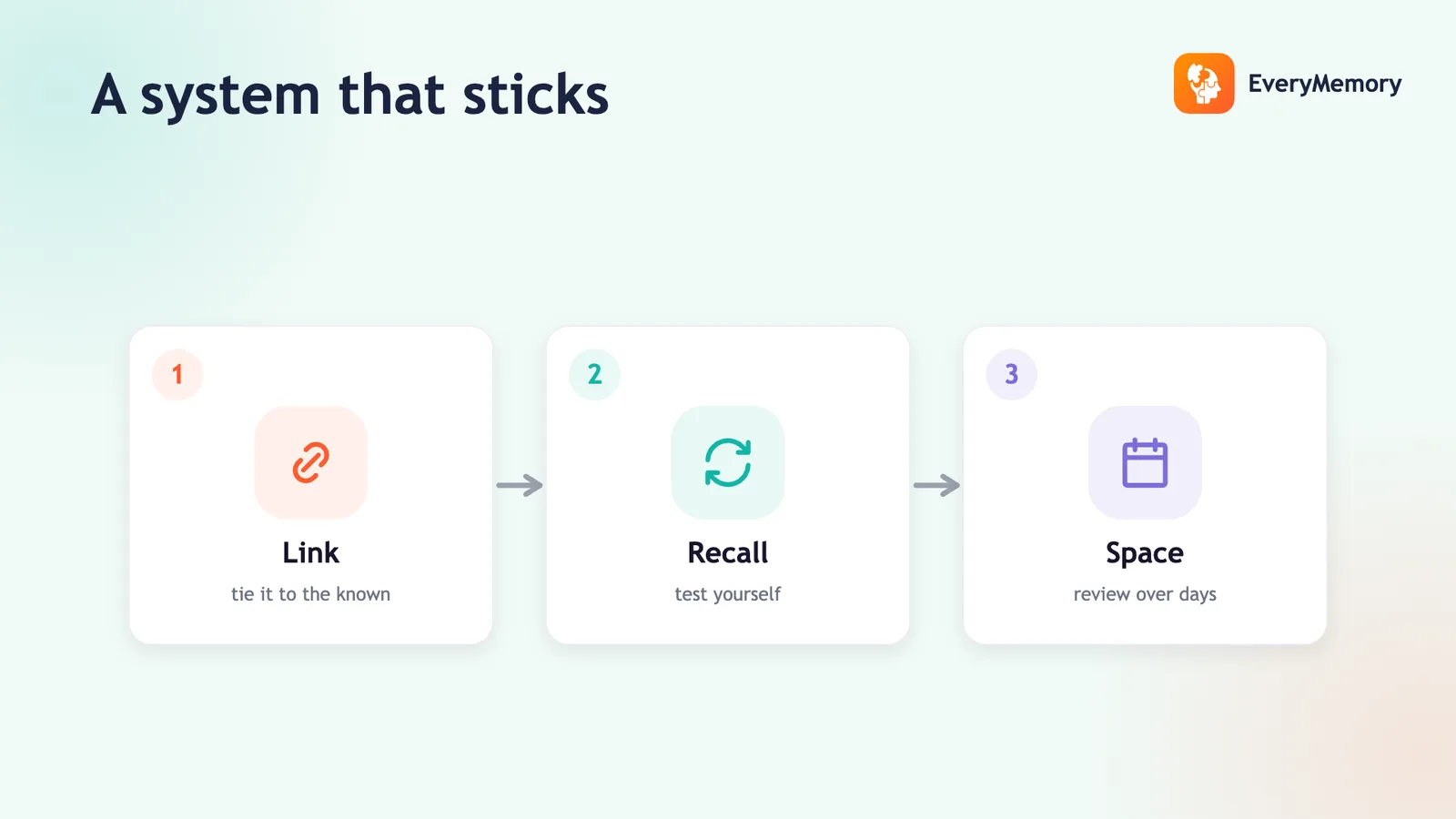
To learn faster, replace passive re-reading with active recall: close the material and try to retrieve it from memory. Space your reviews over days (day 1, 3, 7, 14) instead of cramming. Explain each idea in plain language to expose gaps, and mix related topics rather than drilling one at a time. These four methods make material stick on fewer passes.
Key takeaways
- Active recall (retrieve from memory) beats re-reading every time.
- Space reviews over days - day 1, 3, 7, 14 - instead of cramming.
- Use the Feynman technique: explaining in plain words exposes gaps.
- Interleave related topics and protect single-tasking and sleep.
Most people try to learn faster by going faster - re-reading, highlighting, watching at 2x speed. These feel productive and do almost nothing, because they keep information in front of you instead of forcing your brain to retrieve it. The retrieval is where learning actually happens.
The methods below come from decades of cognitive research, and they share one idea: make your brain do the hard work of pulling information out, spaced over time. That's slower per minute and much faster overall, because you stop re-learning what you keep forgetting.
Active recall beats re-reading every time
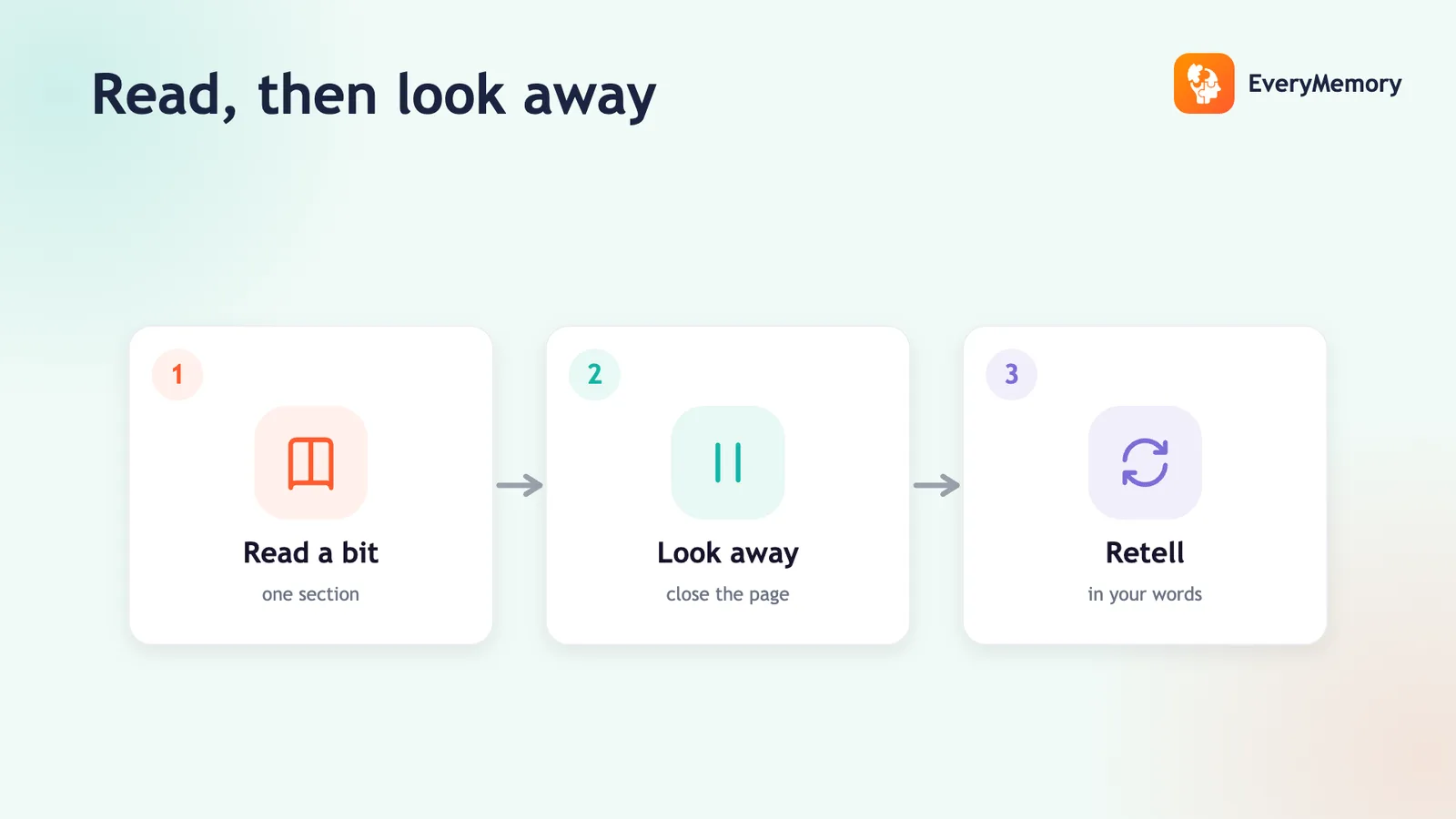
Re-reading creates a feeling of familiarity that fools you into thinking you know something. The test of real learning is whether you can produce the information without looking. So make that the study method itself: read a section, close it, and write or say everything you remember. Then check.
The struggle to retrieve is the point - that effort is what strengthens the memory. It feels harder and less pleasant than highlighting, which is exactly why it works. See keeping your brain active for the same principle applied day to day.
Space your reviews instead of cramming
Cramming gets information into short-term memory and then loses most of it within days. Spacing the same total study time across several sessions gets far more to stick, because each review just before you'd forget reinforces the memory at the moment it's working hardest.
A simple schedule covers most needs:
| Review | Timing | Why |
|---|---|---|
| 1st | Day 1 (same day you learn) | Catch what didn't encode the first time |
| 2nd | Day 3 | Reinforce before the steep early forgetting |
| 3rd | Day 7 | Move it toward durable storage |
| 4th | Day 14 | Confirm it has stuck; long gaps now |
The Feynman technique: teach it to find the gaps
Named after the physicist Richard Feynman, this method is simple: explain the thing you're learning in plain language, as if to someone with no background. The moment you stumble or reach for jargon, you've found a gap you didn't know you had - that's the part to go back and learn properly.
It works because clear teaching requires clear understanding. Faking comprehension is easy when you're reading; it's impossible when you have to produce a coherent explanation out loud.
Interleave related topics
Blocking - drilling one topic until you move on - feels orderly but leaves you weak at choosing the right method when topics are mixed, which is how real problems arrive. Interleaving means mixing related problem types in one session: a maths student alternates problem types; a language learner mixes tenses rather than drilling one.
It feels harder and your session accuracy drops, but it builds the discrimination skill - knowing which approach fits which problem - that pure blocking never trains. Pair it with focused attention so each rep lands.
Protect the conditions learning needs
No method survives a split attention or a missed night's sleep. New material is encoded while you're focused and consolidated while you sleep, so two unglamorous things multiply everything above:
- Single-task while studying - one tab, phone elsewhere. Divided attention encodes shallowly and you forget it fast.
- Sleep after learning something important; consolidation does work overnight that no amount of daytime review replaces.
- Study in shorter focused blocks with breaks, not marathon sessions where attention degrades.
✅ Try this today - Turn one chapter into active recall
Try the difference on something you actually need to learn this week:
- Read one section or chapter once, normally, without highlighting.
- Close it. On a blank page, write everything you remember - facts, structure, examples.
- Open the material and mark what you missed or got wrong. Those gaps are your real study list.
- Re-test only the gaps tomorrow (day 1), then again on day 3 and day 7.