 EveryMemory
How to Remember More of What You Read
Remember more of what you read by reading actively - previewing, questioning, then closing the book to recall - instead of passively running your eyes over the page.
Part of the guide: How to Improve Your Memory: The Complete Beginner's Guide →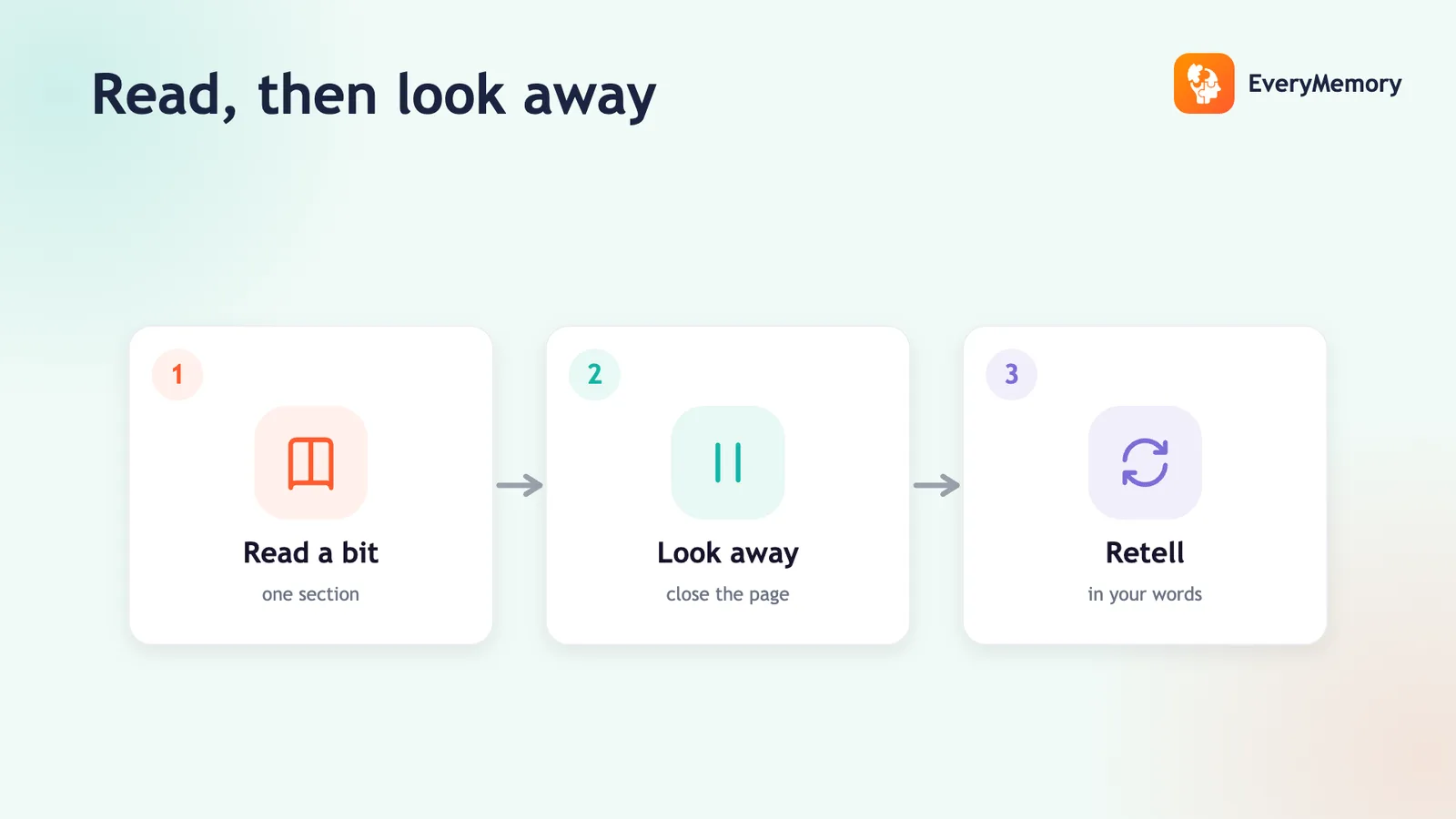
⚡ Quick answer
To remember more of what you read, read actively instead of passively. Preview the structure first, turn headings into questions, and read to answer them. After each section, look away and recall the main points in your own words before moving on. Review across a few days, and connect new ideas to what you already know. Recall, not rereading, is what makes it stick.
Key takeaways
- Read actively: preview the structure and turn headings into questions first.
- After each section, look away and recall the main points in your own words.
- Connect new ideas to what you already know so they have an anchor.
- Review across a few days with recall, not rereading, to beat the forgetting curve.
You finish a book, feel like you learned something, and a week later can barely say what it was about. That's not a reading-speed problem - it's a passive-reading problem.
Running your eyes over a page leaves almost nothing behind, because comprehension in the moment isn't the same as memory later. Remembering what you read takes a handful of active steps that turn reading from input into encoding. Here's the method.
Preview before you read
Spend two minutes scanning the chapter first - headings, the first line of each section, any summary or diagrams. This builds a mental scaffold to hang details on, so each fact has somewhere to land instead of floating loose. Reading without a structure in mind is like pouring water with no cup. The preview is the cup.
Turn headings into questions
Convert each heading into a question before you read that section: "The causes of X" becomes "What causes X?" Now you read to answer something, not just to pass your eyes over words. Reading with a question in mind sharpens attention and gives each section a clear point to retrieve later.
Recall after each section
This is the step that does the heavy lifting. At the end of each section, look away from the page and say or write the main points in your own words. Forcing the recall - even imperfectly - is what builds durable memory; rereading the section instead feels easier but leaves far less behind. If you can't recall it, that's the signal to reread that part, not the whole chapter.
Connect new ideas to old ones
Memory is associative - a new idea anchored to something you already know is far easier to retrieve. As you read, ask how this connects to what you already understand, where you've seen it before, whether you agree. This association weaves the new material into your existing knowledge instead of leaving it stranded on its own.
Review across a few days
One pass fades fast. A brief review the next day, then a few days later, resets the forgetting curve and moves the ideas toward permanent. You don't reread the book - you spend a couple of minutes recalling its key points from memory. That spaced retrieval is the difference between a book you read and a book you remember. Take notes in your own words, not copied quotes, so reviewing is itself a recall act.
✅ Try this today - The preview-question-recall pass
Apply this to the next chapter you read:
- Spend two minutes previewing the headings and turning each into a question.
- Read one section to answer its question, then close the book and say the main points aloud in your own words.
- The next day, recall the chapter's key points from memory before opening it - reread only what you couldn't retrieve.