 EveryMemory
How to Measure Brain Health (Non-Medical)
You can't measure brain health like blood pressure, but you can track useful everyday signals - your own attention, recall, sleep, and mood - against your own past, not a benchmark.
Part of the guide: Understanding Memory Loss and Forgetfulness: A Calm, Reassuring Guide →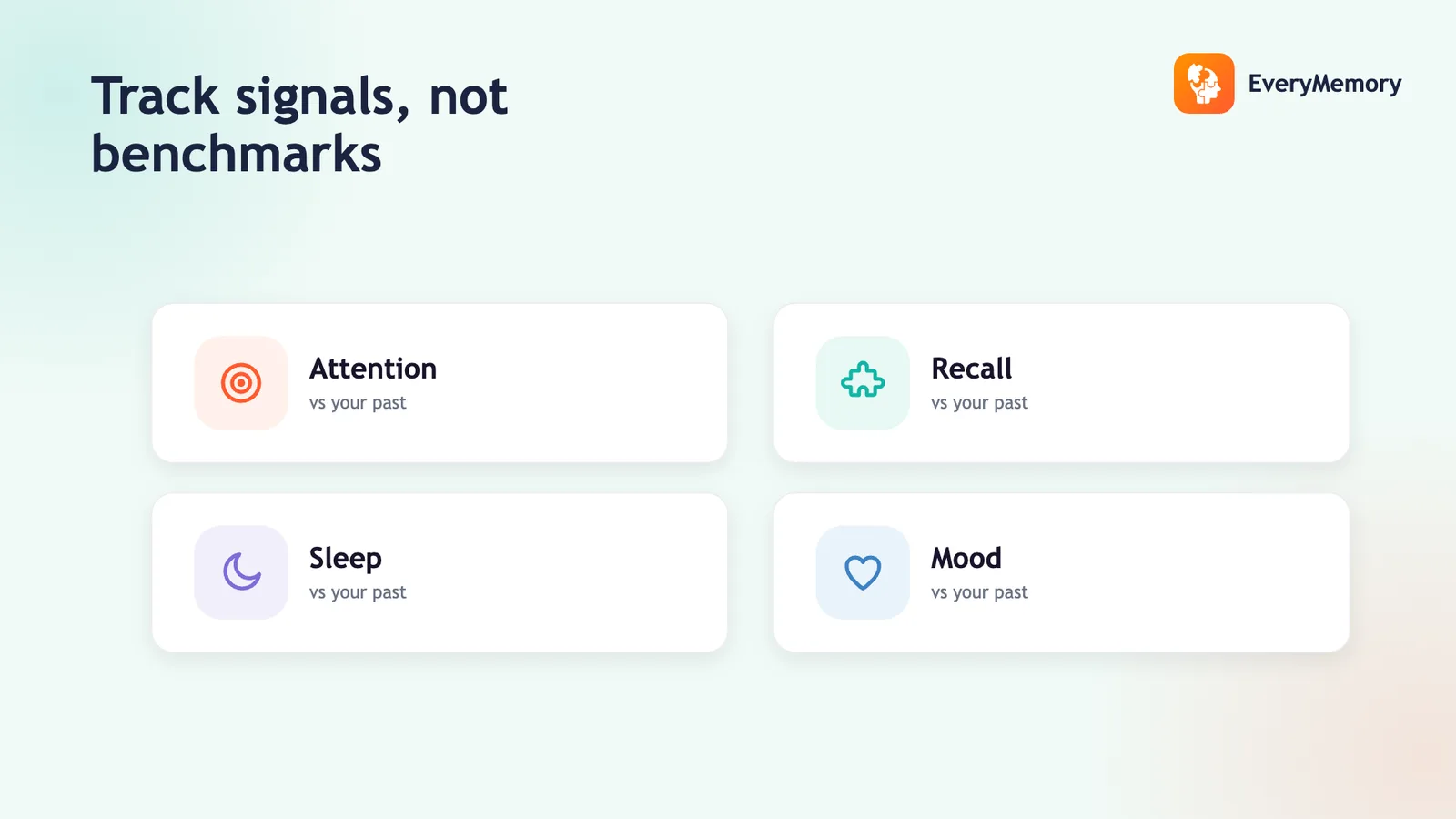
⚡ Quick answer
You can't measure brain health like a vital sign, but you can track everyday signals - attention, recall, sleep quality, mood, and energy - against your own past, under similar conditions, over weeks. There's no real single "brain score" or "brain age." Self-tracking shows your own trend; it can't diagnose anything, so genuine concerns belong with a professional.
Key takeaways
- There's no real single 'brain score' or 'brain age' - that's marketing, not measurement.
- Track separate everyday signals: attention, recall, sleep, mood, energy.
- Keep the method steady and compare only to your own past, over weeks.
- Self-tracking shows a trend but can't diagnose; genuine concerns go to a doctor.
There's no home gauge for brain health the way there is for weight or blood pressure, and any product claiming a single tidy "brain score" or a real "brain age" is overselling. What you can do is track useful everyday signals - your own attention, recall, sleep, and mood - and watch their trend over time.
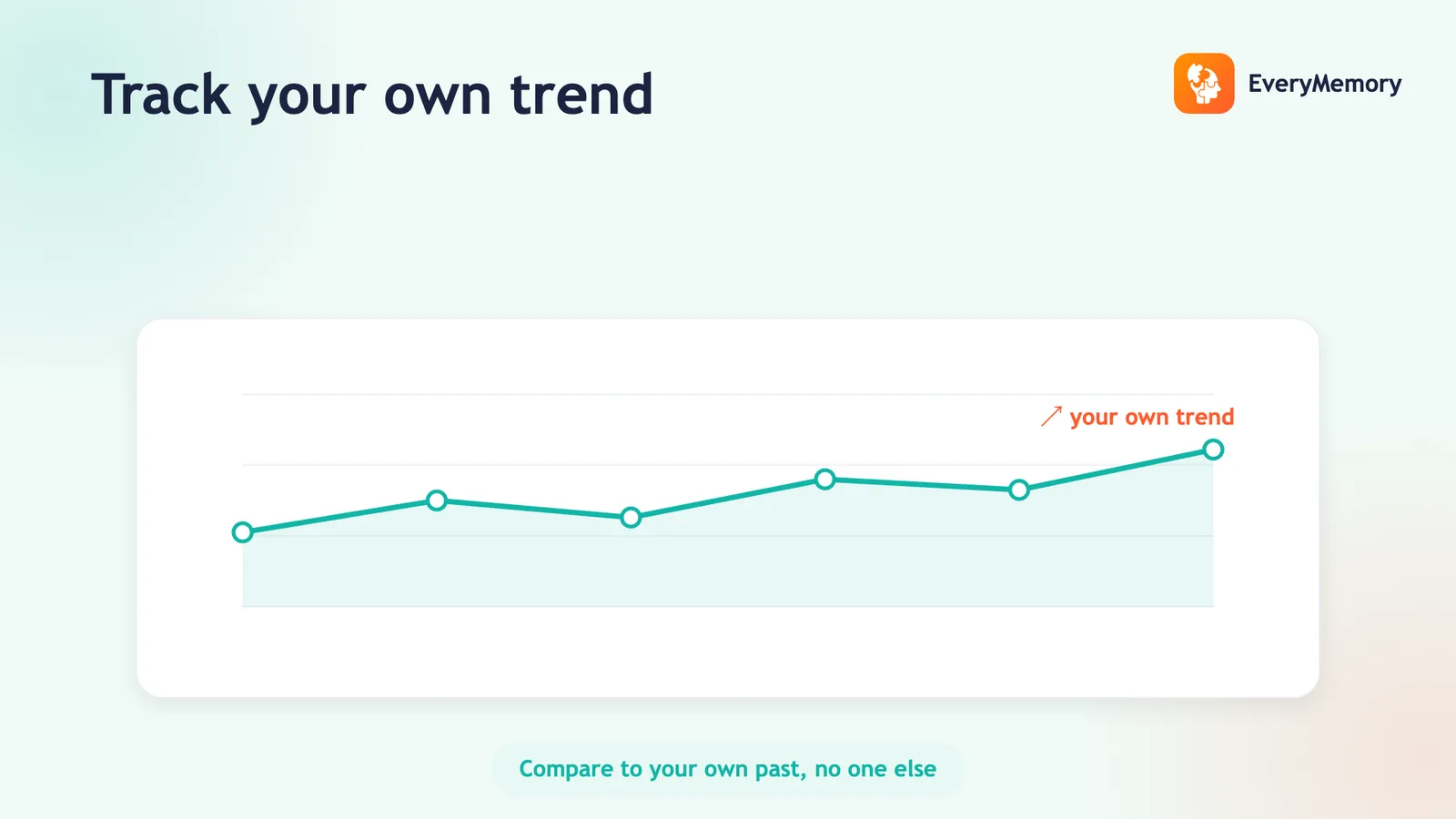
The honest framing is self-relative. You're not measuring against strangers or an invented norm; you're watching your own baseline. Done that way, measuring is reassuring more often than not and helps you see whether your healthy habits are landing.
Why there's no single number
Brain health isn't one thing, so it can't collapse into one honest number. Attention, memory, mood, sleep, and processing speed are distinct, they vary day to day, and they're shaped by everything from last night's sleep to this morning's stress. A single "brain age" or percentile dressed up as science is marketing, not measurement.
What does work is tracking a few separate everyday signals and watching each one's trend. That's modest but real - and it sidesteps the false comfort or false alarm of a made-up score. For the honest version of these checks, see what is a non-medical memory check.
Everyday signals worth tracking
These are observable, self-relative signals - useful precisely because you can watch your own trend in them, not because they grade you against anyone else.
| Signal | What it reflects |
|---|---|
| A repeatable memory or focus check | Your own attention and recall trend |
| Sleep quality and consistency | How well attention is being restored |
| Mood and stress over the week | Whether the worry loop is crowding focus |
| Energy and mental freshness | Everyday mental fatigue load |
| Engagement - learning, social, novelty | How much your skills stay in use |
How to track it honestly
Measuring is only fair if you keep the method steady and compare to yourself. Hold the conditions similar and read the trend, not the single point.
- Pick one repeatable check and do it under similar conditions each time.
- Note a few signals alongside it: sleep, mood, stress, energy.
- Repeat about weekly, keeping the routine consistent.
- Compare each result only to your own past, never to other people.
- Read the trend over weeks; expect day-to-day swings.
What it can't tell you
Be clear about the ceiling. Self-tracking shows your own everyday trend; it is not a clinical assessment and cannot diagnose, screen for, or rule out any condition. A steady or rising trend is reassuring, and a dip that matches a rough patch usually rights itself.
What it can't replace is a professional. A gradual, persistent decline that worries you - or that others notice - is a reason to see a doctor, full stop. Use tracking to know your baseline, not to self-diagnose. For reading the trend, see memory score: how to read your progress.
✅ Try this today - A weekly brain-health signals check
A short, honest, self-relative way to watch your own trend.
- Each week, do the same short memory or focus check, rested and unhurried.
- Rate your sleep, mood, stress, and energy for the week in a line each.
- Log it all in one place, alongside the check result.
- Compare only to your own previous weeks - never to anyone else.
- Monthly, read the trend across all signals rather than any single number.
⚠ When to talk to a professional
This is a general, non-medical self-tracking approach, not a clinical assessment, diagnosis, or screening for any condition, and there is no real single "brain score" or "brain age." If you have a gradual, persistent concern, please speak with a doctor or qualified professional.