 EveryMemory
How to Track Your Memory Over Time
Tracking your memory means repeating the same simple check under similar conditions so you can see your own trend - not a one-off score, and never a comparison with strangers.
Part of the guide: Understanding Memory Loss and Forgetfulness: A Calm, Reassuring Guide →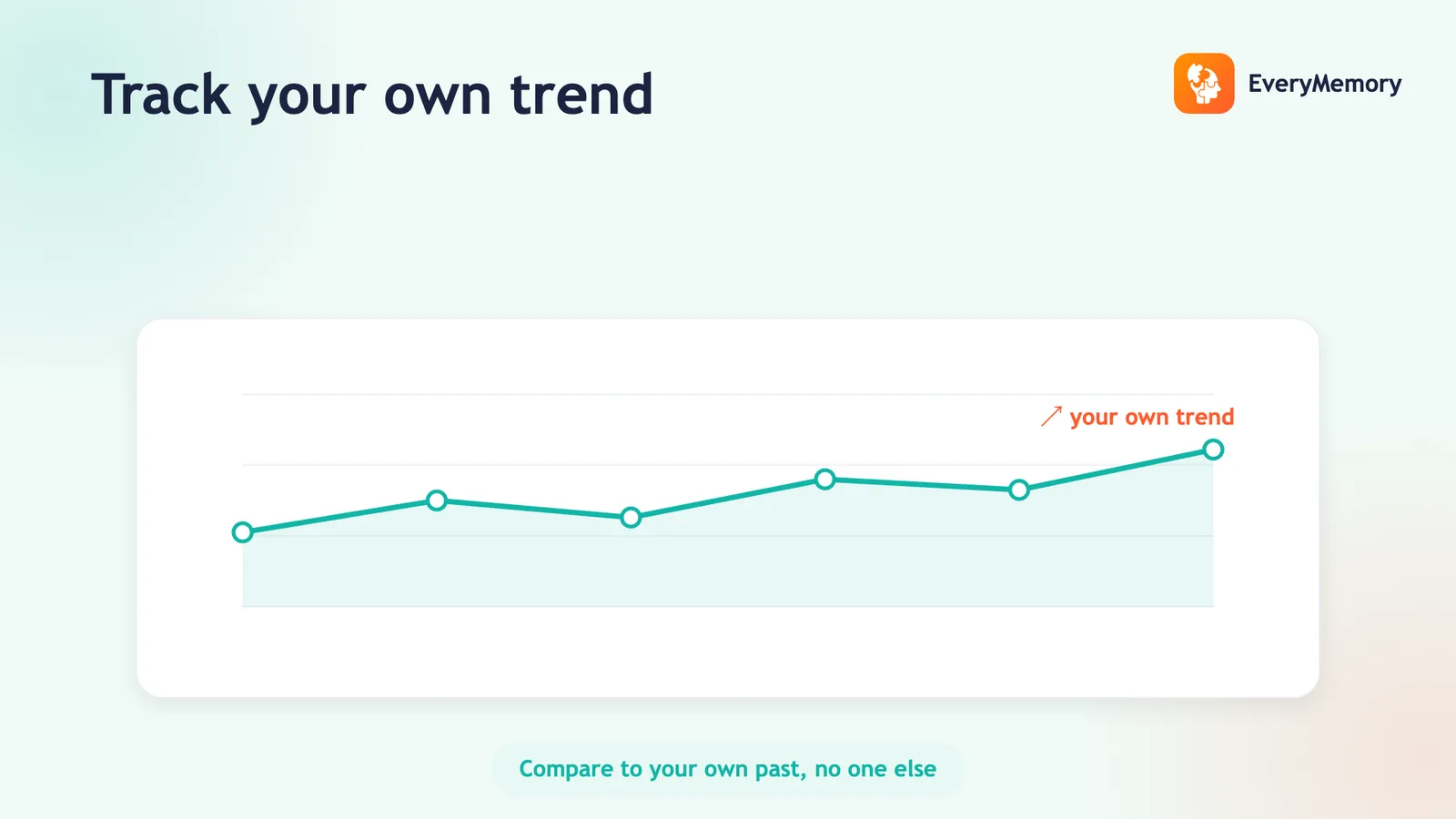
⚡ Quick answer
To track your memory, pick one short check you can repeat, do it under similar conditions - same time of day, rested, unhurried - and log the result. Repeat weekly or so, then look at the trend over weeks, not single days. Compare only against your own past. Day-to-day swings are normal; it's the direction over time that's meaningful.
Key takeaways
- Tracking means repeating the same check under similar conditions to see your own trend.
- A single score is noise; the trend over weeks is the signal worth watching.
- Keep conditions consistent and compare only against your own past.
- Self-tracking shows a trend but cannot diagnose anything.
Tracking your memory isn't about a single dramatic score. It's about repetition: doing the same simple check, in similar conditions, often enough to see a trend. One result on one day is noise - sleep, stress, and the time of day swing it. A line over weeks is signal.
The aim is purely self-relative. You're comparing yourself to your own past, not to anyone else, and certainly not to a made-up percentile. Done that way, tracking is reassuring more often than not: most people's everyday memory holds steady, and seeing that in your own numbers is worth a lot.
Why a trend beats a single score
Everyday memory naturally bounces around. A poor night, a stressful morning, or a noisy room can drop a result without anything being wrong - and a calm, rested day can lift it. So a single check tells you mostly about today's conditions, not your memory.
Repeat the same check over weeks and the day-to-day noise averages out, leaving the underlying trend. That's the number worth watching, and it's almost always steady. For how to interpret the line, see memory score: how to read your progress.
Keep the conditions consistent
A track is only fair if you don't change the test each time. Hold the conditions as steady as you reasonably can so you're measuring your memory, not your circumstances.
| Do this | Not this |
|---|---|
| Same check each time | A different quiz every session |
| Similar time of day, rested | Late at night one week, fresh the next |
| Quiet, unhurried, no multitasking | On the move with notifications buzzing |
| Compare to your own past results | Compare to other people's scores |
| Look at the trend over weeks | Panic over a single low day |
A simple tracking routine
You don't need anything elaborate - just a repeatable check and a place to note the result. Consistency in how and when you check matters more than the tool itself.
- Choose one short check you can repeat, like a memory exercise or self-check.
- Do it at a similar time, rested and unhurried, in a quiet spot.
- Note the result and one line on conditions (sleep, stress, mood).
- Repeat about weekly, keeping the routine the same.
- Every month or so, step back and read the trend, not the last point.
What the trend can and can't tell you
A steady or rising trend is reassuring, and a dip that lines up with bad sleep or a stressful patch usually rights itself as things settle. That's the everyday, reversible kind of variation this is built to show.
What tracking is not is a diagnosis. It's a self-relative habit, not a clinical test, and it can't rule anything in or out. A gradual, persistent decline that worries you - or that others notice - is a reason to see a doctor, not to keep re-testing alone. For the honest framing of these checks, see what is a non-medical memory check.
✅ Try this today - A weekly memory-tracking habit
A small, repeatable ritual that turns single scores into a useful trend.
- Pick one fixed day and time each week - say, Sunday morning, rested.
- Do the same short check in the same quiet spot each time.
- Log the result plus a quick note on sleep, stress, and mood.
- Resist re-testing the same day to chase a better number.
- Once a month, look only at the line over time, ignoring single points.
⚠ When to talk to a professional
This is a general self-tracking method, not a medical test, diagnosis, or screening for any condition. If you notice a gradual, persistent decline that worries you, or others raise concerns, please speak with a doctor or qualified professional.