 EveryMemory
How to Memorize Lines (for Actors)
Actors memorize lines by learning cue-to-line links, not monologues in isolation - working off-book in stages and connecting each line to the action and intention behind it.
Part of the guide: How to Improve Your Memory: The Complete Beginner's Guide →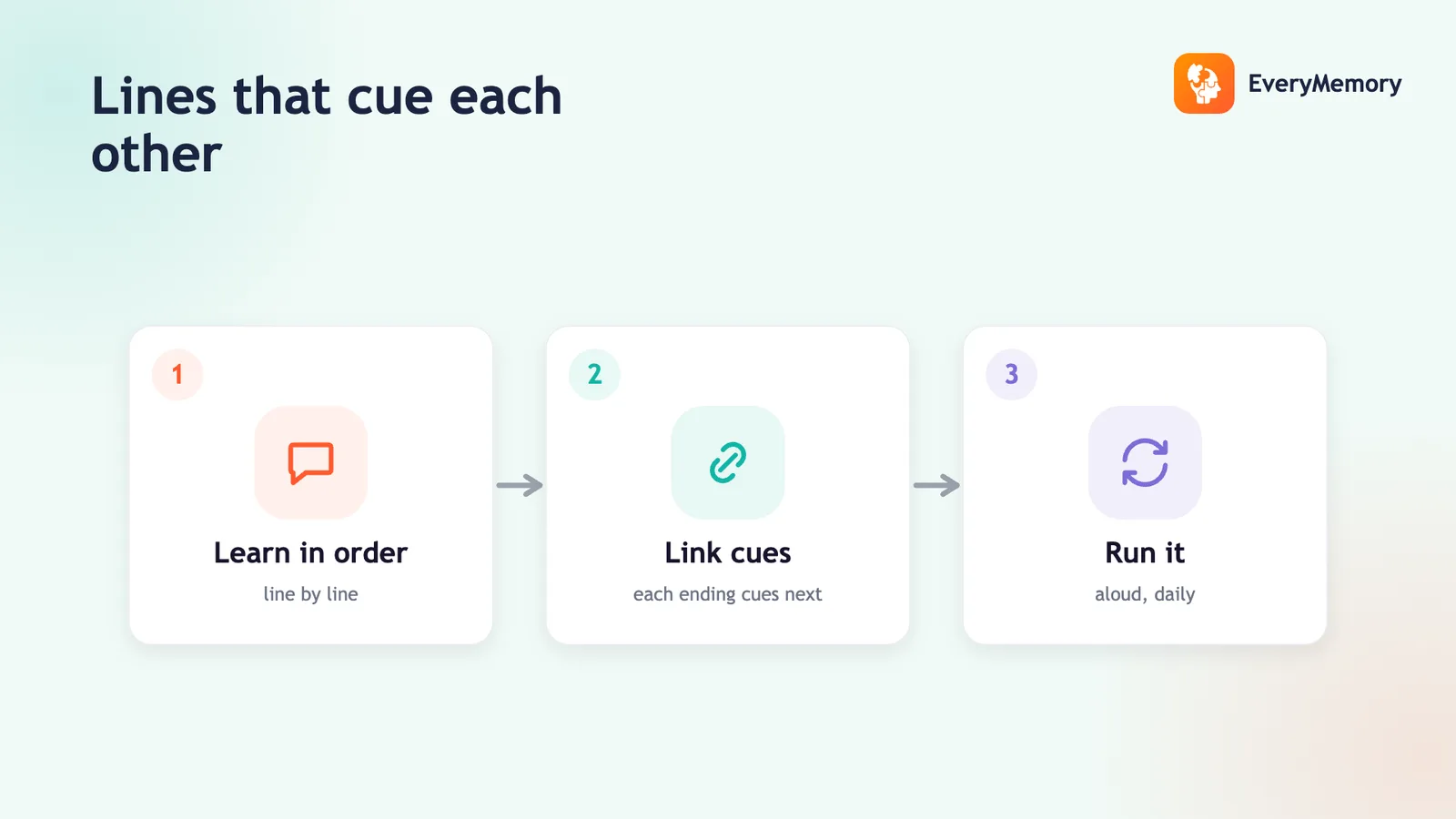
⚡ Quick answer
To memorize lines, learn each one as a response to its cue - the last few words of the line before yours - rather than reciting your part in isolation. Attach the line to the action and intention behind it (why your character says it), then go off-book in stages: prompt allowed, then occasional checks, then clean. Review with spaced repetition so the script stays solid through the run.
Key takeaways
- Learn lines as cue-to-line responses, not your part recited in isolation.
- Attach each line to your character's intention and to physical blocking.
- Go off-book in stages: script in hand, then prompted, then a clean run.
- Drill the hard pickups separately and review on a spacing schedule through the run.
Memorizing lines isn't memorizing a speech you control - it's memorizing your half of a conversation you don't. Your line has to arrive on the heels of someone else's cue, in rhythm, every night.
That's why staring at the script and reciting your monologue in isolation fails so often on stage. You learn the words but not the triggers. Actors who learn lines fast learn them as responses - cue in, line out. Here's how.
Learn cue-to-line, not lines alone
On stage, your line is triggered by the cue - the last words the other actor says before you speak. So that's the link you must build: cue in, line out. Drill the final few words of each cue together with your response, as a pair. Learning your lines in a vacuum gives you the words but not the trigger, which is exactly what fails under the pressure of a live scene.
Cover your lines and have a partner (or an app) read only the cues. Speak your response to each. You're practising the actual retrieval you'll perform on stage, not a recital.
Attach lines to action and intention
A line is far easier to recall when you know why your character says it - what they want, what they're doing, what just changed. Encode the line by its meaning and intention, not as a string of words. Blocking helps too: tie a line to a physical move (you cross to the window as you say it) and the body becomes a cue for the words. Words attached to action and motive stick; floating words don't.
Go off-book in stages
Don't jump straight to a clean run. Work through stages so you're never just guessing in the dark:
- Read-through with the script, marking your cues and any tricky pickups.
- Off-book with the script in hand as a safety net - glance only when you genuinely blank.
- Off-book with a partner who prompts on request - you ask only when stuck.
- Clean run, no prompts, full pace and intention.
Each stage retrieves a little more from memory and reads a little less from the page. That progression is what makes lines reliable.
Drill the hard pickups
Every script has a few spots that catch you - fast exchanges, similar-sounding cues, a line that follows a long speech you're not in. Isolate those and drill them on their own, the way a musician loops a tricky bar. The point you keep fluffing in rehearsal is the point you'll fluff in performance unless you target it.
Space your reviews across the run
Lines fade if you only learned them once. Review on a spacing schedule so they consolidate and stay solid through opening and the whole run.
| When | What to do |
|---|---|
| Day 1 | Learn the scene cue-to-line, off-book with script in hand. |
| Day 3 | Run it again from memory; re-drill any spots you blanked on. |
| Day 7 | Clean run with a partner reading cues only. |
| Day 14 & through the run | Periodic clean runs to keep the script from fading. |
Sleeping between sessions does a lot of the consolidating for you - another reason cramming the night before a performance backfires.
✅ Try this today - The cue-cover drill
Take one scene you're learning and try this:
- Cover all of your own lines with a card or your hand, leaving only the other characters' cues visible.
- Read each cue, then speak your response from memory before uncovering to check.
- Mark every line you missed, then loop just those cue-line pairs five times each.